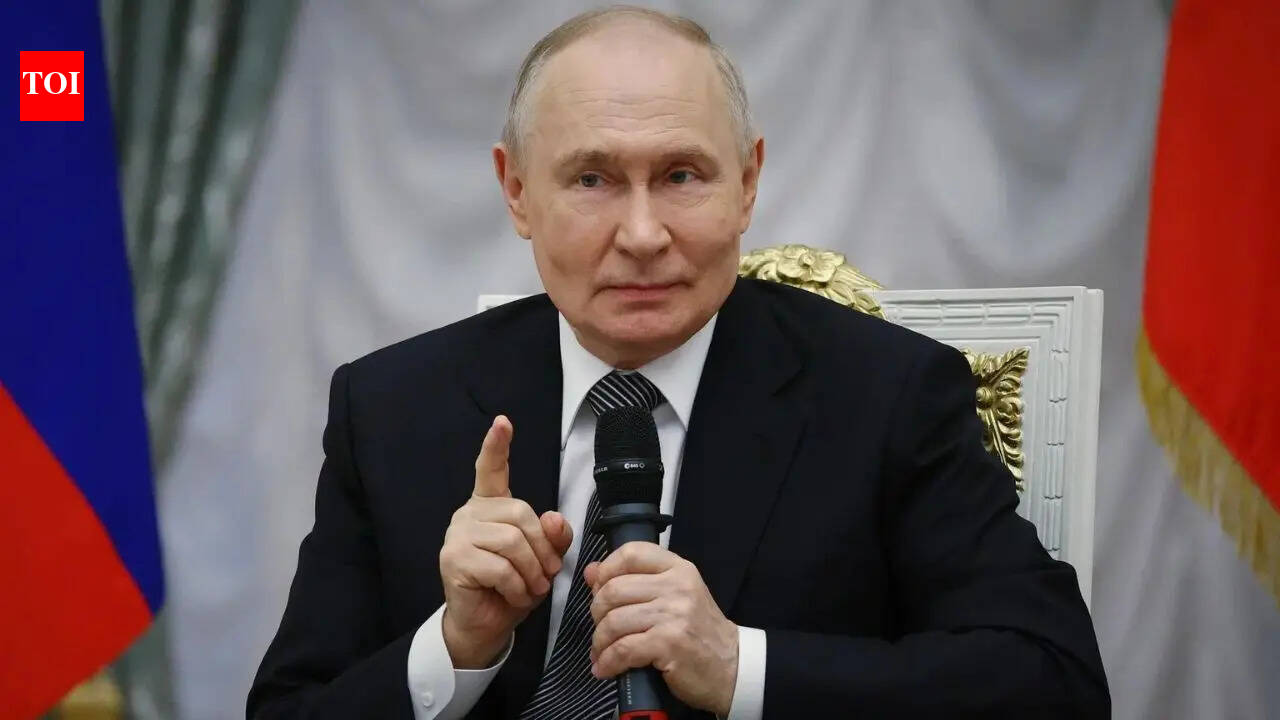

Vladimir Putin (File photo)
For years, Vladimir Putin has cultivated the image of an ageless strongman, riding horses shirtless, playing ice hockey and projecting physical endurance as a symbol of political authority. But behind the carefully staged displays of vigour lies a far deeper obsession now shaping Russian state policy: the pursuit of longevity.The latest sign of that ambition emerged through a Kremlin-backed scientific push that includes gene therapy, organ printing, mini-pig organ cultivation and even ultralow-temperature cryotherapy, all under a sprawling $26 billion state initiative called “New Health Preservation Technologies.”The program has fuelled fresh speculation about whether Putin, now in his eighth decade and already one of Russia’s longest-serving rulers, sees antiaging science not merely as healthcare innovation but as part of a broader quest to preserve power itself.According to a report by The Wall Street Journal, a revealing hot mic moment captured during Putin’s meeting with Chinese counterpart Xi Jinping at a military parade in Beijing last year hinted at the Russian leader’s fascination with extending human life. Putin was overheard discussing the possibility that humans could achieve immortality by replacing organs, a conversation many initially dismissed as eccentric banter between aging strongmen. Notably, the long-serving leaders of both Russia and China are of a similar age, adding another layer to their conversations around longevity and power.But the remarks appear to reflect a very real scientific agenda unfolding inside Russia.Last month, the Russian government announced that scientists were developing a gene-therapy treatment designed to slow cellular aging as part of the state-backed longevity initiative.The drug “represents one of the most promising avenues in the fight against aging,” deputy science minister Denis Sekirinsky said on April 23.Another pillar of the project involves creating transplant-ready human organs in laboratories, one of the same futuristic ideas Putin reportedly referenced in Beijing. Russian researchers are now pursuing bioprinting, or 3D-printing living tissue, alongside xenotransplantation, a process of growing human-compatible organs inside genetically modified mini-pigs.Scientists connected to state agencies claim to have already bioprinted human cartilage tissue and a mouse thyroid gland, with ambitions to achieve full human organ replacement by 2030.“In the Russian Federation, work is under way on a whole range of scientific programs in this field,” the Kremlin press service said in an email. “These projects are supported by the state, and many scientific and research institutions are taking part in them.”At the center of the initiative are two influential figures from Putin’s inner circle, his daughter Maria Vorontsova, who oversees several state genetics programs, and physicist Mikhail Kovalchuk, head of the Soviet-era Kurchatov Institute.Kovalchuk has become one of the intellectual architects of the Kremlin’s antiaging drive, frequently arguing that science will soon allow humans to continuously repair and replace body parts.“It is difficult to discuss immortality, but the ability to repair man will undoubtedly increase,” Kovalchuk told Russian media.Unlike longevity ventures backed by Silicon Valley billionaires such as Jeff Bezos, Sam Altman and Peter Thiel, however, Russia’s efforts have produced limited peer-reviewed scientific research.According to WSJ report, critics say many of the bold claims remain aspirational.“If there are no publications then there are no real results, and their statements should probably be taken as aspirations, not to say dreams,” said Alexander Ostrovskiy, a Russian scientist known for pioneering bioprinting research in the country.Ostrovskiy later left Russia after the full-scale invasion of Ukraine and sold his company, which now reportedly collaborates with the government.“It’s impossible to do science in isolation,” Ostrovskiy said, referring to sanctions that have cut Russian researchers off from Western collaboration. “They are probably telling Putin what he wants to hear to secure funding.”Yet the Kremlin’s interest in antiaging science extends beyond laboratories. Over the years, Putin and his allies have also flirted with fringe theories, unconventional medicine and broader civilizational anxieties about the West.Kovalchuk once warned publicly that Western countries were moving toward the creation of “servant humans”, controllable people with manipulated reproduction and limited self-awareness. He has also promoted conspiracy theories surrounding the Covid pandemic.Putin himself has long shown fascination with similar narratives. Kovalchuk publicly praised the 1968 Soviet film “Dead Season,” in which the CIA conspires with former Nazi scientists to control humanity. Putin has said the movie inspired him to join the KGB.Another major influence was Vladimir Khavinson, often dubbed “Putin’s gerontologist” in Russian media, who promoted peptide-based antiaging therapies derived from calf tissue.Khavinson argued that humans were biologically meant to live to 120 years and reportedly believed preserving Putin’s health was vital for Russia’s stability.He later received one of Russia’s highest state honors directly from Putin before dying in 2024 at the age of 77.Putin’s personal fixation with physical decline has also become increasingly visible in public life. During the Covid pandemic, the Kremlin imposed extreme quarantine measures around the Russian president, including disinfection tunnels and prolonged isolation requirements for visitors. His famously long meeting tables became global symbols of both political distance and apparent germophobia.Western and Russian media have also repeatedly speculated about cosmetic procedures as Putin’s appearance appeared noticeably smoother over time.Even cryotherapy, exposing the body to temperatures as low as minus 170 degrees Fahrenheit, reportedly caught Putin’s attention. Former Austrian chancellor Sebastian Kurz once recalled how Putin enthusiastically recommended the treatment during a meeting at the Kremlin in 2018.Much of Putin’s inner circle is itself aging. Several of Russia’s most powerful figures, including Yuri Kovalchuk, Sergei Chemezov and Nikolai Patrushev, are now in their seventies. In that sense, Russia’s state-backed longevity obsession reflects not only personal anxieties but the concerns of an entire ruling elite confronting mortality.And yet, despite the Kremlin’s futuristic ambitions, Russia continues to face some of the harshest mortality rates in the developed world. Average male life expectancy in Russia stands at roughly 68 years, far below that of the United States and much of Western Europe.For all the billions invested in antiaging science, one reality still shadows the Kremlin’s grand ambitions.Death, unlike elections, remains difficult to manage even for the Kremlin. Go to Source