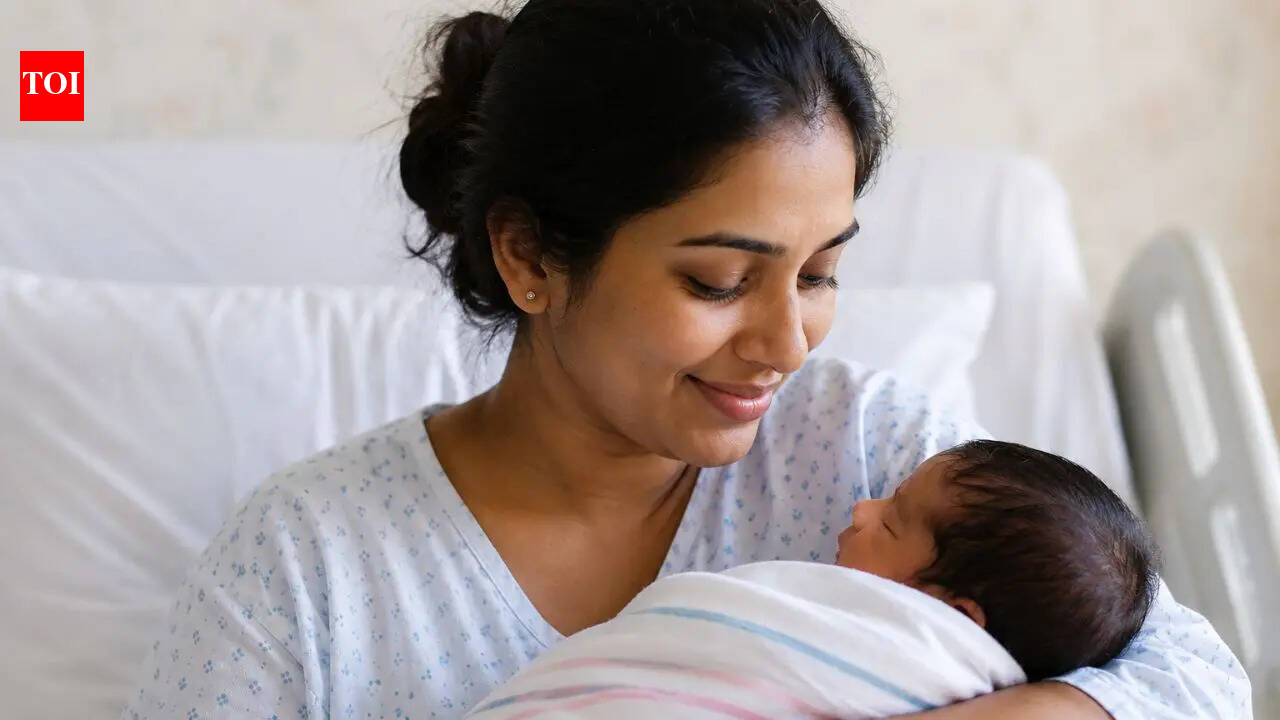

AI generated image
India sees close to 25 million births every year, among the largest maternal and newborn populations on Earth. In the past two decades, the country has seen a visible improvement with maternal mortality dropping sharply, now estimated at 88 deaths per lakh live births, a significant reduction from earlier decades. Simultaneously, institutional deliveries have increased with more women having access to formal healthcare systems. Yet, the story is far from settled.Close to 40 per cent of maternal deaths and newborn deaths still occur during labour or within the first 24 hours of birth, a window where timely and quality care are critical components for survival. However, the gap, increasingly, is not only with respect to access but also about consistency, quality, and to what extent evidence-based practices are adopted across varied healthcare settings.This was central to the discussion in a panel discussion at the Times Future of Maternity 2026, organised by Times Internet and Pregatips, where clinicians looked at how proven medical knowledge can better real-world outcomes.”There is enough global and national evidence of what works. We know what interventions work,” said Professor (Dr.) Arti Maria, Former Dean, ABVIMS & Dr Ram Manohar Lohia Hospital. Decades of research have already established protocols across maternal and newborn care. The problem, according to her, is that these protocols do not always reach the patient in the same form in which they are designed.She pointed to a basic but telling example. Mothers and newborns are meant to remain together immediately after birth, yet this is often not practised. “Maternal and newborn is one diet… they are inseparable, and zero separation must happen,” she said, adding that awareness among families is equally important. This is because when families eventually look at questioning the care practices at hospitals, the system has little option but to respond.This concern around implementation connects directly to outcomes. India’s maternal mortality has improved faster than the global average, as highlighted by Prof. (Dr) Jyotsna Suri, Consultant & Unit Head, Incharge Obstetric Critical Care, VMMC & Safdarjung Hospital. “India especially has improved by more than 75 per cent, whereas worldwide the improvement is around 40 per cent.” While the gains are real, so are the risks that exist.For the uninitiated, the leading causes of maternal deaths today remain postpartum haemorrhage, infections and hypertension, all of which are preventable. What has changed is the availability of structured approaches to manage them. In critical care, timing has become key. “I have to be very vigilant and act in that golden hour,” Dr Suri said, adding that in critical cases of bleeding, deterioration can occur in just a few minutes.Alongside emergency care, the conversation has shifted steadily towards prevention, particularly as the nature of pregnancy itself has changed. Nearly half of pregnancies in India are now considered high-risk. “Nowadays, pregnancy is not the same as it was maybe 30-40 years ago… in India, almost 49.5% of the pregnancies are high-risk,” said Dr Madhu Goel, Director, Obstetrics & Gynaecology, Fortis La Femme.This situation has brought an evolved focus on identification and intervention at an early stage. As part of the standard antenatal care are risk stratification, routine supplementation, and vaccination protocols. The results are visible in areas such as reduced anemia and better management of complications. “The shift from absolutely therapeutic thing to a preventive strategy… is the biggest game changer in high-risk pregnancy,” she said.Prevention, however, is only effective when it is systematic. Dr Tripti Sharan, Director- Obstetrics & Gynaecology; Head- High Risk Pregnancy, BLK MAX Hospital, in her comments described how early risk detection is embedded into routine care through clinical assessments, screenings and regular monitoring. From checking hemoglobin levels to tracking fetal growth and identifying infections, each step contributes to better outcomes. “Detection of risk and preventive strategies is the single most impactful entry point,” she said.While these approaches, taken together, reflect a maturing healthcare system, the experts repeatedly returned to the same constraint – variation. So, what works in one hospital or one region may not always be replicated in another hospital or region.When it comes to public hospitals, the pressure of volume remains a challenge as they cater to dozens of deliveries every day, which essentially need systems that one can depend on under stress. To address this issue, experts noted that simulation-based training and drills, particularly for emergencies like haemorrhage or eclampsia, are being adopted.On the other hand, the scenario is different in private and urban settings as standardisation in protocols across healthcare centres is not visible, while access to the latest clinical evidence is uneven, particularly for India-specific data. As a result, there is a difference in the approach towards treatment, even within the same facility.During the discussion, the conversation also touched upon how care is experienced. Dr Maria underscored that the healthcare systems should look beyond a provider-driven approach. “It’s not about what the doctor thinks… it is also what the patient wants,” she said, arguing that by involving parents directly in neonatal care, particularly in intensive care units, outcomes improved across multiple indicators. For instance, breastfeeding rates increased, hospital stays reduced, and parents were better prepared to care for their babies after discharge.This change, she claimed, required a mindset shift instead of having a new technology or infrastructure.Across the discussion, the underlying point was that there is already a strong foundation for evidence-based maternal and newborn care in India. However, the next phase would be a little complex, requiring aligning systems, standardising practices, and ensuring that quality care is not dependent on geography, institution or circumstance because in maternal and newborn care, experts said the difference between knowledge and execution is often the difference between life and death. Go to Source