
 "Is the world getting ready for an AI Cold War?")

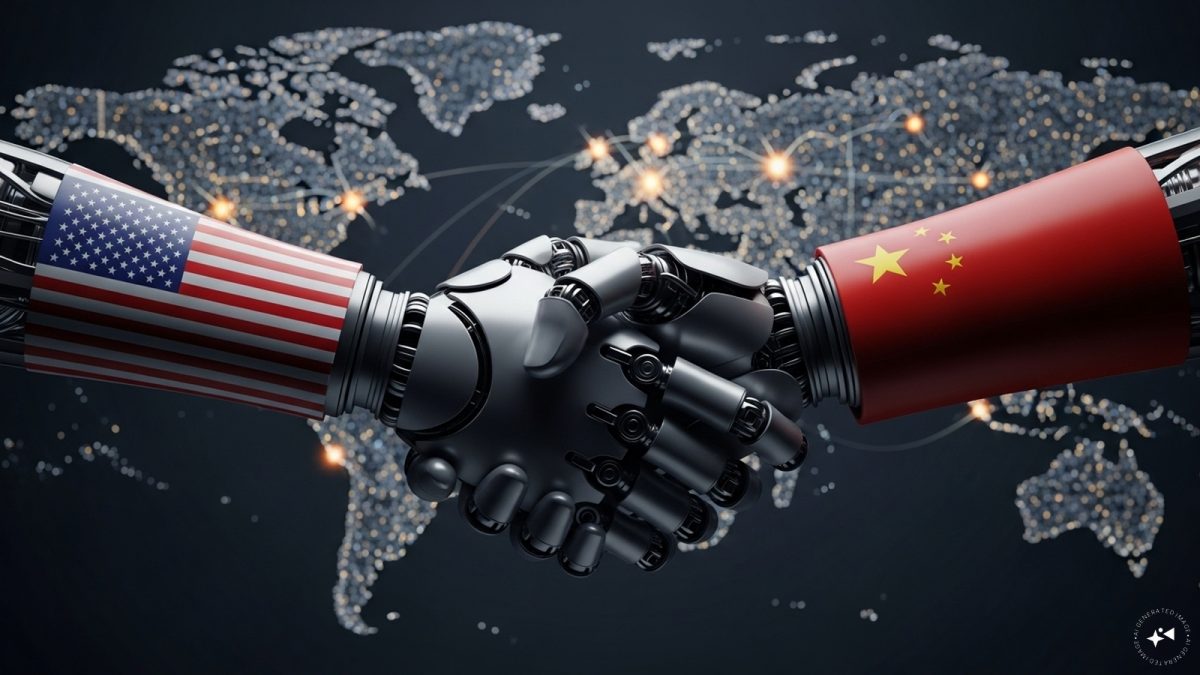
As the US and China tighten controls and build rival AI blocs, fears grow that artificial intelligence is steering the world into a new Cold War.
A new kind of cold war is brewing not with nuclear warheads and ideological pamphlets, but with algorithms and data centers. As artificial intelligence rapidly reshapes everything from military strategy to economic power, a dangerous divide is emerging, pitting the United States and its allies against a China-led bloc in a high-stakes contest for technological supremacy.
Just this week, the paradox was on full display as Chinese President Xi Jinping at Shanghai Cooperation Organisation (SCO) summit, urged member nations like Russia and India to strengthen cooperation on AI, warning against what he called a “Cold War mentality.”
His appeal came as Beijing continues to pitch its Global AI Governance Initiative as an inclusive framework for developing and regulating AI technologies. Yet Xi’s words ring against a backdrop of rising distrust: the United States and its allies increasingly view Chinese advances in AI as a direct strategic challenge rather than an opportunity for collaboration.
Parallel worlds: The new AI blocs
This emerging split aligns uncannily with the logic of the original Cold War, a world bifurcated into antagonistic blocs, both spouting the rhetoric of peace, but racing for supremacy in weapons, economics and ideology. Today’s AI rivalry goes beyond military drones or data centers: it is about setting global standards, controlling flows of data and chips, and defining who will profit from the next big industrial revolution.
The private sector, too, is falling in line. US-based Anthropic is the latest to bar its advanced AI offerings from firms with majority Chinese ownership, joining a cascade of restrictions on Chinese, Russian, Iranian and North Korean actors. This echoes newly-tightened US export controls on semiconductors and cloud access to AI training platforms, measures explicitly designed to keep next-generation AI out of rivals’ hands.
A battle for global rules
On September 1, Xi convened more than 20 world leaders in Tianjin, pitching his “Global Governance Initiative” and new platforms for joint AI development. China’s position in this emerging contest is formidable. The country accounts for nearly a quarter of the world’s AI specialists, produces the largest number of new AI engineers annually and boasts firms like Alibaba, ByteDance and DeepSeek that are driving breakthroughs in large language models and open-source systems.
Its computing power, measured at 246 exaflops in June, is expected to surpass 300 by year’s end, positioning cities like Shanghai as potential hubs of global AI governance. For Beijing, AI is not just a technology but a lever of geopolitical influence.
Yet despite these strengths, China remains isolated in key international arenas. US-led initiatives such as the Global Partnership on AI exclude Beijing, while major gatherings like the 2023 Bletchley Park summit bypassed UN frameworks in favour of coalitions among like-minded states.
China’s calls to treat AI as a “global public good” are often sidelined, compelling it to create parallel systems and inviting dozens of nations to its own cooperation forums, further deepening the divide.
The stakes are terrifyingly high. Experts at the Pentagon are already grappling with how AI could destabilise nuclear deterrence, potentially leading to accidental escalation. A recent analysis in Politico Magazine highlighted fears that an AI-fuelled arms race could make the original Cold War’s nuclear standoff look simple by comparison. The speed of AI-driven warfare could shrink decision times from minutes to seconds, removing the human element of restraint and leading to catastrophic miscalculation.
This growing rivalry risks cleaving the world into two distinct technological ecosystems. One, led by the US, would feature proprietary, closed-source AI dominated by a few corporate giants. The other, championed by China, would revolve around open-source models, offering greater accessibility but operating under a different set of rules and values. Trapped in the middle, developing nations would be forced to pick a side or risk being left behind in the technological dust.
Are neutral pathways possible?
If history is prelude, the march toward an AI Cold War is not preordained, but it is gathering force. Beijing’s calls for joint infrastructure, safety standards and cooperative forums mark one path. US and allied efforts at selective “decoupling,” meanwhile, are already reshaping global supply chains. Europe’s broad “Brussels effect,” via its AI Act could become a battleground: will rising powers shape the rules, or remain rule-takers?
For the rest of the world, the “Global South” that Xi now openly courts, the challenge will be to extract benefits from both camps, nurturing homegrown AI capabilities while avoiding capture by either.
End of Article

&description=Is+the+world+getting+ready+for+an+AI+Cold+War%3F)