
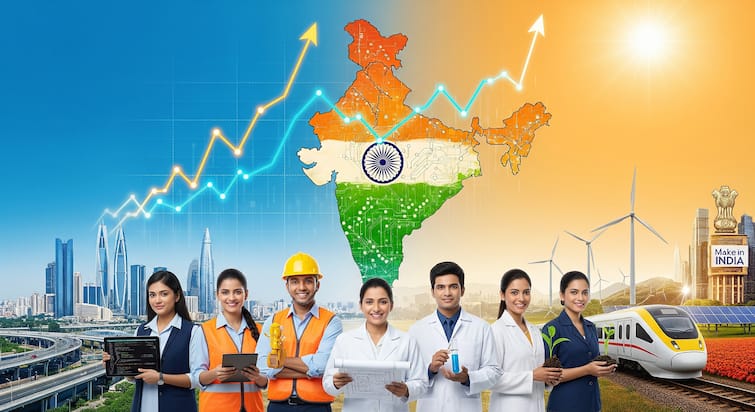

The latest EY Economy Watch report projects India could emerge as the world’s second-largest economy by 2038 in purchasing power parity (PPP) terms, with a GDP of $34.2 trillion. For many global observers, such a prediction might seem astonishing. But for those who have watched India over the past decade, this rise is not accidental; it is the outcome of deliberate governance, reformist zeal, and a national awakening toward self-reliance.
The first pillar of India’s rise is its demographic dividend. With an average age of just 28.8 years in 2025, India will remain the world’s youngest major economy for decades. Unlike ageing societies such as China, Germany, or Japan, India’s young population can drive both consumption and productivity. But demographics alone do not guarantee growth; they must be harnessed through opportunities. This is where government policies have ensured that millions of young Indians can channel their energy into entrepreneurship, technology, and innovation.
Second, India’s domestic consumption-driven model gives it resilience unmatched by export-dependent nations. During global slowdowns, India’s massive internal market sustains demand. This has been visible in recent years, when despite wars, trade disruptions, and the pandemic, India retained its growth momentum. By encouraging domestic manufacturing, local supply chains, and indigenous innovation, the government has reduced overdependence on external markets and laid the groundwork for a more self-sustaining economy.
Third, fiscal discipline has emerged as a cornerstone of confidence. While Western nations are drowning in debt, India’s debt-to-GDP ratio is projected to decline from 81% in 2024 to around 75% by 2030. India’s growth is not fuelled by unsustainable borrowing but by genuine capacity building. It is worth noting that India also enjoys one of the world’s highest savings rates, ensuring a steady pool of domestic capital for investment.
The structural reforms of the past decade are another driver of India’s economic transformation. The introduction of GST unified a fragmented tax regime, boosting ease of doing business. The Jan Dhan-Aadhaar-Mobile (JAM) trinity has delivered unprecedented financial inclusion. UPI has revolutionised digital payments, making India a global leader in fintech. Reforms in labour codes, manufacturing incentives, renewable energy adoption, and production-linked incentives (PLIs) are gradually creating a diversified industrial base. These initiatives reflect not only economic pragmatism but also ideological conviction that India must build its own capacity instead of depending excessively on imports or foreign diktats.
When we compare India with its global peers, its strengths stand out even more. China, once touted as the unstoppable growth engine, now faces a demographic crisis and rising geopolitical distrust. The United States, though dynamic, is crippled by staggering debt and political polarisation. Germany and Japan, ageing and export-reliant, face long-term structural weaknesses. In contrast, India combines youth, scale, reform, and confidence, making its ascent both natural and inevitable.
Of course, challenges remain. Infrastructure must expand at an even faster pace, education and healthcare require deeper investment, and bureaucratic hurdles still need dismantling. Yet, the Government of India’s relentless emphasis on execution — be it in road building, electrification, or digital penetration — shows that India is tackling these issues head-on. Importantly, the ideological spine of this progress is a renewed pride in Bharatiyata, a sense that India’s rise is not just economic but civilisational.
The EY Economy Watch report also underlines India’s ability to withstand global shocks. Even if US tariffs or trade disruptions affect parts of the economy, India’s diversified exports and robust domestic demand act as buffers. This resilience is precisely why policymakers like DK Srivastava emphasise that India is well on its way to becoming a Viksit Bharat (Developed India) by 2047, a vision Prime Minister Modi has repeatedly tied to India’s centenary of independence.
For decades, India was seen as an underachiever — rich in potential but weak in delivery. That perception is fading fast. Today, India is not just the world’s fastest-growing major economy; it is also an economy that is being consciously shaped by reform, self-reliance, and youthful dynamism. Unlike past growth phases that were reactive or accidental, the current rise is strategic, ideologically grounded, and sustainable.
The global economic order is shifting. Old giants are slowing, and India is rising not because others are faltering but because it has built the foundation for a confident future. With youth power and constant reforms guiding its journey, India’s ascent to the second-largest economy by 2038 seems less a forecast and more a certainty.
(The writer is a technocrat, political analyst, and author)
[Disclaimer: The opinions, beliefs, and views expressed by the various authors and forum participants on this website are personal and do not reflect the opinions, beliefs, and views of ABP Network Pvt. Ltd.]
 "Indonesia: Massive public protests erupt after armoured police vehicle struck and killed biker")

