
PC: AI-Generated
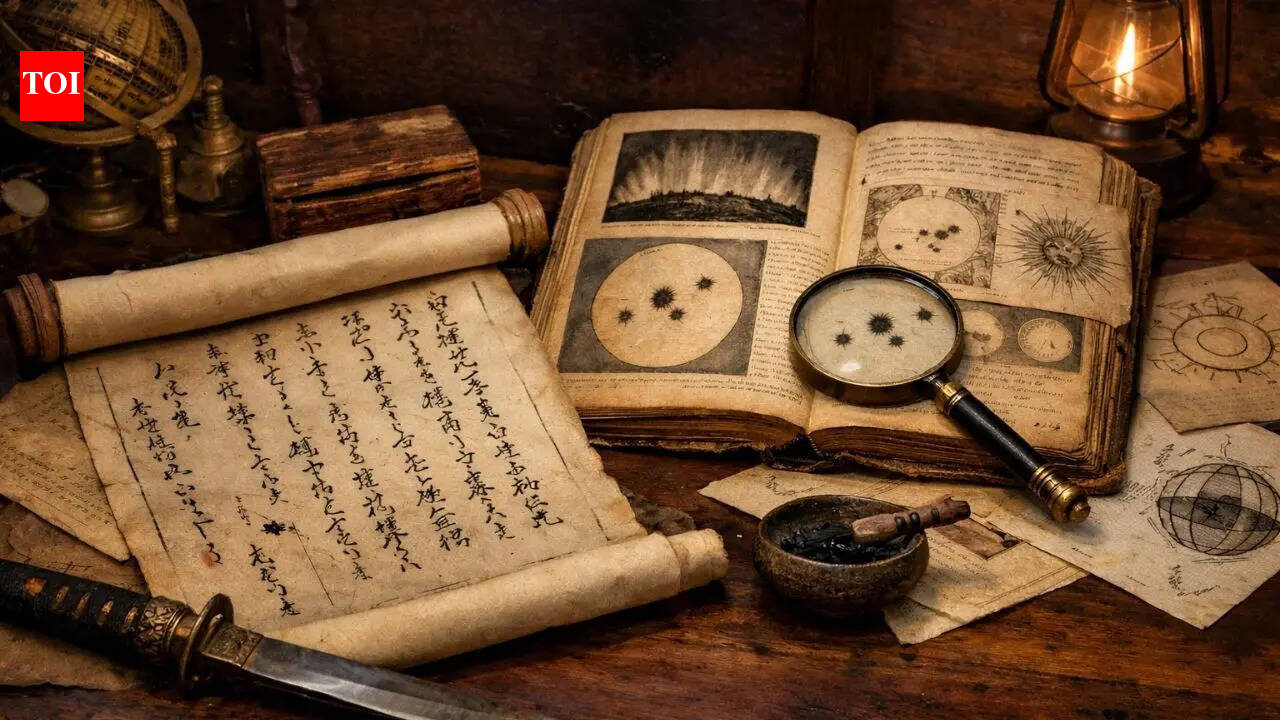
A Japanese poet from the 13th century, watching a blood-red sky and writing his diary, never thought his words would save astronauts today. The researchers at the Okinawa Institute of Science and Technology (OIST) have connected the historical Medieval literature with present-day space weather through the writings of Fujiwara no Teika’s Meigetsuki diary, 1204 Common Era (CE). By cross-referencing his description of ‘red lights’ in his diary with levels of carbon-14 from ancient cypress trees, researchers were able to identify a large solar particle event. This interdisciplinary breakthrough shows how cycles of the sun were much shorter and more erratic in the past, giving vital information to NASA for their Artemis missions and future long-term exploration of deep space.
A Japanese poem from 826 years ago revealed a massive solar storm
Research into the phenomenon of solar storms began with the account of a Japanese courtier and poet, Fujiwara no Teika, who recorded the appearance of ‘red lights’ in the northern sky above Kyoto in February 1204, as noted in the study published in the Okinawa Institute of Science and Technology (OIST). As identified by modern scientists, these phenomena are Stable Auroral Red (SAR) arcs that appear as a result of intense geomagnetic activity. To support his claim, astrophysicists examined the annual growth rings of ancient Asunaro cypress trees located at the site of the event and discovered an increase in radioactive carbon-14 corresponding to the same time period as the appearance of the aurora.
8-year solar cycles fueled extreme particle events
Through this research, scientists have determined that the behaviour of the sun’s magnetic activity was markedly different from what it is today during the early 13th century. Presently, solar cycles last roughly 11 years; these cycles were shorter (usually lasting only 7 to 8 years) 800 years ago, as noted in the Journal of Space Weather and Space Climate. The rapid cycling of sunspot activity corresponds with the occurrence of extreme solar particle events, which consist of high-energy bursts of radiation. These radiation events can peel away large portions of the atmosphere and severely affect electronic equipment.
800-year-old data is the key to astronaut survival
Understanding the Extreme Solar Particle Events (ESPEs) of the past is critical to the preservation of human life in our space program. NASA and other companies utilise those past events to help develop computer simulations of potential radiation hazards to astronauts as they travel outside of Earth’s magnetic field. Astronauts would die on the lunar surface or while travelling to Mars if they were exposed to a magnitude of radiation similar to what was recorded in 1204. Therefore, the red lights of this superstorm are the blueprints of modern radiation shielding today.
The science of using trees to map ancient space weather
When high-energy solar particles impact Earth’s atmosphere, the spallation reactions produce Carbon-14, which is absorbed by trees that are alive at the time of the collision. Each of these trees produces one growth ring per year, providing a complete, searchable, and dated record of all cosmic radiation absorbed by those trees back into time for nearly a thousand years after the collision. According to the research published in Nature Communications, this scientific technique, called the ‘Miyake Event,’ allows scientists to identify the exact year of a solar storm long after the occurrence of the storm, using carbon isotope analysis. Go to Source