
Last Updated:
Australia said the IRGC used proxies to target Jewish Australians. Here’s what it uncovered, and why it expelled Iran’s ambassador Ahmad Sadeghi


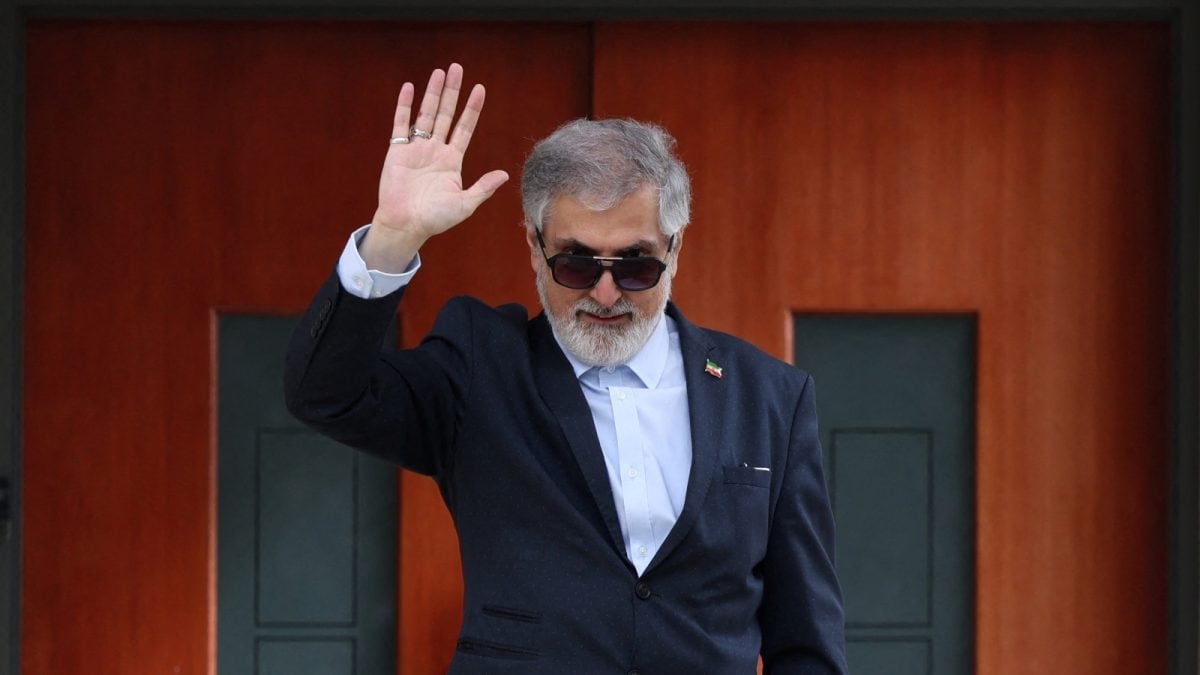
Australia expelled Iran’s ambassador to Canberra, Ahmad Sadeghi, and three senior diplomats, accusing the Iranian government of orchestrating antisemitic attacks on Jewish sites in Sydney and Melbourne. (Image: Reuters)
On Tuesday, Australia expelled Iran’s ambassador to Canberra, Ahmad Sadeghi, and three senior diplomats, accusing the Iranian government of orchestrating antisemitic attacks on Jewish sites in Sydney and Melbourne. The Australian government said all four diplomats had been given seven days to leave the country, and announced that it had suspended operations at its own embassy in Tehran, withdrawing all diplomatic personnel to a third country. Australians currently in Iran were advised to leave immediately due to the risk of arbitrary detention.
The dramatic action, described as the first such expulsion since the Second World War, followed an investigation by Australia’s domestic intelligence agency, the Australian Security Intelligence Organisation (ASIO), which concluded that Iran’s Islamic Revolutionary Guard Corps (IRGC) had directed at least two attacks targeting Jewish communities in 2024.
Recommended Stories
The IRGC, ASIO said, had used a network of offshore criminal operatives and local proxies to distance itself from the attacks, but the plot originated in Tehran.
Prime Minister Anthony Albanese called the incidents “extraordinary and dangerous acts of aggression” carried out by a foreign state on Australian soil. “They sought to harm and terrify Jewish Australians, and to sow hatred and division in our community,” he said. The decision to expel the diplomats, suspend the embassy, and move towards listing the IRGC as a terrorist organisation comes at a time of growing public anger over Israel’s war in Gaza, rising antisemitic incidents at home, and increasing international concern over Iran’s global security operations.
The Attacks That Led To This Escalation
ASIO concluded that the IRGC was behind two coordinated arson attacks targeting Jewish institutions:
On 20 October 2024, an arson attack damaged Lewis’ Continental Kitchen, a kosher deli in Bondi, Sydney. The fire caused significant destruction to the premises, which had served the local Jewish community for decades.
On 6 December 2024, a more severe incident occurred at the Adass Israel Synagogue in Ripponlea, Melbourne. Two masked individuals were seen entering the synagogue, pouring flammable liquid inside and setting it ablaze. The fire caused millions of dollars in damage. The synagogue, built in the 1960s by Holocaust survivors, was active at the time.
According to ASIO Director-General Mike Burgess, the attacks were not the actions of isolated extremists but part of a broader, foreign-directed plan.
Speaking at a press conference with the prime minister, Burgess said the IRGC had used a “complex web of proxies” and offshore organised crime facilitators to carry out the attacks. While Iranian diplomats were not directly involved, ASIO assessed that the plot was initiated and funded by the Iranian government.
What Has The Investigation Uncovered So Far?
As reported by CNN, Australian police have charged two individuals in connection with the Melbourne synagogue attack. Counter-terrorism investigators in Victoria alleged that three people broke into the premises and started the fire. Electronic devices were seized from one suspect’s home and are being examined for foreign links. One of the accused is scheduled to appear in court this week.
Burgess confirmed that while ASIO is still examining other antisemitic incidents, these two attacks in October and December were the only ones so far conclusively tied to Iran. However, Prime Minister Albanese told the media that the IRGC was “likely” involved in more cases.
Albanese described the acts as “extraordinary and dangerous”, saying they aimed to spread fear among Jewish Australians and “sow hatred and division” within Australian society. He added, “The Australian people want two things: They want the killing in the Middle East to stop, and they don’t want conflict in the Middle East brought here.”
How Has The Jewish Community In Australia Responded?
Australia is home to an estimated 120,000 Jewish citizens and one of the world’s largest communities of Holocaust survivors outside Israel. The attacks on the kosher deli and synagogue were part of a broader spike in antisemitic incidents reported since the start of the Israel–Hamas conflict in October 2023.
According to data cited by the Indian Express, the Executive Council of Australian Jewry (ECAJ) recorded over 2,000 antisemitic events between October 2023 and October 2024. These included graffiti at Jewish schools, arson attempts, and threats made in person and online. In one instance in February 2025, two nurses at a Sydney hospital were suspended for posting a video on TikTok threatening Jewish patients.
Daniel Aghion, President of the ECAJ, condemned the IRGC’s alleged involvement, calling it an “assault on Australia’s sovereignty”. In a statement reported by Associated Press, the council said, “These were attacks that deliberately targeted Jewish Australians, destroyed a sacred house of worship, caused millions of dollars of damage, and terrified our community.”
What Has Iran Said In Response?
Iran has strongly denied all allegations. In a press conference, Iranian Foreign Ministry spokesperson Esmaeil Baghaei rejected the accusations as “baseless” and politically motivated. He warned of “reciprocal action” and suggested that Australia’s move was influenced by internal political dynamics.
According to Al Jazeera, Baghaei claimed the expulsions were timed to distract from growing pro-Palestinian protests across Australia. These demonstrations, held in cities including Sydney, Melbourne, and Adelaide, were among the largest the country has seen in recent years. “It seems that this action is taken in order to compensate for the limited criticism the Australian side has directed at the Zionist regime,” Baghaei said.
Tehran-based political commentator Foad Izadi told Al Jazeera that Ambassador Sadeghi had been outspoken in his support for the Palestinian cause and alleged that the Australian government was trying to silence dissent. He said, “Expelling a country’s ambassador is rarely done. The fact that the Australian government has done this is an indication that they’re afraid of the demands this population makes when it comes to the issue of genocide in Palestine.”
What Role Does The Israel–Gaza War Play In The Backdrop?
The diplomatic breakdown between Canberra and Tehran is unfolding as Australia undergoes a visible shift in its Middle East policy. On 11 August 2025, the Albanese government announced it would vote to recognise the State of Palestine at the 80th United Nations General Assembly. The decision followed widespread public pressure over reported famine conditions and civilian casualties in Gaza.
As per Reuters, a DemosAU poll found that 45 per cent of Australians supported recognising Palestinian statehood even before a peace deal, up from 35 per cent the previous year. This shift has drawn sharp criticism from Israel, with Prime Minister Benjamin Netanyahu calling Albanese “a weak politician who betrayed Israel and abandoned Australia’s Jews.”
In response, Australian Minister for Home Affairs Tony Burke rejected the accusation and said, “Strength is not measured by how many people you can blow up or how many children you can leave hungry.”
What Are The Implications For Bilateral Ties?
The Australian government has announced that it will soon introduce legislation to designate the IRGC as a terrorist organisation. This move, once passed, will make it a criminal offence to materially support or coordinate with the group, and could lead to broader legal actions and sanctions.
Australia’s embassy in Tehran has been suspended indefinitely, and the government has warned of an elevated risk of arbitrary detention for dual nationals or Australians visiting Iran. While some limited diplomatic lines will remain open, Wong said these would only be maintained to safeguard Australia’s consular and strategic interests.
The fallout is likely to strain an already fragile bilateral relationship. Iran has a record of detaining dual nationals and foreign citizens as leverage in diplomatic disputes. Australian officials say contingency planning is underway in case of retaliatory measures.
About the Author

Karishma Jain, Chief Sub Editor at News18.com, writes and edits opinion pieces on a variety of subjects, including Indian politics and policy, culture and the arts, technology and social change. Follow her @kar…Read More
Karishma Jain, Chief Sub Editor at News18.com, writes and edits opinion pieces on a variety of subjects, including Indian politics and policy, culture and the arts, technology and social change. Follow her @kar… Read More
Loading comments…
Read More
 "Jammu flash floods: Why are questions being raised about the Vaishno Devi yatra?")