
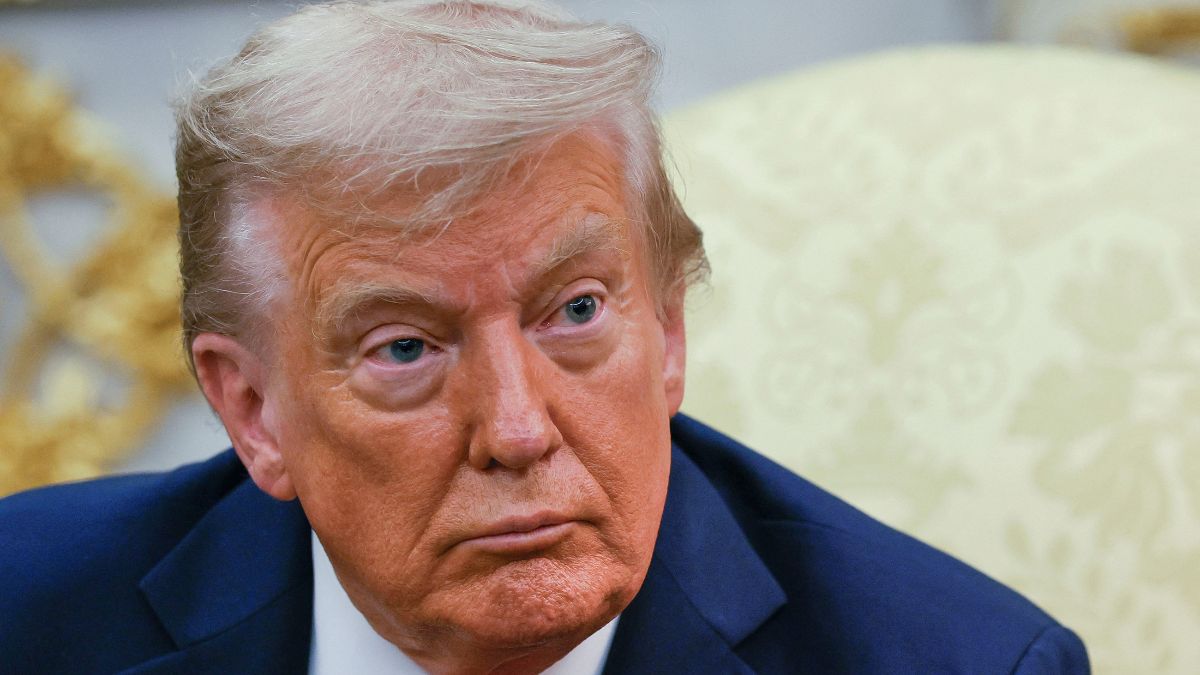
 "Tariff turmoil: On slippery legal ground, Trump quietly switches laws to keep India levies alive")

When President Donald Trump first announced punitive tariffs on Indian imports in early April 2025, his administration cited the International Emergency Economic Powers Act (IEEPA) of 1977 as the legal basis.
The statute, originally crafted in the aftermath of Watergate to grant presidents broad authority during national emergencies, had historically been used for sanctions and asset freezes against adversaries.
What the text never mentioned, however, was tariffs. Attorneys soon noted that no US president before Trump had interpreted IEEPA as providing such powers, highlighting the novelty — and fragility — of the move.
Legal challenge and courtroom pushback
The unusual use of the emergency statute prompted a swift legal challenge. The Liberty Justice Center, a non-partisan advocacy group, filed suit in the US Court of International Trade just days after the baseline 10 per cent tariff took effect. Their central argument was that Trump had exceeded his authority: IEEPA empowered presidents to block financial transactions and restrict property, not to rewrite the tariff code, Reuters reported.
Federal judges began to share this scepticism. In hearings before an appellate panel on August 4, Circuit Judge Jimmie Reyna pointed out that the word “tariffs” did not appear anywhere in IEEPA.
Even Trump’s own attorney, Brett Shumate, conceded that no president had ever read the statute in this manner, though he insisted the interpretation was nonetheless lawful. The case, dubbed by Trump himself as “America’s Big Case,” quickly took on constitutional dimensions, with expectations that the Supreme Court would eventually be asked to weigh in, Associated Press reported.
Silent switch to older trade laws
As the litigation gathered steam, the Trump administration appeared to acknowledge the shakiness of its legal footing.
By the second round of tariff hikes in early August — when duties on Indian goods surged to 50 per cent — the White House supplemented its reliance on IEEPA with two older statutes that explicitly authorise tariff actions: Section 232 of the Trade Expansion Act of 1962 and Section 301 of the Trade Act of 1974.
Both provisions had been used extensively in prior decades, the former in the name of national security and the latter as a trade remedy against unfair practices.
The timing suggested a strategic retreat. Legal observers speculated that the quiet shift was aimed at shoring up the administration’s defence in court while preserving the appearance of consistency in policy.
Invoking multiple, sometimes contradictory, statutes points to the Trump administration’s uncertainty about the legal backing of new tariffs. Appeals judges, in turn, questioned whether this patchwork approach truly solved the jurisdictional problem or merely delayed an eventual reckoning, Reuters.
Economic and diplomatic stakes
For India, the consequences have been severe. The escalating levies cover a wide range of goods—textiles, gems, jewellery, seafood and leather among them—representing nearly 55 per cent of India’s merchandise exports to the United States.
Exporter groups estimated the duties could affect $87 billion worth of trade, sharply undermining competitiveness and handing an edge to rivals such as Bangladesh, Vietnam and China, Reuters said.
Indian officials have described the tariffs as “unfair, unjustified, and unreasonable.” Prime Minister Narendra Modi has publicly declared that his government will not compromise the interests of domestic farmers, small industries, or producers.
Speaking in Ahmedabad, he urged citizens to prioritise swadeshi goods, even as he acknowledged the heavy pressure from Washington. The Ministry of External Affairs similarly warned that India would take all necessary steps to safeguard national interests.
Diplomatic frictions have spilled into broader strategic relations. The tariff escalation came at a time when the United States had been seeking to deepen cooperation with India through the Quad grouping, alongside Japan and Australia, as a counterweight to China. Instead, the punitive measures risked eroding goodwill and weakening alignment on security issues.
Courts move slowly, but damage is fast
Even if Trump ultimately loses in court, Indian exporters may not see immediate relief. Economists have cautioned that litigation is slow-moving and that the economic damage from lost market share, supply chain disruptions and reduced investment could persist long after duties are struck down.
Trump’s warnings of economic catastrophe
Trump himself has cast the litigation in apocalyptic terms. In a Truth Social post on August 8, he warned that if the courts struck down his tariffs, the result would mirror the 1929 Wall Street crash, ushering in a new Great Depression.
The claim, though widely dismissed by economists as hyperbolic, reflected the administration’s awareness of the stakes. With an estimated $50 billion in revenue projected from tariffs, losing the case could leave a gaping hole in budget plans and embolden opponents both at home and abroad, Barron’s reported.
Supreme Court likely to step in
The case now appears destined for the Supreme Court. The Federal Circuit has expedited its briefing schedule, but regardless of its ruling, observers expect appeals to proceed.
Reuters reported that if the high court takes up the case in its October 2025 term, a definitive ruling could come within a year. Importers, in turn, are preparing refund claims in case the tariffs are invalidated—a process that itself could take years.
A turbulent road ahead
For now, Indian exports to the US remain saddled with record-high US tariffs that came into effect on Wednesday. The legal uncertainty only compounds the instability facing exporters and investors. While the administration’s shift to older trade statutes may have postponed a reckoning, it has not eliminated the fundamental legal challenge. Courts remain unconvinced, businesses unsettled and diplomats frustrated.
What the episode highlights is the fragility of unilateral trade actions when built on contested legal grounds. Even as Trump projects strength and warns of catastrophe, the machinery of law and diplomacy grinds slowly, leaving India and its exporters to tread through a turbulent phase.
End of Article

&description=Tariff+turmoil%3A+On+slippery+legal+ground%2C+Trump+quietly+switches+laws+to+keep+India+levies+alive)