By Hemant Sood
There is a peculiar pattern that repeats itself in financial markets, one that is playing out right now with striking familiarity. A crisis erupts. News channels run wall-to-wall coverage. WhatsApp groups light up with warnings. And millions of investors, gripped by the same anxiety, do the one thing that history consistently punishes: they stop investing, or worse, they sell.
We are in one of those moments. The US-Israel-Iran conflict has disrupted shipping through the Strait of Hormuz. Brent crude has crossed $100 per barrel. The Indian rupee has hit a record low of 92.35 against the dollar. Fertiliser plants are cutting production. Road contractors are invoking force majeure. The Nifty has corrected sharply. FIIs have pulled out nearly $2 billion from Indian equities in the first two weeks of March alone.
And yet. And yet.
If you are a long-term investor in India, someone investing for a decade or more, this moment is not what it appears. It is not a warning to exit. It is a question about conviction.
The Market Has Seen This Before – Every Time
Let us place 2026 in its proper context. In 2008, Lehman Brothers collapsed and the Sensex fell 60 per cent in a year. In 2013, the Fed hinted at tapering its bond-buying programme and the rupee crashed to 68 a level that seemed catastrophic at the time. In 2020, COVID-19 shut down
the global economy and Indian markets fell 38 per cent in weeks. In 2022, Russia invaded Ukraine, oil hit $130 a barrel, and inflation spiralled worldwide.
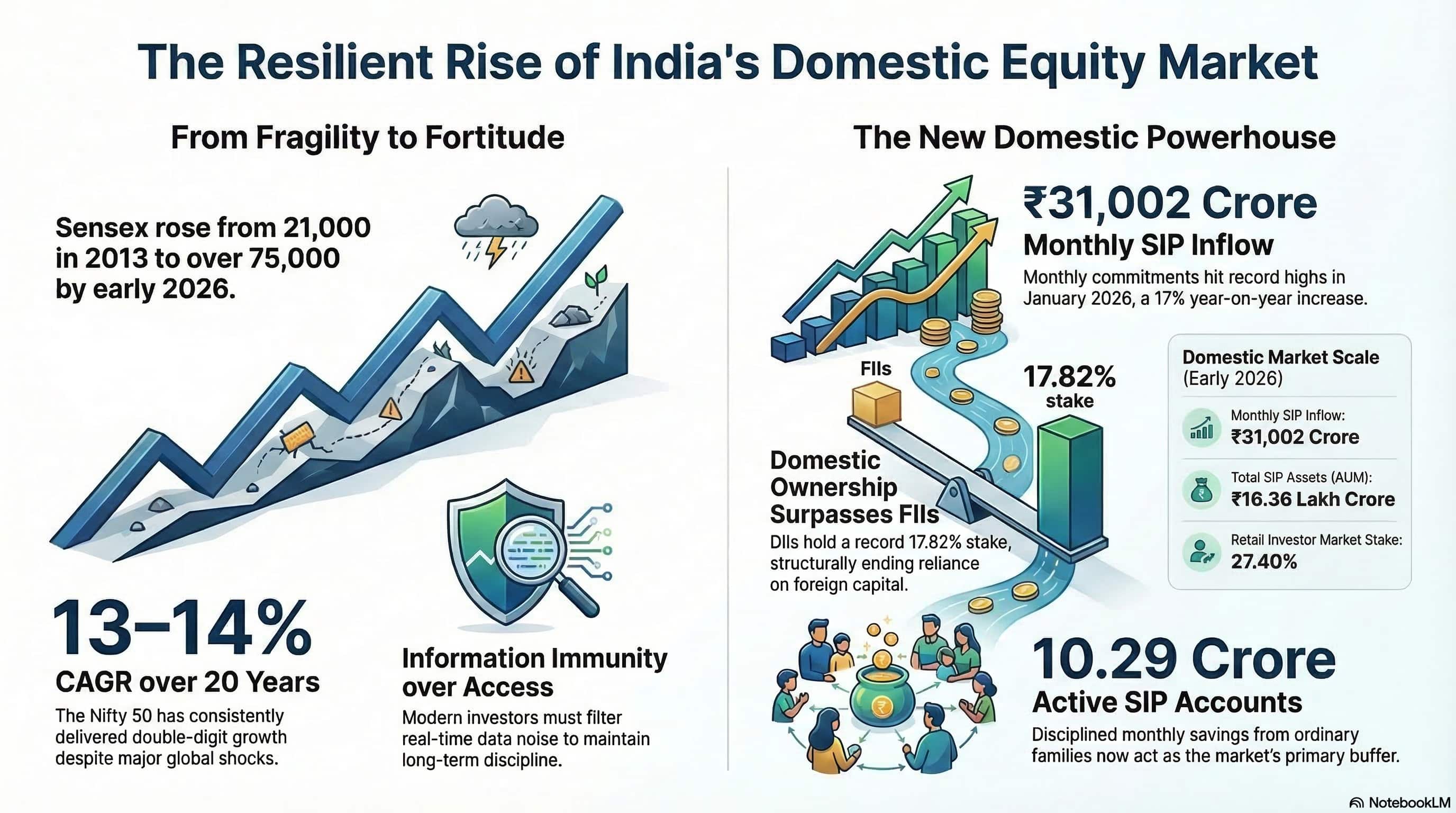
In each of those cases, the investors who stayed invested or better still, added more, were richly rewarded. The Sensex, which was at 21,000 during the 2013 crisis, is trading north of 75,000 today. The Nifty 50 has delivered roughly 13-14 per cent CAGR over the past 20 years. Every crisis looks permanent from inside it. None of them were.
What makes 2026 different is not the nature of the shock, it is the speed of information. We are drowning in real-time data, expert opinions, and alarming headlines. The investor’s challenge is not information access. It is information immunity.
The Domestic Story Has Quietly Changed the Rules
There is something genuinely new about this market cycle that deserves more attention than it gets. The old script, FIIs sell, India falls, retail investors panic, cycle repeats, is breaking down.
Monthly SIP inflows have held above 30,000 crore for consecutive months 31,002 crore in January 2026, a 17 per cent year-on-year increase. SIP assets under management have grown to 16.36 lakh crore. Over 10.29 crore SIP accounts are now active.
These are not speculative flows chasing momentum, they are disciplined, monthly commitments from ordinary Indian families who have quietly decided that equity markets are where their savings belong.
Domestic Institutional Investors now hold a record 17.82 per cent stake in NSE-listed companies surpassing FII ownership. Retail investors themselves control 27.40 per cent of the market. The era of India’s equity markets being held hostage to foreign capital flows is structurally ending.
Think about what this means in practice. During the 2008 global financial crisis, the kind of FII outflow we saw then would have cratered Indian markets by more than 50 per cent. Today, that same magnitude of outflow is being absorbed by domestic flows without causing a systemic collapse. That is a structural shift of enormous consequence for long-term investors.
Understanding the Current Risks Clearly
None of this means we should be complacent. The risks from the current geopolitical environment are real and specific, and long-term investors benefit from understanding them rather than being blindsided.
Crude oil above $100 per barrel affects India’s current account deficit directly. Every $10 increase per barrel widens the deficit by 40-50 basis points. A weaker rupee amplifies the effect because crude is priced in dollars. This translates into higher inflation, compressed corporate margins in import-dependent sectors, and potential pressure on government finances through fuel and fertiliser subsidies.
The LPG and natural gas disruption is creating production pressures in fertiliser manufacturing. Petronet LNG has invoked force majeure. Fertiliser companies are receiving only 70 per cent of their contracted gas allocation. India has approached China for emergency urea supplies ahead of the Kharif sowing season in June. If this conflict extends another two to three months, agricultural input costs will spike, impacting rural consumption and food inflation.
Bitumen prices have risen by approximately 2,000 per tonne, straining margins at road infrastructure companies. Several contractors have approached NHAI for force majeure relief. India’s flagship infrastructure push, one of the central pillars of the FY27 earnings recovery thesis, faces a 2-3 quarter headwind if the conflict continues.
These are not reasons to exit the market. They are reasons to be thoughtful about which parts of the market you own and why.
Five Things Long-Term Investors Should Do Right Now
- Do not stop your SIPs. This is the single most important instruction. Rupee-cost averaging is not a theory, it is a mechanism. Every month you invest during a correction, you are buying more units at lower prices. Those units compound over years. The investors who stayed invested through 2020’s COVID crash saw their portfolios double within 18 months.
- Review allocation, not exposure. The macro environment is telling you something specific about which sectors face headwinds. Aviation, oil marketing companies, fertiliser manufacturers, and road-heavy infrastructure companies face margin pressure. Upstream energy (ONGC, Oil India), IT services, and pharma benefit from high crude and a weak rupee. Shift weight within equity, not away from it.
- Add gold, not as speculation but as insurance. 8-10 per cent of your portfolio in gold or sovereign gold bonds makes sense in a stagflationary environment. It has performed precisely when equities struggled in 2025-26. Think of it as portfolio shock absorption.
- Judge funds by consistency, not last year’s returns. According to the SPIVA India Mid-Year 2025 report, 66 per cent of actively managed large-cap funds underperformed their benchmark. Over 10 years, that number rises to 73-74 per cent. The fund that gave you 40 per cent last year may have simply owned the right theme at the right time. Look for funds that beat their benchmark consistently across market cycles, not just during bull runs.
- Keep a liquidity reserve and hold your nerve. 10-15 per cent in liquid funds or short-term debt gives you the ability to deploy capital during corrections without being forced to sell equity at thewrong time. The investor who panics and sells is usually the one who needed the money and had no buffer.
The Larger Opportunity That Volatility Obscures
Step back from the noise of March 2026 and ask: what does India look like in 2030?
A $5 trillion economy marching toward $7 trillion. The world’s largest working-age population entering peak consumption years. A financial services sector that is financialising savings at unprecedented scale demat accounts grew fivefold in five years to over 20 crore. A manufacturing sector receiving global supply chain diversification tailwinds as companies reduce China dependence. A defence industry transitioning from import to indigenous production. A digital infrastructure that is arguably the most advanced in the world for a country at India’s income level.
None of these structural drivers have changed because of the US-Iran conflict. None of them will be materially altered by a quarter or two of crude at $100. What has changed is the price at which you can buy into this story.
Nifty earnings are projected to grow approximately 17 per cent in FY27 and while that number carries caveats given the current macro environment, the underlying direction of India’s corporate earnings over a five-year horizon is not in serious doubt. Corrections do not change trajectories. They change entry prices.
The Mindset That Separates Wealth Builders from Wealth Destroyers
I have spent years working with retail investors across India, from sophisticated high-net-worth families to first-generation investors in Punjab’s smaller towns.
The pattern I see repeatedly is this: investors who build real wealth are not smarter than everyone else. They are not better at predicting macro events. They are simply more comfortable with uncertainty. They have internalised one truth that takes years to learn: the market does not reward the most anxious participant. It rewards the most consistent one.
Volatility is the price of admission for the returns that equity markets offer. You cannot have one without the other. The question is whether you view that price as a burden or as the very thing that creates your opportunity.
Right now, in March 2026, amid crude shocks and currency records and geopolitical uncertainty, that question is being answered by over 10 crore SIP investors who quietly, unflinchingly, are investing anyway.
(The author is Founder & Director, Findoc, an Indian broking and investment platform)
[Disclaimer: The opinions, beliefs, and views expressed by the various authors and forum participants on this website are personal and do not reflect the opinions, beliefs, and views of ABP News Network Pvt Ltd.]