The escalation of hostilities between the United States, Israel and Iran has pushed global energy markets into fresh turbulence. In just six days, crude oil prices have climbed more than 12 per cent, reflecting mounting fears over supply disruptions in one of the world’s most sensitive oil corridors.
As the conflict intensifies, the core question for India is twofold: how high can oil prices go, and what does this mean for investors and the broader economy?
Crude Oil’s Sharp Climb
Global crude benchmarks have moved decisively upward since the outbreak of hostilities.
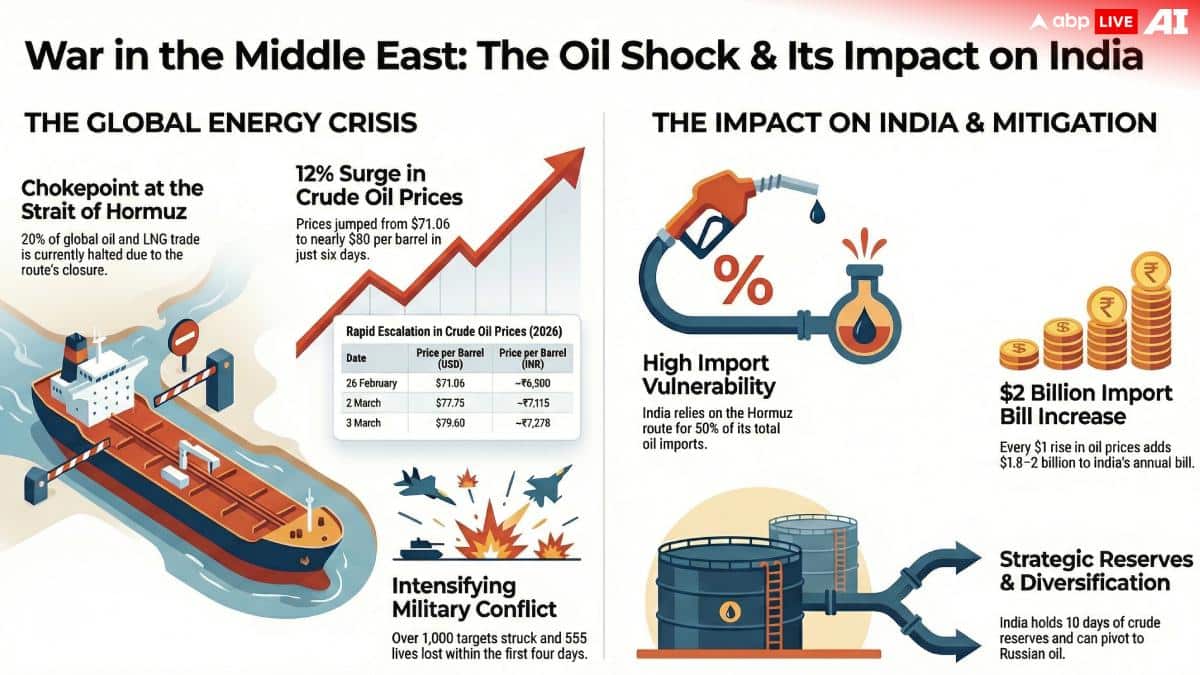
February 26, 2026: $71.06 per barrel (approximately Rs 6,500 per barrel)
March 2, 2026: $77.75 per barrel (approximately Rs 7,115 per barrel)
March 3, 2026: $79.60 per barrel (approximately Rs 7,278 per barrel)
The surge reflects immediate geopolitical risk premiums being priced into energy markets.
The war entered its fourth day on March 3, 2026. On February 28, the US and Israel launched joint strikes on Iran. Iran’s Supreme Leader Ali Khamenei and other senior officials were killed in the attacks. On the third day of the war, Iran retaliated by targeting six US bases across four Middle Eastern countries.
More than 1,000 Iranian locations have reportedly been targeted so far, with over 2,000 bombs dropped in the first 30 hours. At least 555 people have been killed and over 700 injured. According to the US Central Forces, more than six American soldiers have been killed in Iranian attacks.
The most consequential development for global energy markets has been Iran’s decision to close the Strait of Hormuz, warning that ships passing through could be targeted. Vessel movement through the Strait has halted, with several tankers anchored at sea.
Why The Strait Of Hormuz Matters
The Strait of Hormuz is one of the world’s most critical energy chokepoints.
- It lies between Iran and Oman.
- At its narrowest, it is just 33 kilometres wide.
- Shipping lanes in each direction are only 3 kilometres wide.
- Nearly 20 per cent of global oil and LNG trade passes through it.
- Around 15 million barrels of crude oil move through it daily.
Major Gulf producers depend on this route to export oil and gas. Importing countries rely on it to sustain supply chains. Even a temporary disruption can create cascading effects on freight, insurance and delivery schedules.
India’s Direct Exposure
India imports more than 88 per cent of its crude oil needs. Nearly 50 per cent of those imports, approximately 2.5 to 2.7 million barrels per day, transit through the Strait of Hormuz.
Every $1 increase in crude prices could raise India’s annual import bill by approximately $1.8-2 billion.
India currently holds crude stock for around 10 days and fuel reserves for about one week. The country can tap its Strategic Petroleum Reserve (SPR) and source supplies from Russia, the US, West Africa and Latin America if required. Russian oil, in particular, is available in the Indian Ocean region and can be accessed relatively quickly.
However, India remains heavily dependent on LPG (80-85 per cent imports) and LNG (around 60 per cent imports), with limited strategic reserves in these categories.
If the crisis persists, oil prices could potentially cross $100 per barrel. Even if the Strait remains closed for only one to two weeks, congestion and supply delays could extend disruptions for several more weeks.
Economic Ripple Effects
Higher crude prices raise the risk of inflation through increased petrol, diesel and cooking gas costs. Freight and insurance premiums may rise. Longer shipping routes could add 15-20 days to delivery schedules, affecting exports.
Electronics and basmati rice exports could face logistical strain. Remittances from Gulf countries may also be affected if regional economic activity slows.
Domestic markets have already reflected the uncertainty.
Ashish Gupta, CIO, Axis Mutual Fund, noted on March 2 that Nifty 50 and Sensex were trading lower by around 1.8 per cent each, government bond yields were trending slightly higher, Brent crude was up around 6 per cent and gold had risen roughly 3 per cent.
He emphasised that while oil is the first transmission channel of global conflicts into Indian markets, history suggests that such shocks have rarely led to sustained equity underperformance when conflicts remain regional.
He pointed to previous episodes, including the Russia-Ukraine war in 2022, Balakot in 2019 and other Middle East flare-ups, where markets saw short-term drawdowns but ultimately stabilised as fundamentals reasserted themselves.
What Should Investors Do?
Nehal Meshram, Senior Analyst at Morningstar Investment Research India, advised that mutual fund investors should remain anchored to long-term goals and avoid reactive portfolio changes. She underscored the importance of diversification across equities, debt and gold, noting that debt can provide stability while gold often acts as a hedge during uncertainty.
She cautioned against panic selling and suggested that investors with ongoing SIPs should continue steady investments rather than attempt short-term market timing.
Varun Gupta, CEO of Groww Mutual Fund, echoed similar caution. He said geopolitical risks have increasingly become part of the global backdrop and that while volatility may rise, long-term asset allocation should not be materially altered based on headlines.
He highlighted Multi Asset Allocation Funds as potentially better suited for such environments, given their exposure across equities, debt and commodities like gold and silver.
For Indian investors, the core risk lies in the duration of the conflict and the sustainability of elevated oil prices. Short-term volatility is almost certain. However, market history indicates that earnings growth, domestic demand and policy stability ultimately drive long-term returns.