
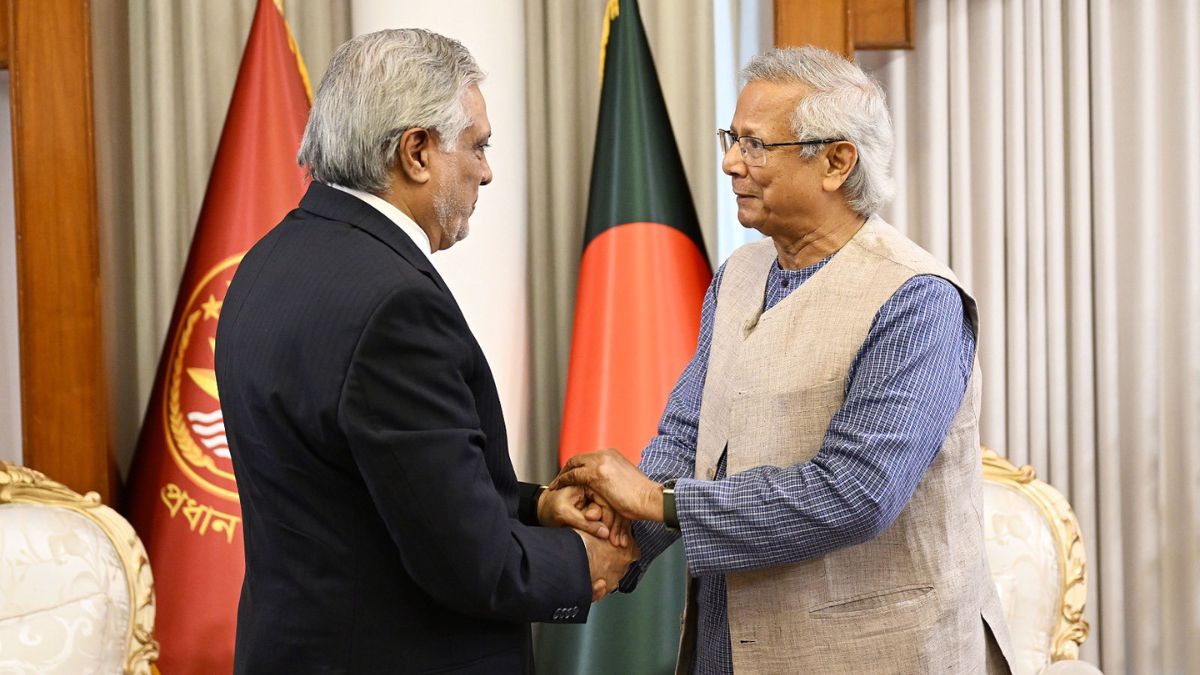
 "‘Definitely, don’t agree’: Bangladesh rejects Pakistan’s ‘1971 issues resolved twice’ claim")

Bangladesh on Sunday rejected Pakistan’s Deputy Prime Minister Ishaq Dar’s claim that the issue of reparations and financial settlements was resolved twice
As Pakistan’s Foreign Minister, Ishaq Dar, commences his visit to Bangladesh, his counterpart, Md. Touhid Hossain said that both nations are not on the same page regarding the ‘unsettled issues’ from 1971. While speaking to the Pakistani deputy prime minister, Bangladesh’s foreign adviser demanded an apology from Pakistan and settlements of financial matters.
However, Dar claimed that these issues have been resolved in the past. While both nations have expressed cooperation in trade and investment, they are on diverging paths when it comes to the issue of reparations.
On Saturday, Dar arrived for a two-day visit to Bangladesh to rebuild ties between the two nations. Dar’s trip to Dhaka came following the ouster of Bangladesh’s long-time Prime Minister Sheikh Hasina “Definitely, I don’t agree (with Dar). Had it been so, the problems would have been solved. We explained our position and they (Pakistani side) did theirs,” Hossain told the media as quoted by Prothom Alo.
He maintained that both nations would continue talking about the matter in the coming days.
Bangladesh seeks a financial settlement from cash-strapped Pakistan
While addressing the media, the foreign adviser said that Dhaka sought settlement of pre-independence financial issues, repatriation of stranded Pakistanis and “seek them to express regret, the apology for the genocide that took place here (in Bangladesh in 1971).”
“I have strongly upheld the Bangladesh stance,” said Hosain. When asked if he agrees with Dar’s comments that the 1971 issues were “resolved twice,” the Bangladeshi diplomat said, “It would be wrong to expect problems of 54 years to be solved in a single day.”
According to Dar, the issues were resolved twice, first in 1974 in tri-partite talks involving New Delhi in India and during Pakistani President Pervez Musharraf’s era. “The then president Pervez Musharraf settled the issues of genocide again during his Dhaka visit when he talked in public with an open mind,” Dar claimed.
However, he concluded his assertion by saying that there is scope and possibility of “doing good for the two peoples of our two countries is tremendous.”
Not the first time
This is not the first time Dhaka raised the concern with Pakistan after Bangladesh’s Chief Adviser Muhammad Yunus came to power. During the first foreign secretary-level talk in 15 years, Bangladesh had asked Pakistan to resolve the unsettled historical issues and settle the pre-independence asset sharing. Dhaka also demanded a formal apology for the genocide committed during the 1971 Liberation War.
Dar’s visit came amid a visible shift in regional politics in the past year involving Bangladesh, Pakistan and India. After the ousting of the Hasina government, following a violent student-led street protest, the Yunus government was seen as inclined towards Pakistan.
On Dar’s first day of the visit. Hossain mentioned that the two nations signed one agreement and five memoranda of understanding (MoUs). Bangladesh-Pakistan ties were at their lowest point during Hasina’s Awami League regime, particularly when it initiated in 2010 the trial of collaborators of Pakistani troops during the 1971 Liberation War.
End of Article


&description=%E2%80%98Definitely%2C+don%E2%80%99t+agree%E2%80%99%3A+Bangladesh+rejects+Pakistan%E2%80%99s+%E2%80%981971+issues+resolved+twice%E2%80%99+claim)