
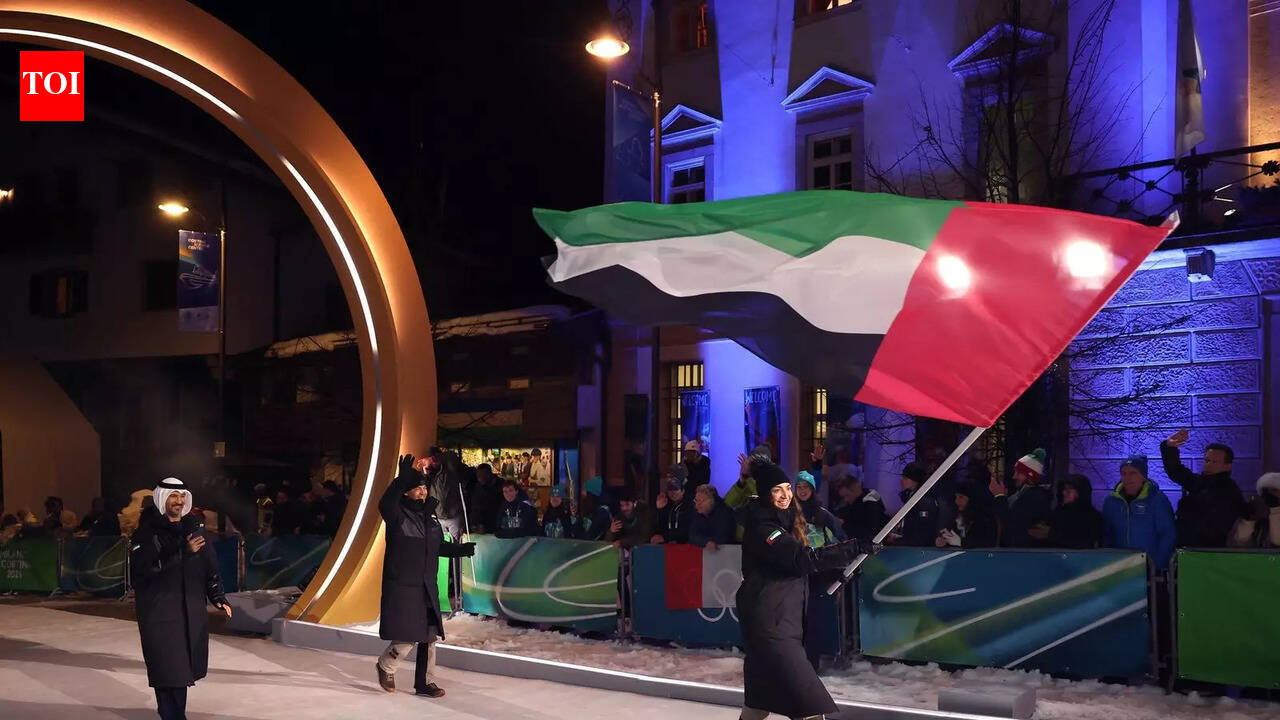

UAE skiers make history at Milan-Cortina 2026, broadening winter sports’ global reach / image: @UAENOC
The 2026 Winter Olympics in Milan Cortina officially kicked off today with a dazzling opening ceremony, but for the Middle East, the standout moment was the arrival of the United Arab Emirates delegation. For the first time in history, the UAE flag was paraded alongside traditional winter sports giants at the San Siro Stadium. This debut marks a massive milestone in the nation’s sports strategy, moving beyond the traditional summer games to compete on the global ice and snow stage. This achievement is the result of years of investment in indoor facilities like Ski Dubai and rigorous training programs in Europe, proving that geography is no barrier to Olympic ambition.
UAE’s historic debut at Winter Olympics
In a momentous first, the United Arab Emirates proudly stepped onto the Winter Olympics stage. For the first time in its history, the UAE sent a senior Winter Olympic team to Milano-Cortina 2026, marking a milestone in its sporting evolution.Two alpine skiers, 19-year-old Alexander (Alex) Astridge and 29-year-old Piera Hudson, carried the UAE flag during the opening ceremonies: Astridge in Milan and Hudson in Cortina d’Ampezzo, respectively. Their participation placed the UAE among a growing list of countries expanding winter sports beyond traditional snowbound nations, underscoring how determination and global support can transcend climate boundaries.Senior UAE sports officials attended the festivities, including Fares Mohammed Al Mutawa, Secretary-General of the National Olympic Committee, Mohammed bin Darwish, Executive Director of the Olympic Committee, and Hamel Al Qubaisi, Vice President of the UAE Winter Sports Federation.
Milan-Cortina 2026
The Milan-Cortina 2026 Winter Olympics mark a bold new chapter for the Olympic movement, blending world-class sport with a modern, multi-city hosting model. Scheduled from February 6 to 22, 2026, the Games are being hosted by Italy, with competitions spread across Milan, Cortina d’Ampezzo, Livigno, Bormio, Predazzo, and Anterselva — making it one of the most geographically diverse Winter Olympics ever staged.The Games will bring together nearly 3,000 athletes from over 90 countries, competing across eight sports and 16 disciplines, including alpine skiing, cross-country skiing, biathlon, ice hockey, figure skating, snowboarding, and speed skating. More than 110 medal events are scheduled, highlighting both traditional winter disciplines and newer, youth-driven formats.Milan-Cortina 2026 is also the first Winter Olympics to feature a dual-city opening ceremony, with celebrations taking place simultaneously in Milan and Cortina, symbolising the fusion of urban culture and alpine heritage. Organisers have positioned the Games as a sustainability-focused Olympics, prioritising existing venues, reduced environmental impact, and long-term legacy use rather than large-scale new construction.For nations like the United Arab Emirates, the Games represent more than competition. Milan-Cortina 2026 stands as a global stage for inclusion, evolution, and the breaking of sporting stereotypes, making the UAE’s debut part of a much larger Olympic story.
Meet the athletes leading UAE
The UAE’s historic Winter Olympics debut is led by two alpine skiers, marking the country’s first-ever participation in senior Winter Olympic competition.Alexander (Alex) Astridge, 19, and Piera Hudson, 29, will represent the UAE in alpine skiing events, competing against some of the most experienced winter athletes from traditional snow-sport powerhouses such as Austria, Switzerland, Norway, and the United States. Both athletes have trained extensively abroad while also using Ski Dubai as a foundational training base, reflecting the UAE’s growing winter sports infrastructure.Officials from the UAE Winter Sports Federation and the UAE National Olympic Committee have been clear that the primary objective at Milan-Cortina 2026 is experience, exposure, and long-term development, rather than immediate medal contention. Alpine skiing is among the most competitive disciplines at the Winter Olympics, with athletes often requiring multiple Olympic cycles to reach podium level.That said, qualification itself is a significant achievement. Competing on Olympic slopes places UAE athletes on the global performance map, allows them to benchmark against elite competitors, and builds a pathway for stronger results in future Games. As Hamel Al Qubaisi, Vice President of the UAE Winter Sports Federation, previously noted, participation at this level is a “critical step in building a sustainable winter sports ecosystem for the UAE.”
Why did it take the UAE so long?
The UAE’s arrival at the Winter Olympics did not happen overnight, and the timeline reflects the realities of building winter sports in a non-snow country. Unlike nations with natural alpine terrain and generational winter traditions, the UAE began its winter sports journey from the ground up.One of the primary reasons for the delayed debut is infrastructure and access. Competitive winter sports require consistent exposure to snow, high-altitude training, and international competition circuits. For decades, the UAE simply did not have the facilities or athlete pipeline needed to meet Olympic qualification standards.That began to change in the last decade. The opening of Ski Dubai provided a controlled training environment, while the formation and international recognition of the UAE Winter Sports Federation, including its membership in the International Ski Federation (FIS) in 2022, created the administrative and competitive framework required for Olympic participation.Another key factor was athlete eligibility and development. Winter athletes often peak after years of international competition, and the UAE first had to identify dual-national or resident athletes willing to compete under its flag while meeting strict Olympic qualification criteria. This process takes time, investment, and sustained international exposure.
Looking ahead
Officials from the UAE National Olympic Committee have previously stressed that the country’s approach was deliberate rather than rushed. The focus was on ensuring athletes met global standards, governance structures were in place, and participation would be credible, not symbolic.Milan-Cortina 2026 represents the point where preparation, infrastructure, and athlete readiness finally aligned. The debut is not a late entry, but a strategic arrival, signalling that the UAE is entering winter sports with intent, structure, and a long-term vision rather than as a one-off appearance. Go to Source

