
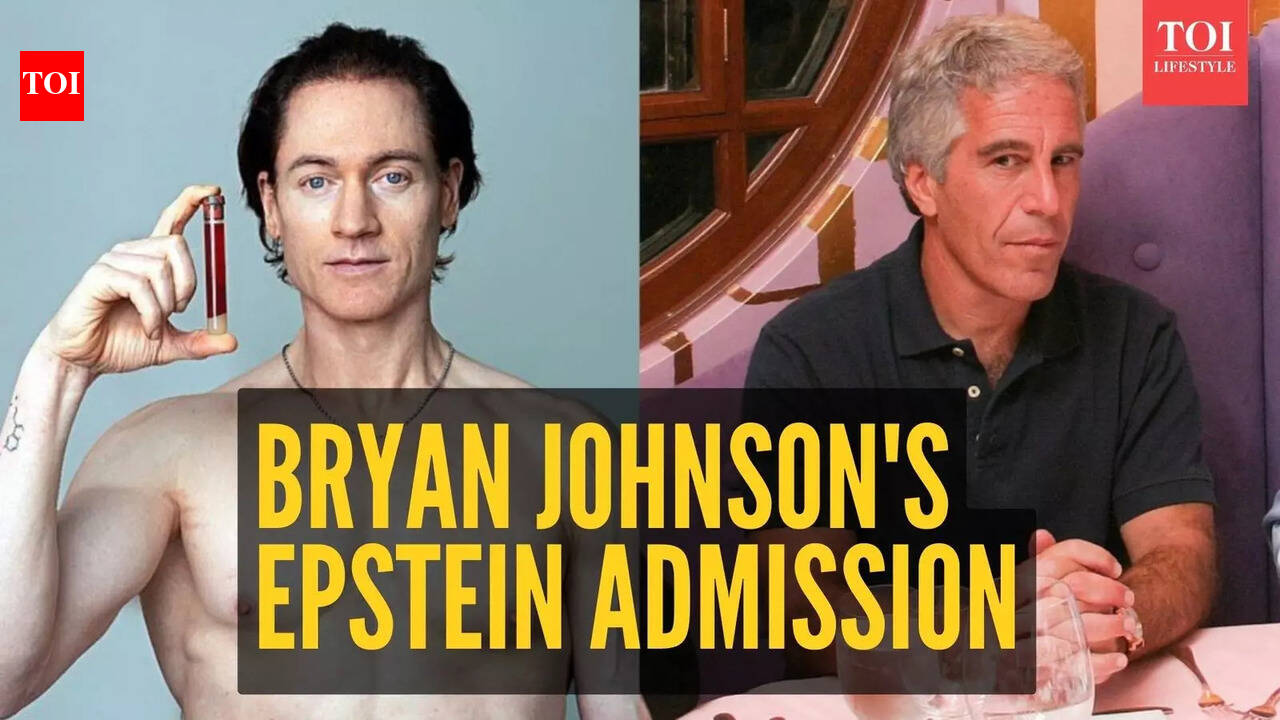

Did Bryan Johnson Knowingly Engage with Jeffrey Epstein? Tech CEO’s Defence Under Fire
Tech entrepreneur Bryan Johnson, best known for his longevity and brain-interface ventures, has ignited a fresh social-media firestorm by revealing a long-buried encounter with the late convicted sex offender Jeffrey Epstein, prompting both support and fierce backlash online. Johnson’s candid admission, buried in Epstein’s newly released files, quickly trended as commentators, critics and conspiracy theorists weighed in on what it means for elite networks and Silicon Valley credibility.In a series of posts on X (formerly Twitter), the billionaire recounted meeting Epstein over a 10-minute Zoom call about eight years ago, initiated through a mutual contact during the early days of his brain-tech company Kernel. Johnson said that he immediately felt something was “wrong” about Epstein and ended the interaction. He described the decision as instinctual and visceral, even before the full public reckoning of Epstein’s crimes.
The tweetstorm: What Bryan Johnson actually said
Johnson’s thread began by recalling how the introduction arose while he was building Kernel, an ambitious neural-interface startup. “8 years ago I met Epstein via zoom. A mutual contact put us in touch as I was building my brain interface company Kernel and he had supposedly done some neuroscience stuff at MIT,” Johnson wrote. “After a ten minute video call I immediately called the person who put us in contact and told him that Epstein seemed like a very dark person. I felt sick to my stomach. I also told him I that never wanted to speak to him again (sic).”He added that at the time, he knew little about Epstein’s history and shared, “I remember this so clearly because I knew nothing about him but weirdly, intuitively, something was deeply wrong. Being in his proximity felt dangerous. Despite having nothing to go off of, I never interacted with him again and came to find out years later that he’d had a f***** up past (sic).”
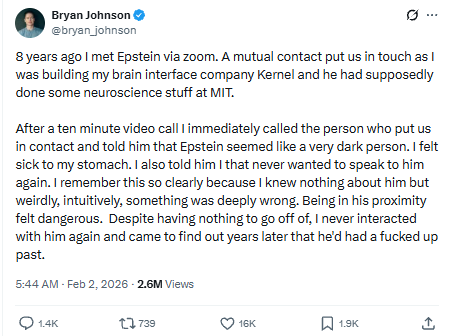
Bryan Johnson tweets about his brief encounter with Epstein
In follow-up back-and-forth with users, Johnson clarified that although he had initially offered to meet Epstein in person while travelling through New York, the exchange ultimately was a call and his only encounter. When questioned about why he did not check Epstein’s background, Johnson wrote, “tbh it wasn’t part of my algo to check if someone being intro’d to me was a registered sex offender (sic).”
Internet erupts: Scepticism and accusations against Bryan Johnson
The thread polarised reactions online, with some users defending Johnson’s instincts while others accused him of inconsistency. One commenter shared a screenshot suggesting Johnson had tried to arrange a meeting after Epstein was already a convicted offender and alleged, “You’re 100% lying. Here’s you trying to meet up with him after he was a convicted sex offender.”
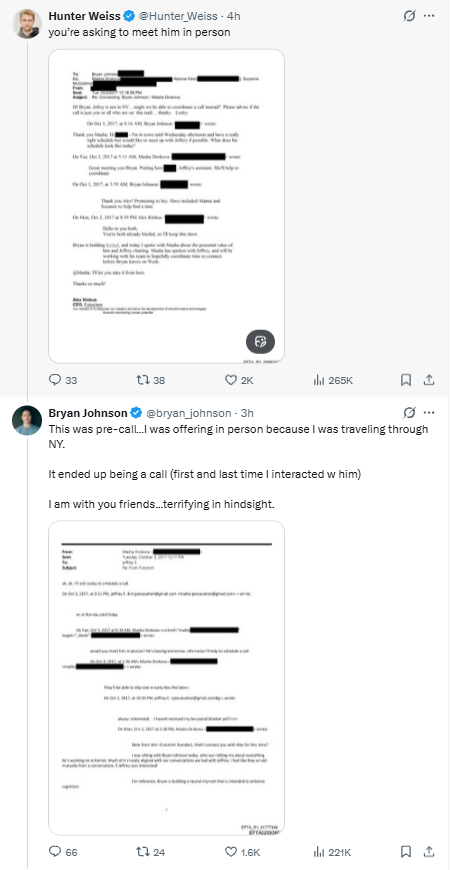
X (formerly Twitter) users accuse Bryan Johnson for defending his brief encounter with Epstein
Others questioned the credibility of distancing oneself only after being named in recent file dumps. Reddit threads and replies have highlighted both sides: several users joked and mocked Johnson’s narrative, claiming it sounded like “crisis PR,” while others argued Epstein’s network was widespread and many professionals could unknowingly cross paths with individuals connected to him.Some critics noted that simply appearing in the “Epstein files” is not necessarily evidence of wrongdoing, pointing out that many figures with elite credentials were linked to him long before his criminal convictions. Others dismissed Johnson’s explanation as “hyperbolic” or opportunistic given the timing of the disclosure.
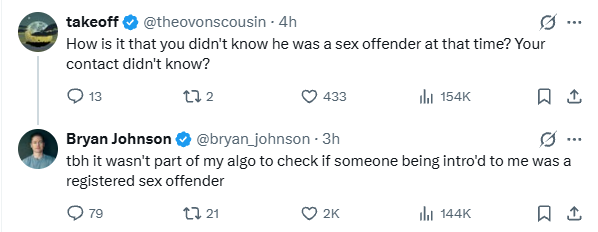
X (formerly Twitter) users accuse Bryan Johnson for defending his brief encounter with Epstein
The resurfacing of Epstein-linked files, part of broader releases tied to investigatory archives, has reignited scrutiny of powerful networks long after Epstein’s 2019 arrest and death. Public curiosity is particularly acute when billionaires, tech founders and cultural icons are mentioned in connection with him. In similar episodes, high-profile figures like Tesla CEO Elon Musk have faced questions about alleged links to Epstein, with Musk publicly denying any relationship.
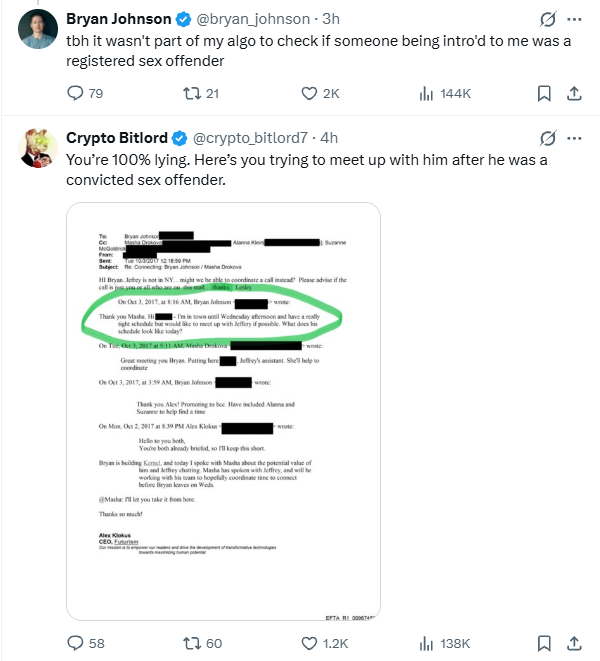
X (formerly Twitter) users accuse Bryan Johnson for defending his brief encounter with Epstein
In Johnson’s case, his public profile as a self-styled biohacker pursuing radical anti-ageing and human enhancement through his Blueprint project, makes his acknowledgment of such an encounter particularly newsworthy. His broader social presence, including international discussions about health and longevity, keeps him in the spotlight even beyond the Epstein thread.
Context: Epstein Files, power and proximity
Epstein’s tangled web of connections with scientists, financiers, politicians and celebrities has long fascinated and disturbed analysts. The disclosure of emails, spreadsheets and communication logs in recent years has prompted both investigative reporting and intense online debate about how far his influence reached and who knew what when.Commentators often stress that presence in records does not automatically imply guilt but raises questions about networks of influence, particularly when introductions are facilitated by mutual contacts with credibility. Critics argue that public figures have a responsibility to use due diligence when associating with anyone, especially those later revealed to have committed heinous crimes. Advocates for transparency see revelations like Johnson’s as part of a broader reckoning with elite circles and accountability.
What Bryan Johnson’s narrative reveals about intuition and reputation management
Johnson’s telling leans heavily on “instinct” rather than foreknowledge of Epstein’s past, an angle that has drawn both sympathy and ridicule online. His assertion that he had no background check “algorithm” to flag someone’s criminal status highlights how tech culture can sometimes prioritise network access over vetting, especially when introductions come from seemingly reputable sources.It also reveals the challenges high-profile founders face when their names surface in controversial archives: the need to balance transparency, self-preservation and narrative control. In this case, Johnson’s public recounting may be seen as a pre-emptive effort to frame his past actions before others do. The Johnson tweetstorm is the latest example of how digital archives and social platforms are reshaping public memory and accountability. Go to Source

