
The city’s bus service is still running entirely on CNG. While neighbouring Delhi has rapidly expanded its electric bus operations and positioned e-buses as the backbone of its public transport transition, Gurgaon’s shift to a greener fleet remains largely limited to electric cabs and autos.
India managing director at International Council on Clean Transportation (ICCT) Amit Bhatt told TOI, “Delhi’s progress was driven by faster execution and policy support. Delhi was able to move faster largely because it received strong support under central schemes like FAME II (Faster Adoption and Manufacturing of Hybrid & Electric Vehicles in India) and the PM e-Drive, along with better planning and quicker implementation.
Haryana also qualifies for these schemes, but reforms such as a proper payment security mechanism and a structured implementation framework are crucial. Without these, cities struggle to get projects cleared and executed on the ground.”
Over the past decade, the city saw only limited traction in EV adoption within the shared mobility segment, with 20,332 electric commercial vehicles registered so far. This includes 2,685 electric cabs and 3,392 electric passenger autos.
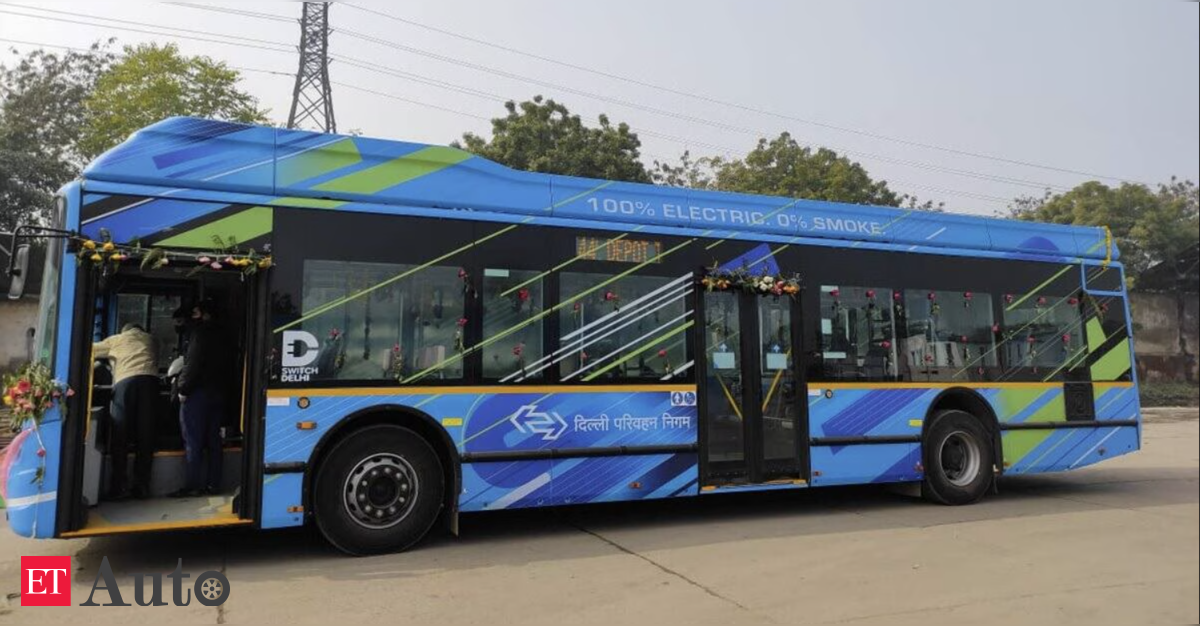
On the contrary, over the past two years, the number of electric buses in Delhi has risen from 300 to 1,725, now acco unting for more than 45 per cent of the DTC fleet. Despite plans and repeated attempts, Gurugram Metropolitan City Bus Limited (GMCBL) has not been able to induct a single electric bus into its fleet since 2019. GMCBL’s first attempt to bring electric buses began in Sept 2019, when it floated a request for expression of interest (RFEOI) to deploy 100 electric buses in the city. The plan was later shelved after the Haryana govt decided to procure buses for statewide operations instead.
In 2023, the state opted into the PM e-Sewa scheme, under which Convergence Energy Services Ltd (CESL) stepped in to facilitate deployment. In Feb 2025, CESL finalised a concessionaire to procure, operate and maintain 450 electric buses across Haryana, with Gurgaon expected to receive 100. Another 100 e-buses were confirmed later in Sept. Despite these announcements, the e-buses are yet to move from paper to roads.
According to the GMDA, the gross cost contract was finalised by CESL, but the proposal is awaiting govt approval. Only after that can GMCBL sign the agreement and initiate the rollout. The proposal is likely to be placed before the high-powered purchase committee on Monday and is expected to receive the govt’s nod, officials added. The timeline for the induction of e-buses was already missed. Earlier, the first batch of electric buses was expected to arrive by June last year, but officials now say deliveries may begin by April. GMDA officials said preparatory work was taken up to support electric buses once approvals come through.
A GMDA official said, “Development of the required infrastructure to support the induction of electric buses into GMCBL’s fleet was already taken up. A charging substation was installed at the Sector 10 depot and an e-bus depot is being developed in Sector 48. GMCBL currently operates CNG buses, but the upcoming induction of 200 buses is planned to be fully electric as part of the shift towards sustainable public transport.”
Officials in the transport department said they are also pushing EV adoption in last-mile connectivity. Motor vehicle officer Herender Veer said, “The govt has committed itself to sustainable public transport. We are encouraging EV adoption and are facilitating faster registration and permits, especially for autos. Charging infrastructure will be expanded. Diesel autos completely stopped operating in Gurgaon and we are pushing for cleaner alternatives to reduce pollution.”
Auto drivers and unions, however, said the shift will pick up only when charging access improves and maintenance costs become more manageable. President of Haryana Auto and E-rickshaw Drivers’ Union Mahabir Singh said, “Some drivers moved to electric, but mass adoption will happen only when the infrastructure is ready and operating costs are manageable. A CNG auto gives around 25 km per kg. With EVs, drivers worry about charging availability, battery replacement after a few years and whether the battery quality will hold up.”
At present, the city’s public bus service has a modest fleet size of 150 buses that run on CNG, while another 50 buses are operating in Faridabad.
According to the comprehensive mobility management plan of Gurgaon (released in 2019), the city witnesses around 21.88 lakh intra-city motorised trips daily, with 57 per cent of trips being work-related and 29 per cent linked to education. Urban mobility experts say this makes expanding and electrifying public transport more necessary and immediate, especially as the city continues to grow outwards.
ICCT MD Bhatt said, “The city needs a much larger bus fleet. As per the ministry’s urban transport guidelines, cities require around 40-60 buses per lakh population, but Gurgaon is nowhere close to that benchmark. Unless the govt treats public transport expansion as a priority and appoints a strong nodal agency to drive this transformation, scaling up – including electrification – will remain a challenge.”>