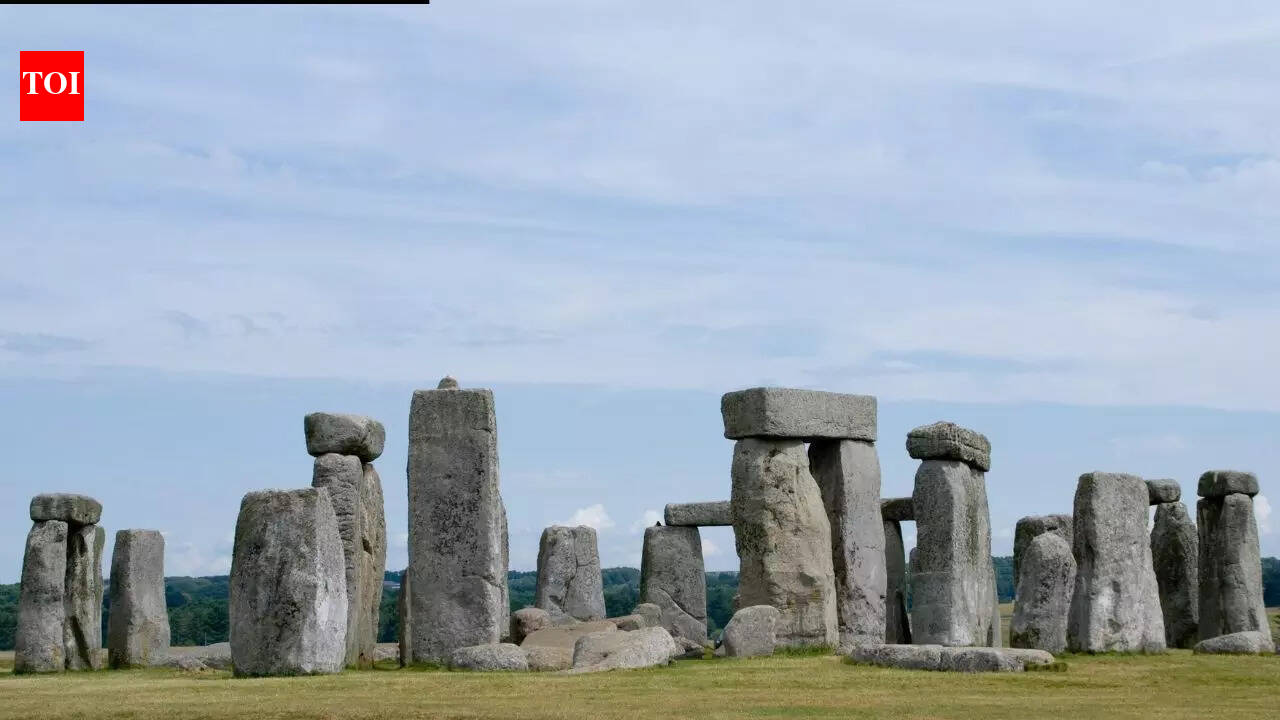

Stonehenge sits on open chalk land in southern England, familiar and yet still awkwardly unexplained. For decades, one practical question has hovered over the site without settling. How did stones weighing many tonnes arrive here long before wheels, metal tools or written plans. A new study led by geologists at Curtin University shifts that discussion onto firmer ground. By analysing tiny mineral grains in local river sediments, the researchers tested whether glaciers once carried the stones south during the Ice Age. The results point away from ice and towards people. The landscape around Salisbury Plain shows no chemical trace of glacial delivery. Instead, the sediments reflect local recycling. This strengthens the view that Neolithic communities moved the stones themselves, deliberately, over long distances alone.
Researchers uncovered the truth behind Stonehenge’s 25 tonne stones
The research “Detrital zircon–apatite fingerprinting challenges glacial transport of Stonehenge’s megaliths” focuses on detrital minerals, mainly zircon and apatite, found in streams that drain Salisbury Plain. These grains act as long-lived markers of where sediment has travelled. If glaciers had crossed the area, they would likely have left behind mineral signatures from Wales or northern Britain. That signal is absent. The zircon ages instead match rocks already known from southern England, suggesting the material has been recycled locally rather than dumped by ice. This matters because glacial transport has often been used as a convenient explanation. If ice sheets had carried the stones close to Stonehenge, human effort could be seen as minimal. The new data makes that position harder to hold.
Salisbury Plain shows no sign of ancient ice
The study also reinforces a growing consensus among geomorphologists. There is little physical evidence that glaciers ever reached Salisbury Plain during the Pleistocene. No clear moraines, no consistent erratic trails, no buried till layers. While ice did extend far into Britain during earlier cold periods, its southern limits remain well north of the monument.Fine sediments can travel far beyond glaciers through meltwater. Large stones usually do not. The absence of glacial fingerprints in the surrounding sediment makes it unlikely that multi-tonne blocks arrived by chance.
Sarsens were local but still demanding
Not all of Stonehenge came from far away. The largest stones, the sarsens, were sourced from West Woods, about 25 kilometres to the north. That distance may sound modest, but the stones weigh around 25 tonnes each. Moving them would still have required planning, labour and time. The mineral analysis does not focus on sarsens directly, but it supports a broader pattern. Stonehenge was not constructed using random materials that happened to be located nearby. Its materials were selected and brought in with intent.
Bluestones point clearly to human effort
The smaller bluestones tell a sharper story. Their geological fingerprints match outcrops in the Preseli Hills of west Wales, around 230 kilometres away. Some stones may have travelled by sea for part of that journey, others overland. Either way, the distances involved rule out casual movement. One stone stands out even more. The Altar Stone appears to come from the Orcadian Basin in northeast Scotland. If correct, that implies a journey of more than 700 kilometres. No known ice route explains this. Human organisation does.
What the science changes and what it does not
The study does not describe exactly how the stones were moved. Sledges, rollers and boats remain plausible tools. What it does change is the balance of probability. Stonehenge looks less like a monument finished by chance and more like one completed through sustained effort. There is no single moment where the mystery disappears. Instead, the space for easy answers narrows. The stones arrived because people brought them. That idea now sits more comfortably with the evidence, even if the work behind it remains only partly visible. Go to Source