
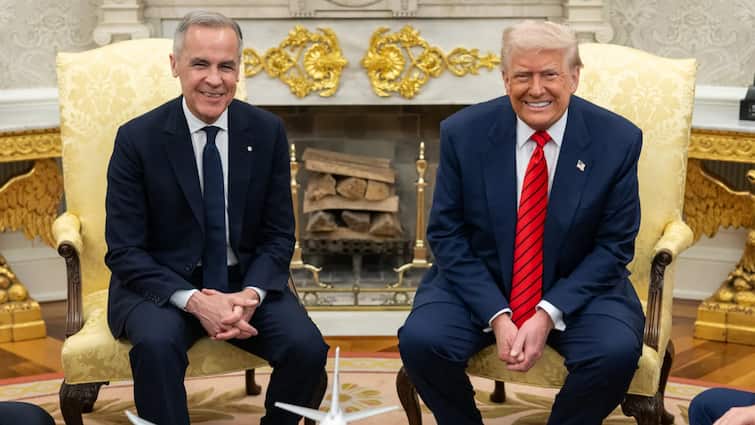

Canada has no plans to pursue a free trade agreement with China, Prime Minister Mark Carney said on Sunday, following threats of steep tariffs from US President Donald Trump.
“We have commitments under CUSMA not to pursue free trade agreements with non-market economies without prior notification. We have no intention of doing that with China or any other non-market economy,” Carney stated.
He added that Canada’s recent engagement with China focused only on addressing specific trade issues that had arisen in the past few years. “What we have done with China is to rectify some issues that developed in the last couple of years,” he said.
PM Mark Carney responds to Trump’s 100% tariffs threats
“We have commitments under CUSMA not to pursue free trade agreements with non-market economies without prior notification. We have no intention of doing that with China or any other non-market economy.” pic.twitter.com/oAdDN7lYPf
— 6ixBuzzTV (@6ixbuzztv) January 25, 2026
Carney emphasised that Canada remains bound by its existing commitments under the Canada–United States–Mexico Agreement (CUSMA), which requires prior notification before negotiating trade deals with non-market economies.
Trump’s 100% Tariff Warning
Carney’s remarks follow President Trump’s warning on Saturday that Canada could face a 100 percent tariff if it pursued a free trade agreement with China. Trump used social media to issue a series of sharp statements targeting both Canada and Beijing.
“China will eat Canada alive, completely devour it, including the destruction of their businesses, social fabric, and general way of life,” Trump wrote on Truth Social.
He further warned, “China is successfully and completely taking over the once Great Country of Canada. So sad to see it happen.” In other posts, he described Canada as “systematically destroying itself” and called the China deal “a disaster for them,” claiming that Canadian businesses are relocating to the United States.
“A MUST WATCH. Canada is systematically destroying itself. The China deal is a disaster for them. Will go down as one of the worst deals, of any kind, in history. All their businesses are moving to the USA. I want to see Canada SURVIVE AND THRIVE!” he added.
Carney’s statements signal Ottawa’s intention to adhere to existing trade obligations while clarifying that ongoing discussions with China are limited to resolving specific trade disputes, rather than establishing a new trade agreement.
Canada’s stance comes after a series of reciprocal trade measures between Ottawa and Beijing. In 2024, Canada matched the United States by imposing a 100 percent tariff on Chinese electric vehicles, along with 25 percent tariffs on steel and aluminum. China responded with significant duties on Canadian exports, including canola oil, pork, and seafood.
Earlier this month, during a visit to China, Canada revised its approach by reducing the 100 percent tariff on Chinese electric vehicles. In return, China lowered tariffs on certain Canadian agricultural products. Prime Minister Carney emphasised that the adjustment aimed to stabilise trade relations rather than create a pathway for unrestricted imports.


