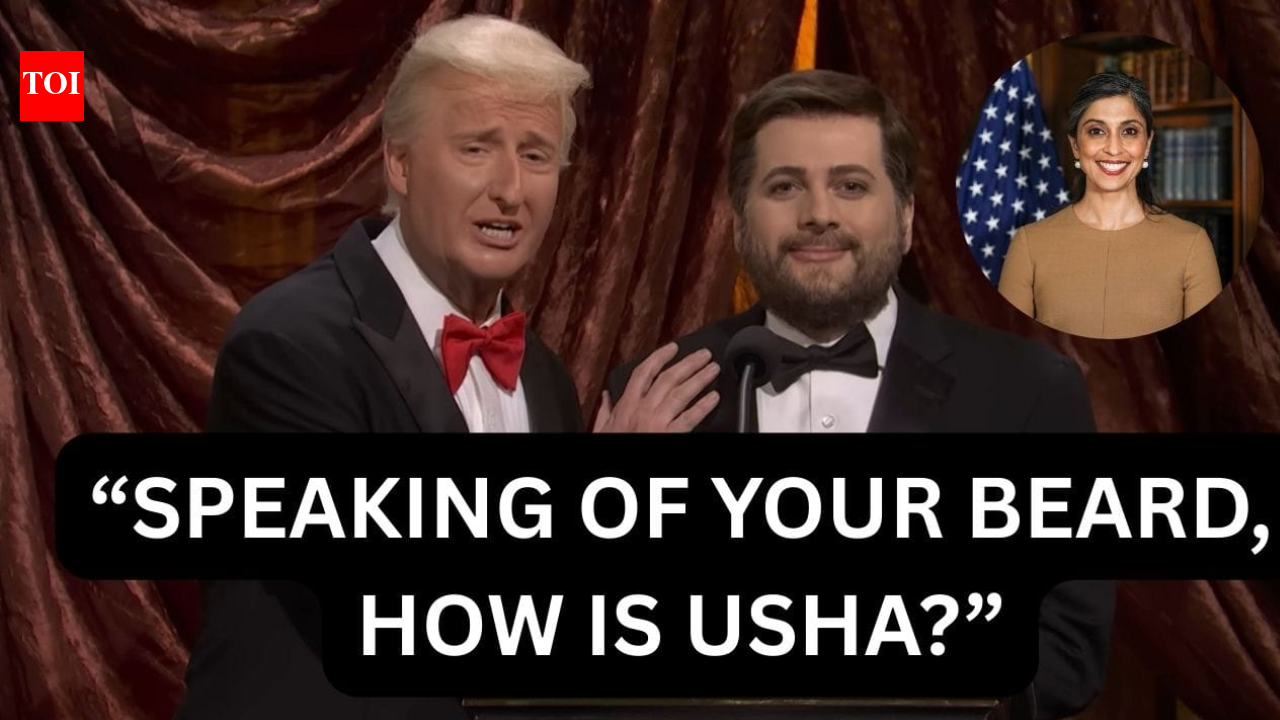

This week’s Saturday Night Live cold open began with a parody awards ceremony called The Trumps, a familiar SNL device that reimagines the Oscars through the narcissistic logic of Donald Trump. The premise itself was broad and accessible: Trump hosting an awards night celebrating himself, his administration, and the institutions he claims to have bent to his will. As with most SNL cold opens, the sketch was designed to function on multiple frequencies at once, mixing easy political satire with sharper, culturally specific jokes aimed at audiences fluent in online discourse.One of those sharper moments arrived via a blink-and-you’ll-miss-it cameo by J. D. Vance, played by Mikey Day. In the sketch, Vance jokes that if he becomes president in 2028, he would be the first US president with a beard in a hundred years. Trump immediately snaps back: “Speaking of your ‘beard’, how is your wife Usha?”On the surface, the line registers as a typical Trump-style insult, a crude pivot from facial hair to marriage delivered for a quick laugh. But that surface reading misses what the joke is actually doing. The word “beard” is not accidental. It is a piece of queer terminology smuggled into a network television sketch, and its meaning is precise. In queer slang, a “beard” refers not to facial hair, but to a partner used as a heterosexual cover, historically by queer individuals who felt pressure to conceal their sexuality in hostile social or professional environments. That particular joke has circulated for years in online spaces, forming part of the same rumour ecosystem as the infamous JD Vance couch joke. The SNL line riffs on a long-circulating internet innuendo suggesting that Vance is queer and that Usha Vance functions as his “beard”. The show is not making a factual claim. Instead, it is exploiting a piece of subcultural vocabulary that many casual viewers will not recognise, while others will immediately understand the implication.This kind of layered humour is central to how SNL has survived in the social media era. The cold open has become less about telling a single joke clearly, and more about stacking references that travel well online. A line like this generates clips, screenshots, and explainers precisely because it splits the audience. If you do not know the slang, the joke passes as crude banter. If you do, it lands as a deliberately provocative wink, one that feels far more transgressive than the sketch otherwise suggests.The reason the joke works at all is because JD Vance’s personal life has already been folded into internet speculation in a way few mainstream politicians experience. JD and Usha Vance’s relationship has been the subject of unusually persistent gossip, much of it incubated in MAGA-adjacent online spaces where personal narratives are treated as ideological battlegrounds. While Usha Vance recently announced her fourth child, the internet briefly went into overdrive when she was spotted without her wedding ring, an absence her publicist dismissed as innocuous.That moment fed into a broader rumour cycle that has little regard for evidence but enormous appetite for symbolism. Around the same time, many online commentators, and even mainstream figures such as Joy Reid, amplified claims that JD Vance was preparing to “divorce” Usha Vance and instead marry a so-called “white queen”, Erika Kirk. The rumour drew on racial, ideological, and aesthetic anxieties within Trumpworld, casting Usha Vance as an inconvenient mismatch in a movement increasingly obsessed with cultural homogeneity.None of these claims have been substantiated. But in contemporary political culture, truth is often secondary to circulation. By the time SNL referenced the joke, it had already become part of the ambient background noise surrounding Vance’s public image, familiar enough to be recognisable, even if only to a niche audience.That is the ecosystem SNL now operates in. The show does not originate these narratives. It harvests them, compresses them, and refracts them through satire. In this case, a single word, “beard”, operates as a cultural dog whistle, quietly importing years of online rumour, queer slang, and political gossip into a five-second exchange. Most viewers will miss it. Some will laugh without knowing why. And a smaller group will recognise exactly what the joke is doing, and why it feels sharper, and crueller, than it first appears. Go to Source