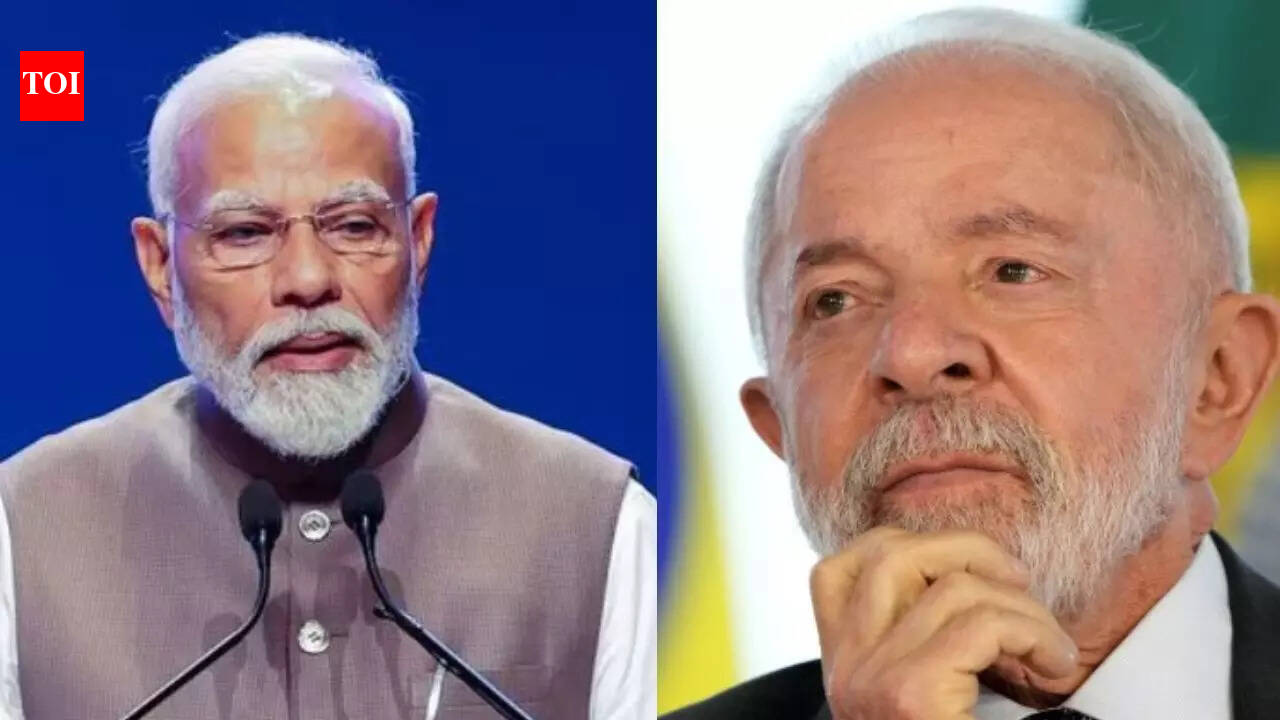
Prime Minister Narendra Modi on Thursday held a telephone conversation with Brazilian President Luiz Inácio Lula da Silva against the backdrop of ongoing tariff tensions between India and the United States under the Donald Trump administration.
Modi said close cooperation between India and Brazil was essential for advancing the shared interests of the Global South and said he looked forward to hosting the Brazilian leader in India.
Glad to speak with President Lula. We reviewed the strong momentum in the India-Brazil Strategic Partnership, which is poised to scale new heights in the year ahead. Our close cooperation is vital for advancing the shared interests of the Global South. I look forward to welcoming…
— Narendra Modi (@narendramodi) January 22, 2026
“Glad to speak with President Lula. We reviewed the strong momentum in the India-Brazil Strategic Partnership, which is poised to scale new heights in the year ahead. Our close cooperation is vital for advancing the shared interests of the Global South. I look forward to welcoming him to India soon,” Modi wrote on X.
Call Amid Uncertainty Over India–US Trade Deal
The Modi–Lula conversation comes at a time when New Delhi continues to grapple with tariff pressures imposed by the US. Lula had confirmed last August that a state visit to India would take place in early 2026 and had earlier told Reuters that he intended to initiate discussions within the BRICS grouping on addressing levies imposed by the Trump administration.
Trump’s Optimism On India Trade Ties
US President Donald Trump on Thursday expressed confidence in a “good” trade deal with India, describing Prime Minister Modi as a “fantastic leader” and a “great friend”.
“I have a great respect for your prime minister (Modi). He is a fantastic man and a friend of mine. We are gonna have a good deal,” Trump said in response to a question by a Moneycontrol journalist on the sidelines of his address at the World Economic Forum in Davos, Switzerland.
Tariffs Remain In Place
It has been nearly five months since tariffs on Indian exports to the US were raised to 50 per cent. Half of this was described by Trump as a “penalty” for India’s purchase of Russian oil. Uncertainty continues over whether and when a trade agreement may be concluded.
Mixed Signals From Trump Administration
Trade negotiations between officials from both countries began before the tariffs took effect, with formal talks commencing in March–April last year after receiving approval in February. Recent statements by Trump and senior members of his administration have added to the lack of clarity.
US Commerce Secretary Howard Lutnick claimed that a potential trade deal collapsed because Prime Minister Modi did not “call” the US President. Another aide recently said Trump had approved a bill that could raise tariffs on India to as high as 500 per cent.
India swiftly rejected Lutnick’s remarks. Optimism resurfaced after the new US ambassador to India, Sergio Gor, said Washington viewed India as an important partner and that trade negotiations were continuing.
Earlier this month, Trump suggested tariffs on India could be raised further. Speaking to reporters aboard Air Force One, he said:
“India wanted to make me happy. Modi is a very good guy, and he knew I was not happy. And it was important to make me happy. We can raise tariffs on them very quickly.”
Brazil Also Hit By Trump-Era Tariffs
Brazil has also faced trade action under the Trump administration. In July, Washington imposed a 40 per cent tariff on Brazilian products, in addition to an earlier 10 per cent levy. The move was linked to the Brazilian Supreme Court’s conviction of former president Jair Bolsonaro, a Trump ally, for attempting a coup.
The 40 per cent tariffs on Brazilian food products, including beef, coffee, cocoa and fruits, were withdrawn in November. A Reuters/Ipsos poll at the time found that rising food prices had contributed to Trump’s approval ratings falling to their lowest level since his return to power.