
Joe Tidy,BBC cybersecurity correspondentand
Farshad Bayan,BBC Persian

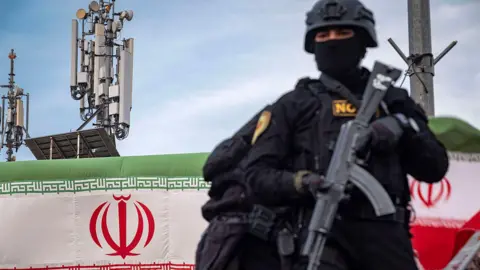 NurPhoto via Getty Images
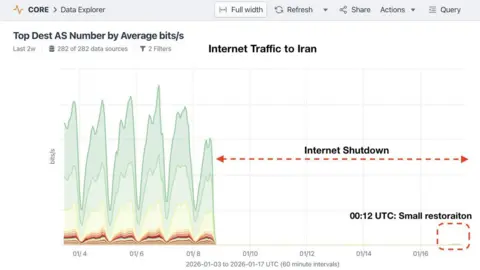
Iran is 10 days into one of the most extreme internet shutdowns in history, with 92 million citizens cut off from all internet services and even disruption to phone and text messaging.
The Iranian government cut off services on 8 January, apparently to stifle dissent and prevent international scrutiny of a government crack down on protesters.
Iranian Foreign Minister Abbas Araghchi said the internet was cut off in response to what he described as externally directed “terrorist operations”.
The government has not said when internet services will return, but new reports suggest that, behind the scenes, the authorities may be making plans to restrict it permanently.
On 15 January, the news website IranWire reported that government spokesperson Fatemeh Mohajerani told journalists that international web access will not be available until at least the Iranian New Year in late March.
Internet freedom observers at FilterWatch believe the government is hastily implementing new systems and rules to cut Iran off from the international internet.
“There should be no expectation of reopening international internet access, and even afterwards, users’ access to international internet will never return to its previous form,” FilterWatch said, citing unnamed government sources.
While the BBC cannot independently verify this report or the timing of its implementation, journalists who spoke to BBC Persian also said they were told that internet access would not be restored anytime soon.
From temporary outage to “communication black hole”
Iran has maintained a tight grip over the internet for many years, with most western social media apps and platforms blocked, as well as external news websites like BBC News.
However many people have managed to access popular apps such as Instagram using Virtual Private Networks (VPNs).
Internet freedom campaigners at Access Now say Iran has consistently used shutdowns as a way to mask mass violence and brutal crackdowns on protesters, as seen during the nationwide internet shutdowns during the November 2019 and September 2022 protests.
 Kentik
A shutdown was also imposed during the Iran-Israel conflict in June 2025.
However, the current blackout has lasted longer than any previous shutdown.
In a public statement, the charity Access Now said that full restoration of internet access is imperative.
“Restricting access to these essential services not only endanger lives but embolden authorities to conceal and evade accountability for human rights abuses,” it said.
Already there are reports that livelihoods in Iran are being badly impacted by the shutdown with e-commerce particularly affected.
As of 18 January, the Human Rights Activists News Agency (HRANA) estimates that more than 3,300 confirmed protester deaths have been recorded, with more than 4,380 cases under review. It also reports that the number of arrests has reached 24,266 across 187 cities.
The real number of people killed and detained is believed to be significantly higher, but the lack of access means the figures cannot be independently verified.
Internet monitoring project, FilterWatch, says that the latest shutdown spells the start of a more extreme “digital isolation” and increased surveillance on what is said, sent and viewed online.
Amir Rashidi, director of cyber security and digital rights at the Miaan Group, which runs FilterWatch, told the BBC he believes the authorities are moving towards a tiered system in which access to the global internet would no longer be automatic but subject to approval.
Access would be granted through a registration and vetting process, he expects, adding that the technical infrastructure for such a system has been in place for years.
Who decides about the Internet?
According to FilterWatch, the plans are not being spoken about publicly, with key decisions increasingly concentrated within security bodies rather than civilian ministries.
Protecting Iran from cyber attacks – of which there have been many high profile and disruptive cases in recent years – may be another motivation for the extreme moves.
However, analysts caution that the plans may not fully materialise or could be applied unevenly due to internal power dynamics and broader economic and technical pressures.
Amir Rashidi notes that risks to internet providers, alongside users’ ability to adapt or migrate to alternative platforms, could further complicate implementation.
 NurPhoto via Getty Images
If Iran goes ahead with the plans being reported on, it will be following similar systems in Russia and China.
China has led the world on internet control not just with enormous state censorship over online discussion but also with what people are able to access abroad.
The so-called Great Chinese Firewall blocks citizens from much of the global internet and all western apps like Facebook, Instagram and YouTube are not reachable without VPNs – but they are also becoming harder to use.
In 2019, Russia began testing for a grand plan to create a similar system dubbed Ru-net.
But unlike China, which built state control into the internet as the web spread decades ago, Russia is having to retrofit state control into complex systems.
Russia is going a step further than China and planning to switch itself off from the world wide web with a “kill switch”, which will apparently be used at times of crisis.
The system will allow internal internet traffic and keep the country moving online but without traffic going outside or in – a digital border in effect. But it has yet to be fully tested.
Where is internet in Iran heading?
If the reports are accurate, it seems that Iran is planning to a quasi combination of permanent Chinese and Russian internet control.
“In Iran there seems to be a move to isolate everyone from any electronic access, unless approved by the government,” said computer security expert Prof Alan Woodward from Surrey University in the UK, after reviewing the reports of Iran’s plans.
He believes the Iranian regime has probably moved ahead with its longer term plans, using the current blackout as a reason to make the technical switches and orders now, whilst everything is cut off.
Amir Rashidi says the question is no longer technical, but political – arguing that whether such systems are fully implemented now depends on political will.
 Mobina / Getty Images
Starlink and other internet-from-space services, known as Low Earth Orbit (LEO), have also complicated control for Iran during the protests.
LEO internet services allow users to get around all censorship and shutdowns by connecting via satellites.
The government was able to jam and interfere with some Starlink users but it has been confirmed to the BBC that other terminals remain operational after the company updated its firmware to bypass government blocking efforts.
The service, which is owned by Elon Musk, also waived subscription fees for Iranian users.
In spite of the increasing tools being used by repressive regimes, Woodward is surprisingly optimistic about the future of internet.
He cites advances in LEO and the fact that many phones can now use satellites even when the internet is down for things like SOS messages.
There are also emerging apps that use mesh networks relying on Bluetooth, which can bring connectivity where there is none.
“Its almost inevitable that internet access will be truly universal eventually but it’ll always be cat and mouse for repressive regimes”, Woodward says.