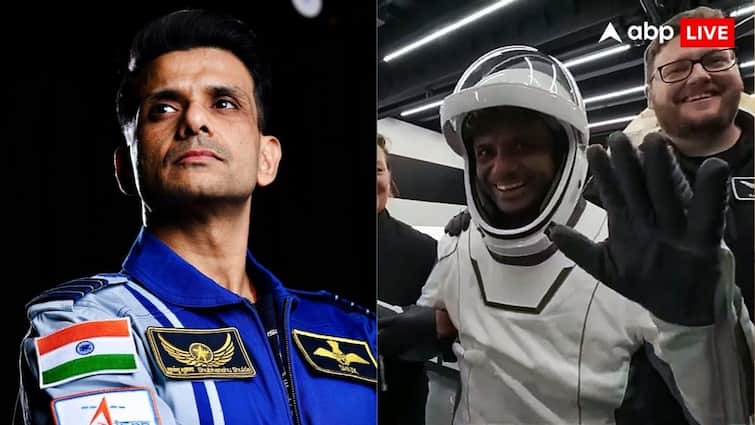

The World’s Largest B2C Book Fair, currently underway at Bharat Mandapam, New Delhi, from January 10 to 18, 2026, continues to serve as a platform for ideas that go beyond literature, drawing audiences to discussions on science, history, and national identity. A major highlight of the fair was a session by Group Captain Shubhanshu Shukla, a fighter pilot of the Indian Air Force and an astronaut, who spoke about his journey from Earth to space and the realities of living in a microgravity environment. Addressing the audience, Shukla reflected on his astronaut training that began in 2020 and shared how nearly a year of preparation shaped his mission. He presented a short film documenting his journey, explaining the objectives of the mission and the scientific work carried out in orbit.
Life, Science and National Pride
Shukla also spoke in detail about conducting experiments in zero gravity, where natural convection does not exist and ventilation becomes critical for controlling carbon dioxide levels. He explained that longer stays in space demand greater physical and mental adjustment after returning to Earth, as gravity significantly affects the human body and emotional balance. Reflecting on the experience of viewing Earth from orbit, Shukla described it as deeply moving and almost divine. He observed that while Earth appears vast and prominent, stars seem smaller due to the absence of Earth’s atmosphere. He also referred to the discussion on 150 years of “Vande Mataram,” linking scientific progress with national consciousness and pride.
During the interactive question-and-answer session, Shukla paid tribute to Rakesh Sharma, India’s first astronaut, noting that more than four decades after Sharma’s historic spaceflight, India has emerged as a confident and capable spacefaring nation. He also spoke about India’s expanding space ambitions and encouraged young people to actively contribute to the country’s future in space science.