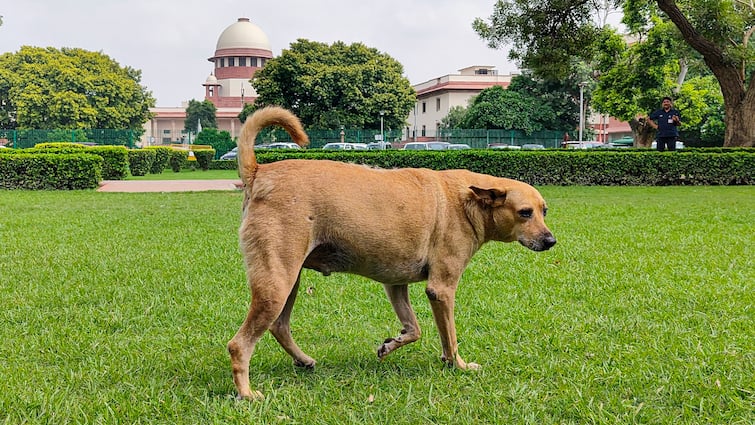

The Supreme Court on Thursday resumed hearings on a batch of petitions filed by animal welfare groups as well as by petitioners seeking stricter enforcement of the Court’s earlier directions on the management of stray dogs. The proceedings focused on clarifying the scope of previous orders and addressing concerns over public safety, animal welfare, and ecological balance.
Removal Directive Applies Only To Institutional Zones
During the hearing, the bench made it clear that its earlier directions had been misread and overstretched. The judges stressed that the Court had never ordered the removal of all stray dogs from public places. Instead, the directive was limited strictly to institutional and sensitive areas, such as hospitals and similar premises.
The bench reiterated that strict compliance with the Animal Birth Control (ABC) Rules remains the cornerstone of the Court’s approach. Emphasising patient safety, the judges posed a pointed question on how many dogs could reasonably be allowed inside hospital wards.
In a lighter moment during the proceedings, the Court observed that “dogs and cats are natural enemies,” remarking that encouraging cats could help control rodent populations—an aside that nevertheless reflected broader concerns about sanitation and disease control.
Call For Better Enforcement, Not New Rules
Senior advocate Vinay Navare, appearing before the Court, clarified that the ABC Rules themselves were not being challenged, but their poor implementation across states was the real issue. He pointed to the so-called “Lucknow model”, which has been cited for its relatively effective handling of stray animal management, and suggested it be replicated nationwide.
Navare argued that local self-governing bodies, including municipal corporations, councils, and village panchayats, must be placed at the centre of enforcement efforts, as per India Today. He also highlighted the need for improved infrastructure to support these bodies. Suggesting a judicial roadmap, he proposed that the Supreme Court could outline an implementation framework, with High Courts monitoring compliance at the state level.
Stray Animal Issue Goes Beyond Dogs
Senior advocate CU Singh broadened the scope of the debate, contending that the issue should not be viewed solely through the lens of stray dogs. He warned that abrupt or blanket removal of dogs often leads to unintended ecological consequences, such as a rise in rats and monkeys, reported Live Law.
Singh explained that rodents—known carriers of multiple diseases—are naturally kept in check by dogs, and that sudden interventions can disturb this balance. Responding to his submissions, the bench reiterated its concern about institutional safety, remarking: “On a lighter note, dogs and cats are enemies. Cats kill rodents, so we should promote more cats and fewer dogs. That would be the solution. Tell us how many dogs you want roaming around in hospital corridors?”
Singh maintained that indiscriminate removal could create a “vacuum effect”, triggering rodent surges and new public health risks. The Court’s observations reflected an attempt to balance animal welfare, public health, and ecological realities, even as it underscored that hospitals and similar institutions must remain protected zones.