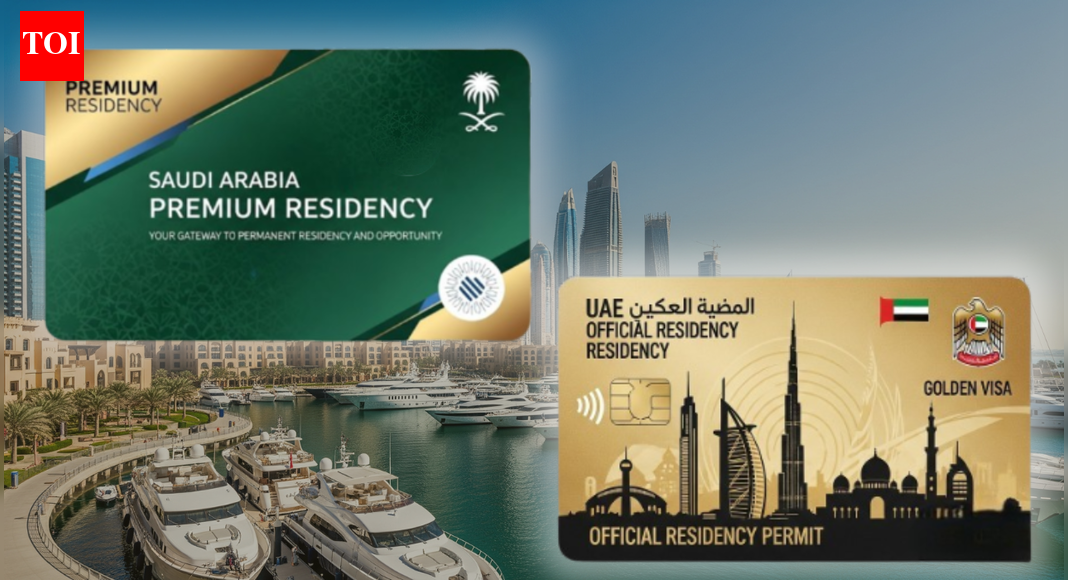

Both programmes offer sponsor-free residency to attract global talent, investment, and long-term economic participation/Representative image
For decades, long-term residency in the Gulf was deliberately elusive. You were welcome to work, invest, and build, but never quite to stay. For a time, that model worked. But as both the UAE and Saudi Arabia began to confront the limits of oil-led growth, it became clear that attracting the world’s best talent and capital would require something more durable: not just opportunity, but status, security, and a package of long-term incentives designed to persuade people to put down roots rather than pass through. The UAE Golden Visa and Saudi Arabia’s Premium Residency (often called the Saudi “Green Card”) are the most serious responses yet to that shift. Introduced in the same year, 2019, they are often compared as competing products. In practice, they reflect two very different models of economic diversification, state control, and lifestyle trade-offs.
Why these programmes were introduced
UAE: Retention in a hyper-mobile economy
By 2018, the UAE faced a paradox of its own making. It had become a global hub for finance, healthcare, technology, logistics, media, and culture, yet the people sustaining those sectors remained structurally temporary, tied to two- and three-year employer visas. That arrangement no longer matched the country’s long-term ambitions.When the Golden Visa launched in 2019, it was framed largely around investment and capital inflows. But between 2021 and 2025, its logic broadened decisively. The programme began prioritising retention over revenue: keeping skilled professionals, stabilising families, and reducing churn among high-value residents. Eligibility expanded well beyond investors to include scientists, creatives, entertainers, digital influencers, and even volunteers working on climate and humanitarian initiatives. The shift reflected a deeper recalibration, away from a purely transactional model and towards building a knowledge-based economy in which contribution, visibility, and expertise carry as much weight as capital. That evolution matters. Today, the programme is less about money alone and more about who contributes to the ecosystem.
Saudi Arabia: Permanence as policy
Saudi Arabia’s Premium Residency was introduced in 2019 as part of the Kingdom’s early Vision 2030 reforms, at a moment when long-term foreign presence was still highly restricted. The programme was designed to remove the traditional sponsorship system and offer qualified expatriates the ability to live, work, and own assets in the country with far greater security than standard residence permits allowed.While initially limited to two pathways, the scheme expanded significantly in 2024 and now covers seven categories, including exceptional competence, recognised talent, investors, entrepreneurs, real estate owners, and both limited- and unlimited-duration residency options. The structure remains more financially anchored than the UAE’s Golden Visa, with clear monetary thresholds for permanent or annual status, but it has begun moving in a similar direction—using residency as a tool to attract expertise, enterprise, and long-term participation rather than short-term labour. Compared with the UAE, Saudi Arabia’s approach is narrower in eligibility but deeper in permanence, signalling a gradual shift towards long-term settlement rather than mobility alone.
Eligibility: Breadth vs depth
UAE Golden Visa: Broad and modular
As of 2025, the UAE Golden Visa officially covers 12+ eligibility categories, many of which do not require capital investment at all. Key routes include:
- Investors
- Real estate investment of AED 2 million (≈ USD 545,000)
- Can be one property or multiple, mortgaged under conditions
- Entrepreneurs
- Business or startup with minimum capital around AED 500,000 (≈ USD 136,000) or approved incubator backing
- Highly skilled professionals
- Doctors, scientists, engineers, AI specialists, senior executives
- Often salary-based (typically AED 30,000–50,000/month, ≈ USD 8,200–13,600), no capital required
- Creatives and cultural figures
- Artists, filmmakers, writers, designers endorsed by UAE cultural bodies
- Content creators and digital professionals
- Expanded significantly in 2024–2025
- Outstanding students and graduates
- From top global or UAE universities
- Humanitarian workers and volunteers
- A notable shift away from purely economic logic
Saudi Arabia Premium Residency: Narrower but more final
Saudi Arabia’s programme is more selective and financially explicit. Options include:
- Permanent Premium Residency
- One-time fee: SAR 800,000 (≈ USD 213,000)
- Annual Premium Residency
- SAR 100,000 per year (≈ USD 26,700)
- Category-based pathways (expanded in 2024)
- Exceptional competence (scientists, researchers, senior specialists)
- Talent (culture, sports, arts, requires ministerial endorsement)
- Investor / entrepreneur
- Real estate owner
- Limited- and unlimited-duration variants
There is no formal minimum investment, but income, assets, and background checks are stringent. Financial independence is assumed.
Residency length, renewal, and absence rules
UAE Golden Visa
- Valid for 5 or 10 years, renewable
- No local sponsor required
- No minimum stay requirement
- Can remain outside the UAE for extended periods without cancellation
- Renewal depends on maintaining eligibility (investment, salary, or status)
- Path to Citizenship: Residency of 30 years may lead to citizenship, with accelerated consideration for exceptional service.
Saudi Premium Residency
- Permanent option: lifetime status, no renewal
- Annual option: renews yearly with fee
- No sponsor required
- Extended absence can affect some privileges, but status remains intact for lifetime holders
In practical terms, the UAE model suits residents who need mobility and extended time abroad, while Saudi Arabia’s structure is designed for those planning to base themselves in the Kingdom long term.
Taxation: Individuals, businesses, and structures
Personal tax (both countries)
- 0% personal income tax
- No tax on foreign-sourced personal income
UAE: Business and investment tax
- Corporate tax: 9% on profits above AED 375,000 (≈ USD 102,000)
- Over 40+ free zones, many offering:
- 0% corporate tax on qualifying income
- 100% foreign ownership
- Simplified compliance
- No capital gains tax
- No inheritance or wealth tax
Best suited for: Founders, consultants, remote businesses, international holding structures.
Saudi Arabia: Business tax reality
- No tax on employment income
- Corporate tax or zakat applies depending on ownership structure
- VAT at 15%, materially higher than UAE’s 5%
- Strong incentives for companies aligned with Vision 2030 sectors
Best suited for: Businesses operating inside Saudi Arabia rather than globally from it.
Property and business ownership
UAE
- Freehold property ownership in designated zones
- Mature mortgage and resale market
- 100% foreign ownership in most sectors
- Free zones ideal for international operations
- Easy sponsorship of employees and domestic staff
Saudi Arabia
- Property ownership permitted for Premium Residency holders
- Restrictions remain in Makkah and Madinah
- Access to large-scale development projects (NEOM, Red Sea, Qiddiya)
- Full business ownership without local sponsor
- Greater access to government-linked opportunities
Families, education, and daily life
UAE
- Extensive international schooling (IB, British, American, Indian curricula)
- Private healthcare with global standards
- English widely spoken
- High cost of housing and schooling, especially in Dubai and Abu Dhabi
- Highly multicultural, low-friction living
Saudi Arabia
- Rapidly expanding international schools, especially in Riyadh and Jeddah
- Strong public and private healthcare
- Larger homes, lower rent in many areas
- Lifestyle varies significantly by city
- Increasing entertainment, culture, and public life since 2019
Cost of Living (Indicative)
| Category | UAE (Dubai/Abu Dhabi) | Saudi Arabia (Riyadh/Jeddah) |
|---|---|---|
| Rent (family apartment) | High | Moderate |
| Schooling | Very high | High but improving |
| VAT | 5% | 15% |
| Transport | Moderate | Lower |
| Healthcare | Private, costly | More affordable |
So which one makes sense?
The UAE Golden Visa makes sense if you:
- Want flexibility over permanence
- Run international or remote businesses
- Value ease of travel, English-first systems, and global connectivity
- Prefer multiple entry routes without locking up capital
Saudi Premium Residency makes sense if you:
- Want long-term certainty or lifetime status
- Intend to base yourself primarily in Saudi Arabia
- Plan to invest or operate locally at scale
- Are comfortable with higher upfront commitment in exchange for permanence
Market demand: what’s driving uptake
Demand for long-term residency in the UAE continues to be driven by stability, zero personal income tax, and the ability to live and work independently of an employer. More than 200,000 Golden Visas approved by 2025 reflect sustained interest from professionals, entrepreneurs, and families, many of whom qualify through non-investment routes and use the visa as a foundation for business formation and property ownership. Saudi Arabia’s Premium Residency shows a different but growing pattern of demand. Over 40,000 applications were submitted in an 18-month period, with more than 8,000 permits issued in 2024. Most approvals have gone to applicants in the Exceptional Competence category, indicating strong interest from senior professionals rather than purely capital-led applicants. The lifetime residency option, sponsor-free status, and rights to own businesses and property continue to attract individuals planning long-term residence inside the Kingdom. Go to Source