


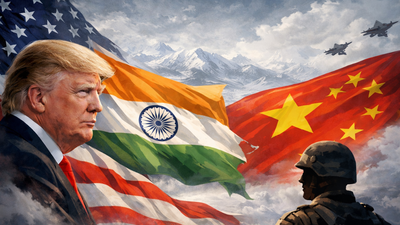
Image created with help of AI
Driving the newsThe Donald Trump administration’s 2025 National Security Strategy (NSS) doesn’t just chart a course-it redraws the map. Released quietly at night, the 29-page document abandons decades of bipartisan foreign-policy orthodoxy in favor of a singular, transactional view of global power-and puts India at the crossroads.In this Trumpian worldview:
- Allies are burdens.
- Values are luxuries.
- Power must be unilateral.
India is named four times-and each time, the ask is clear: Contribute more, align more, expect less.“We must continue to improve commercial relations with India to encourage it to contribute to Indo-Pacific security, including through the Quad with Australia and Japan.”The NSS 2025
Why it mattersThe 2025 NSS is Trump’s clearest articulation of “America First” applied globally-a strategy driven not by alliances or ideology, but by leverage, deterrence, and self-interest.Plus, the new National Security Strategy is the clearest statement yet of how Washington sees power shifting in the Indo-Pacific.
IPL Auction 2026
China is the central competitor. The Indo-Pacific is the primary theater. Trump’s NSS also shows deep nostalgia for 19th-century power politics. It invokes the Roosevelt Corollary to the Monroe Doctrine, warning Latin America not to allow “hostile foreign ownership” of key assets. It praises “Western identity” and warns that some Nato members may become “majority non-European”—a line critics say reeks of racial nationalism. “Certain Nato members will become majority non-European. It is an open question whether they will view their alliance with the US in the same way.”The big picture: The two-front contest with ChinaThe NSS breaks the China challenge into two interlocking priorities:1. Rebalance the economic relationship-using tariffs, industrial policy, and supply chain realignment.2. Maintain credible military deterrence in the Indo-Pacific to prevent conflict.The goal, per the document: a “virtuous cycle” where economic discipline funds long-term defense strength, and military stability creates space for harder economic measures.India sits at the intersection of both goals. It is one of the few countries that:
- Can match China’s geographic and demographic scale.
- Offers manufacturing and investment alternatives.
- Shares an interest in freedom of navigation and supply chain resilience.
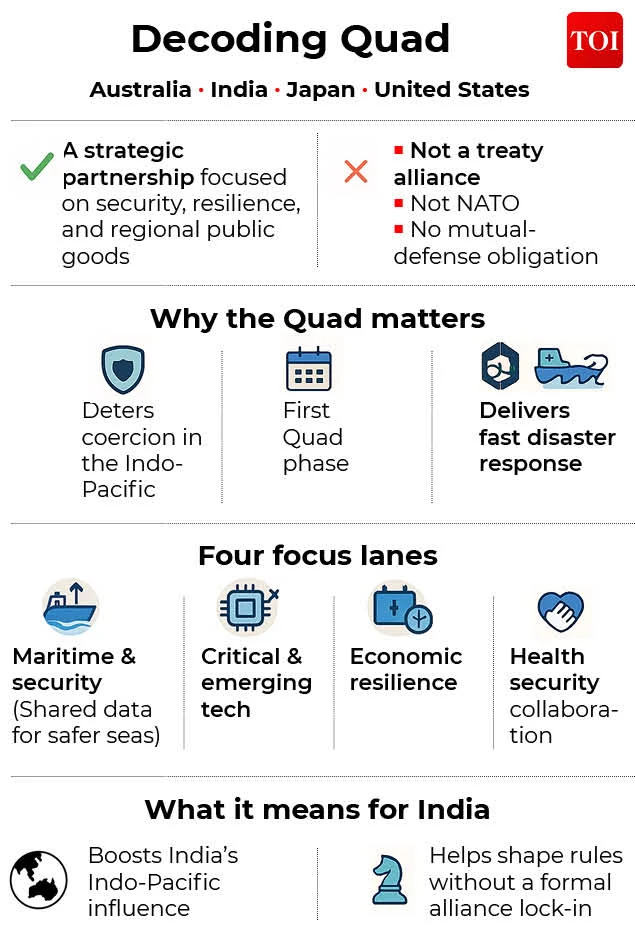
This isn’t diplomacy for diplomacy’s sake. India is now a strategic node in an integrated effort to restructure power in Asia-militarily, economically, and technologically.Zoom in: Quad as an action platform, not a talking shopBy naming the Quad as a vehicle for India’s expanded security role, the strategy treats the grouping as a real mechanism, not a slogan.India’s role in the Quad (with Australia, Japan, and the US) gets specific attention in the strategy. The message: this is not about feel-good alignment among democracies-it’s about concrete strategic coordination.The NSS views the Quad as:
- A regional security multiplier, especially in maritime surveillance and logistics.
- A counterweight to China’s dominance in chokepoints, including the South China Sea and Indian Ocean.
- A framework to deepen tech and defense coordination, without requiring a formal alliance.
Importantly, the US accepts that India will avoid alliance language. But Washington still wants interoperability, joint awareness, and shared capability development.The maritime logic: India in the South China SeaOne of the most pointed passages in the NSS warns of the risk of Chinese coercion in sea lanes: “Control over the South China Sea would allow a competitor to impose de facto tolls or threaten closure of vital global commerce routes.”It adds: Addressing this threat will require cooperation from all affected nations-“explicitly including India.”Why it’s notable:
- It recognizes India as a maritime player, not just a continental one.
- It reframes sea-lane control as an economic security issue, not just a military one.
- It suggests India’s strategic geography and naval presence (especially in the Andaman and Nicobar region) is integral to the Indo-Pacific security architecture.
This marks a paradigm shift. In Donald Trump administration’s view, India is no longer just guarding its own neighborhood-it’s involved in shaping regional order.Between the lines: Tech, minerals, and ecosystemsA long section of the strategy links deterrence to economic and technological primacy. The NSS defines future military power through economic and technological strength-naming:
- AI
- Quantum computing
- Autonomous systems
- Space and undersea capabilities
- Nuclear deterrence
India is seen as a potential partner in building trusted ecosystems, not reliant on China. The logic: the US wants to de-Sinicize the global innovation stack, and India could help build a non-Chinese infrastructure of trust.The document also makes explicit reference to critical minerals and influence in Africa, noting that:“The US should enlist European and Asian allies and partners, including India, to secure access and shape norms.”Translation: India isn’t just a regional actor-it’s part of a global coalition effort to compete with China across emerging markets, tech governance, and strategic resources.India and the Global South: Opportunity-and pressureThe NSS notes that China’s exports to low- and middle-income countries doubled between 2020 and 2024-and now surpass exports to the US.Why it matters for India:
- India also seeks to expand in the Global South, including Africa, Southeast Asia, and Latin America.
- The US effort to diversify supply chains offers a potential investment windfall for Indian manufacturing.
- But it also means more alignment pressure from Washington-especially on:
- Tech standards
- Export controls
- Transshipment enforcement
India may find itself pushed to take sides, particularly as Chinese platforms become more embedded in third-country markets.Strategic ambiguity meets shrinking spaceIndia has long practiced strategic autonomy, balancing ties with the US, Russia, China, and others.But the NSS implies that ambiguity is becoming costly. Washington is constructing:
- Technology alliances
- Critical-mineral blocs
- Security coalitions
And India is expected to be part of them, even without a treaty.The NSS’s tone suggests a “coalition of the willing” model-with partners taking on real commitments, not just symbolic ones. And India is no longer outside that circle.Burden-sharing: India’s special status-and subtle askUnlike Japan or South Korea, India is not a treaty ally and does not host US bases. The NSS accepts that.But the broader message is clear: the US military “cannot, and should not have to, do this alone.”India is likely to be spared the hardest asks-no troop hosting or treaty obligations. Still, Washington will watch:
- India’s naval activism
- Its defense procurement choices
- Its cooperation on maritime domain awareness
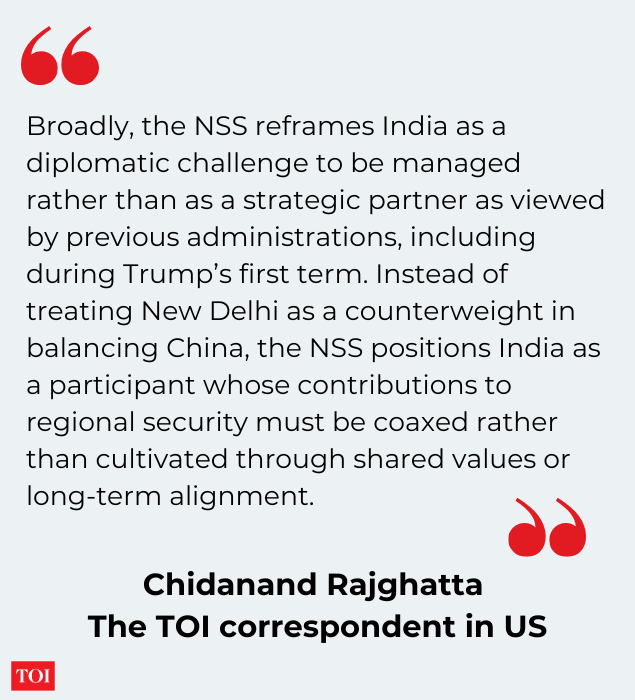
The NSS sets the tone: Shared threat, shared responsibility-even without shared treaties.What they are sayingThe Economist warns the NSS is a “dog’s breakfast” of contradictory impulses—“muscular without being hawkish, restrained without being dovish”—and dangerously dismissive of long-term allies.
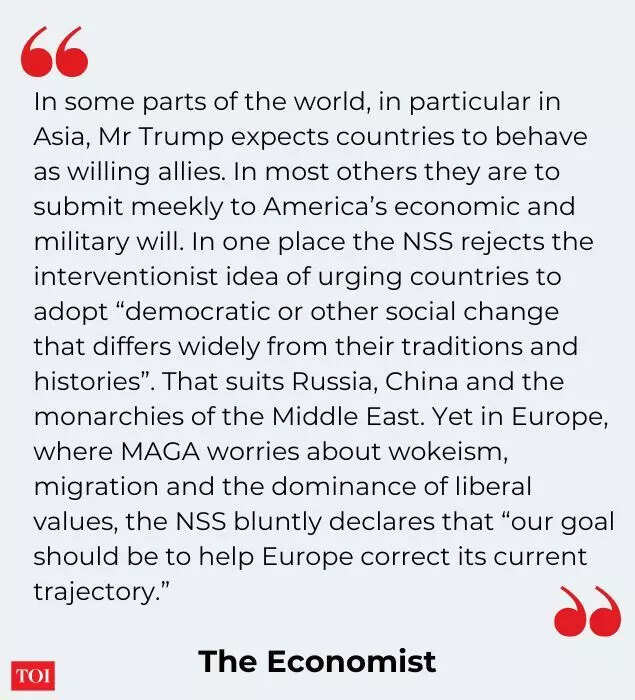
Chidanand Rajghatta calls the document a “hard pivot toward unilateral action” that turns India from a partner to a pressure point, noting the irony of Washington asking more from India while punishing it with tariffs.
MAGA hardliners lament there’s no mention of Islamic terrorism; liberal critics decry the NSS’s silence on authoritarianism in China, Russia, Iran, or North Korea.Nato allies privately worry the document is the first step to US withdrawal from the alliance—a fear stoked by Trump’s past threat to “encourage Russia” to attack freeloading Nato members.Trade and tariff friction: The unresolved tensionThe NSS’s “America First diplomacy” leans hard into tariffs and reciprocal trade. While it promotes deeper US-India commercial ties, it doesn’t promise a smooth path.That creates a familiar dilemma for New Delhi:
- How to partner with the US on security…without accepting unlimited economic concessions or tech restrictions?
The NSS hints that strategic alignment will increasingly shape market access. That could put India in a tight spot-especially if it wants tech access but not tech alignment.What India can take from this strategyFour key signals emerge:1. India is named-clearly-as a strategic asset. Not just a regional actor, but a necessary component of a larger China-balancing architecture.2. Maritime security is moving to center stage.India’s role in sea-lane protection and freedom-of-navigation missions is now strategic, not optional.3. The tech-minerals-economic triangle matters. India is expected to help shape the future of global production and standards-especially outside China’s orbit.4. The US expects quiet alignment-even without alliance.India won’t be asked to sign treaties. But it’s being asked to act like an ally.What’s nextWatch for:
- Quad military exercises to expand scope and geography
- Indo-US joint ventures in critical tech sectors
- Pressure on India to reduce Russian defense ties
- Bilateral discussions on maritime domain awareness
- Washington lobbying New Delhi on export controls and chip alignment
Don’t expect:
- A formal alliance
- US bases in India
- A rollback of tariffs without strategic concessions
The bottom lineThe NSS is a mirror: it reflects Trump’s belief that alliances are transactional, values are optional, and burden-sharing is overdue.The question isn’t whether India will align-it’s how far it can go without losing strategic independence.America First may not mean America Alone—but under Trump’s NSS, India has been drafted. And the fine print says: “Help us win, or step aside.”(With inputs from agencies) Go to Source