
Source: European Space Agency
With the spectacular ability of the James Webb Space Telescope, the earliest ever-known supernova was tracked back to the very dawn of the universe. This supernova is, in fact, the first in a long time observational window into the infant universe and thus serves as the best direct evidence scientists have ever had for the harsh and short lives of the first stars. Some of the stellar explosions can be seen to have paved the way for the chemical evolution of the very young galaxies and based on them, the whole universe has become the environment where new stars, planets, and life could occur. By detecting the tiny and subtle changes in brightness that are the hallmark of the final stage of a giant star’s collapse, Webb has brought the details of the process where the earliest stars died right up to our doorstep and is already changing the current models of universe evolution.
What this early supernova looked like when its star died
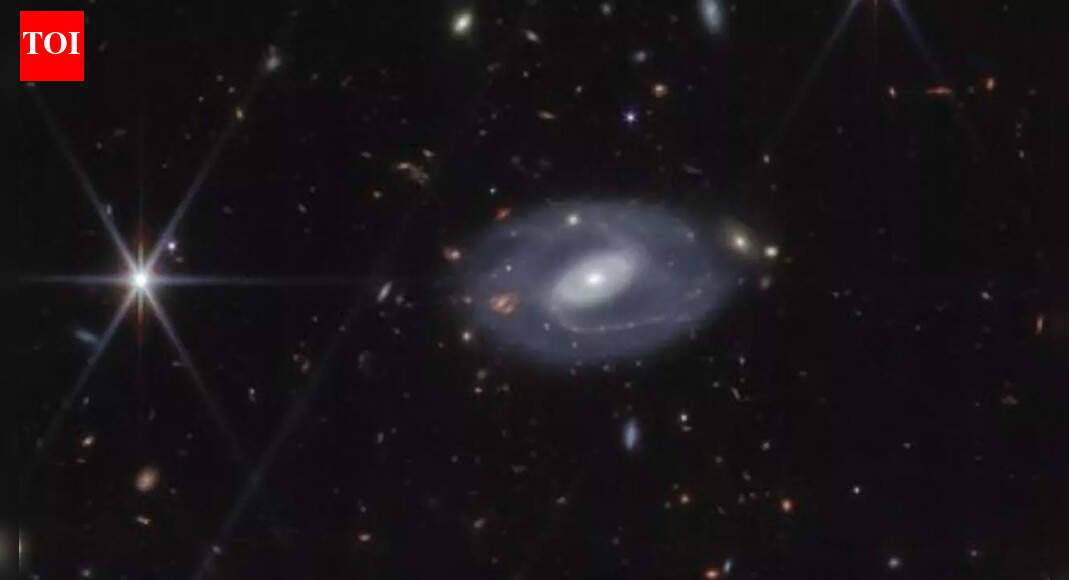
The deep space explosion was found in a small galaxy that existed during the first billion years after the Big Bang, a time when, due to the presence of large amounts of cold gas, intense formation of new stars was taking place in the universe. In those youthful days of the universe, the heavy, huge stars were produced in no time, had a fleeting existence and went out in a blazing manner, thus changing the places where they lived. Using the near-infrared cameras of the James Webb telescope, astronomers were able to spot the barely perceptible light variations between two sets of observations, thus making it possible for them to figure out the light fading sequence of the stellar explosion that happened a long time ago. Scientists, however, were not witnesses to the actual event since the explosion happened billions of years ago; thus, they had to assemble the signature of the event by looking at how different parts of the galaxies varied with time. In doing so, they could single out the light coming from the supernova remnants over the background of the stellar light. This has helped scientists to understand the first massive stars better, grasp their life span and know how their dead bodies led to the rise of the interstellar medium in their galaxies.
What the fading light tells us about the star that exploded
As per the research and the report of the European Space Agency, the team working on this project attributed the observation made by the NIRCam instrument on Webb to a core collapse supernova which led to the most significant drop of light. The scientists, while explaining their findings, only refer to one paper, and they state that the recorded light drop pattern is the closest to the theoretical predictions of an explosion in a young environment with low metal content. The star that caused the supernova seems to have been extremely large and consequently, it ran out of its nuclear fuel very fast and then it collapsed under its own weight. The resulting outbreak of energy propelled the heavy metals to far and wide region, at the same time, a dispersing cloud of the material was left behind which was what Webb detected through its changing brightness. The research posits that these giant stars could have been the norm rather than the exception in the early universe thus the implication would be that the young galaxies would have had lots of such events which were both frequent and energetic and in turn contributed to their internal development. This understanding sheds more light on the question of how the very first heavy elements including those that are necessary for rocky planets and complicated chemistry made their way into the universe.
Why the galaxy around the supernova matters so much
Being acquainted with the features of the host galaxy helps to figure out the vital point of the discovery. The galaxies at that time were producing stars at a rate which was a lot more than the average rate that can be observed in today’s universe if they are dependent on gas that is almost in its natural state and has not been enriched as a result of the constant cycle of star birth and death. The observations tell the story that the galaxy where the supernova occurred was small, tightly packed and very lively, thus it was pretty much in line with the theoretical models of the behaviour of early galaxies. Those kinds of surroundings would have been the sources that generated large numbers of short-lived, very massive stars, each of them capable of bringing about explosive events that would have caused the gas to stir, gravitational structures to change and the speed of the new star formation to be affected. By studying the place of the supernova and the things around it astronomers get a more vivid image of the conditions the stars which are light years away and existed in ancient times had and the ways these conditions were formed. The event, consequently, serves as a picture of a crucial epoch when galaxies had not yet grown fully and were figuring out the way to their tomorrow.
Why this discovery rewrites the timeline of the young universe
The finding is a stepping stone towards the extensive work of outlining the universe’s growth from its earliest phases to the large-scale structures we can see these days.Supernovae are one of the major factors behind such a change as they are the sources of heavy elements needed for forming planets, organic molecules, and complex chemistry. The closer to the beginning of the universe these explosions are, the sooner did galaxies start to put the elements into the new generations of stars. By revealing such a far-off event, Webb proves that the cycle of star birth and stellar death was one of the factors that led to cosmic evolution quite early. That, in turn, enables scientists to reposition the speed at which the enrichment occurred, and also the models of how turbulent early galaxies might have been and how matter was able to spread across the young systems so quickly. The present discovery is also a message that more of such ancient supernovae may come to light, and therefore the record as to the earliest known phenomena may become even more distant from the universe’s beginning.Later on, observations taken from various angles as per Webb’s data will probably reveal a multitude of primordial starbursts that will, in turn, shed light on how the first bright structures influenced their environment and contributed to the cosmos that superseded.Also Read | Why you may spot extra suns on cold mornings: What sun dogs are and how they form Go to Source