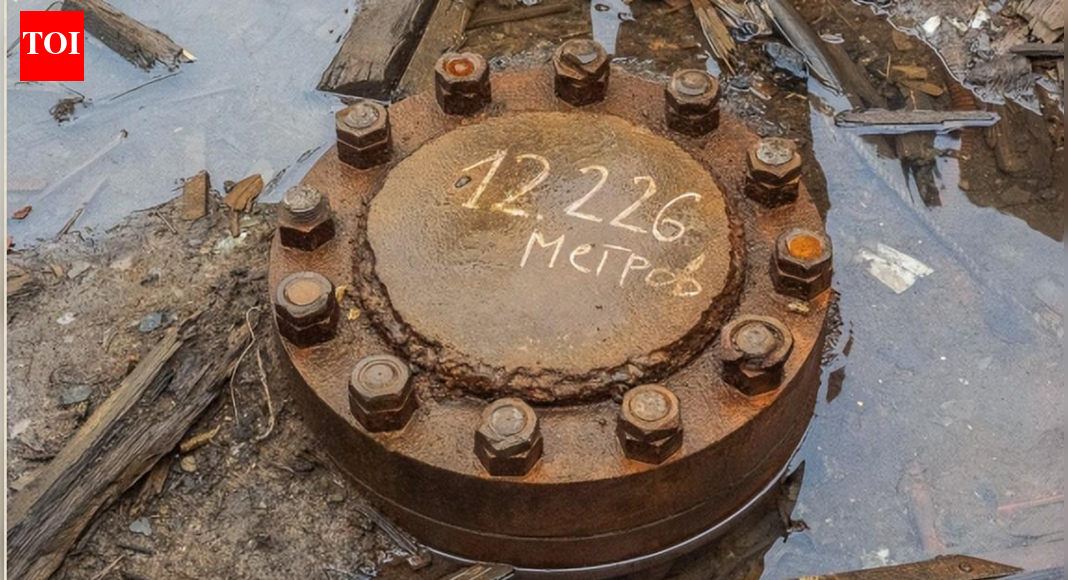

The once-deepest hole now sits sealed shut under an unimpressive metal cap, surrounded by rusted bolts and debris/ Image: Mr. Nobody Medium
During the space race, the US and the USSR were busy firing rockets into the sky. At the same time, out on Russia’s Kola Peninsula near the Norwegian border, Soviet engineers were doing something much stranger: drilling straight down. While their cosmonauts chased orbit, their geologists chased the centre of the Earth, and ended up with the deepest man-made hole in history, later sealed with what looks like an ordinary metal manhole cover in a scrap-strewn yard. That hole is the Kola Superdeep Borehole. It goes so far down that Mount Everest and Mount Fuji stacked on top of each other would still come up short, and yet, in planetary terms, it barely scratches the surface. So why did the Russians dig it, what did they find, and why did they finally give up and bolt it shut?
A Cold War race, but aimed at the ground
The idea of drilling deep into Earth wasn’t uniquely Soviet. In 1958, American scientists launched Project Mohole, an ambitious plan to drill through the seabed off Guadalupe Island, Mexico, to reach the mantle. Backed by the US National Science Foundation, they managed about 601 feet (183 metres) into the ocean floor before Congress pulled the funding in 1966. The Soviets picked up the baton in 1970. Their deep-drilling site at Kola, in the far north of Russia near the Barents Sea, was meant to be the flagship of a new scientific effort: if you can’t go to the centre of the Earth, at least get closer than anyone else. Dr Ulrich Harms, director of the German Scientific Earth Probing Consortium, has visited the site, handled the core samples and even laid a hand on the now-defunct wellhead. The purpose, he says, was simple in theory and huge in scope: “to address key scientific questions” about how our planet is built and behaves, from earthquakes and volcanic activity to the evolution of the crust and the conditions that shaped early life.
How deep is “the deepest hole in the world”?
Visually, Kola is deeply unimpressive. The drilling rig and buildings are gone; what’s left is a small blue-and-white steel cap set into concrete, surrounded by rubble and rust. Under that lid is the real story: a borehole just 9 inches (23 centimetres) wide that drops about 40,230 feet (12,262 metres) straight down, roughly 7.6 miles (12.2 kilometres).
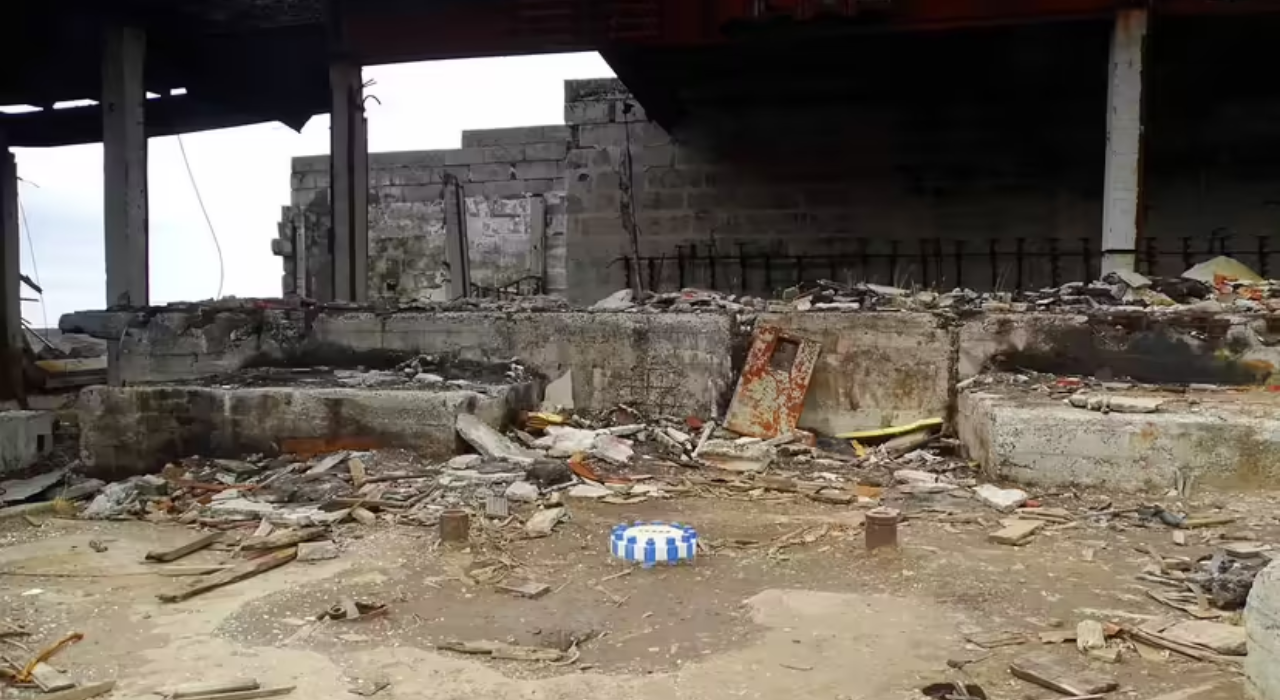
The small blue-and-white cap seen surrounded by rubble is all that seals the Kola Superdeep Borehole, which extends 40,230 feet (12,262 meters) deep. Wikimedia/(CC BY-SA 4.0)
For comparison:
- The Mariana Trench, the deepest part of the ocean, is about 36,201 feet (11,034 metres) below sea level.
- Mount Everest is around 29,000 feet tall; add Mount Fuji on top and you’re roughly in Kola territory.
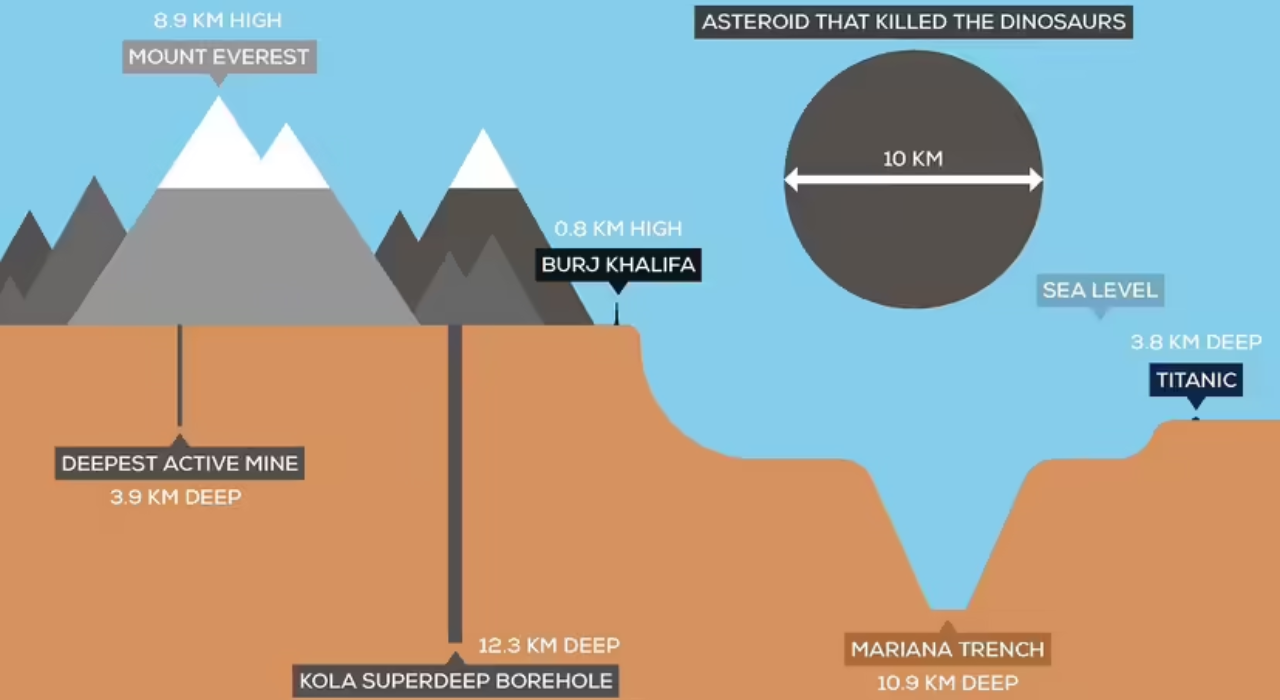
The Kola Superdeep Borehole in Russia is the deepest hole in the world. It’s deeper than the Mariana Trench and deeper than Mt. Everest is tall. Simon Kuestenmacher
And yet, in planetary terms, it’s nothing. The continental crust under our feet is about 25 miles (40 kilometres) thick. Beneath that sits the mantle, stretching another 1,800 miles (about 2,900 kilometres) down. Then comes the outer core, about 1,400 miles (2,250 kilometres) thick, before you finally reach the inner core, a dense, mostly iron sphere with a radius of about 758 miles (1,220 kilometres). Kola, for all its engineering bravado, pierced only about a third of the local crust, and roughly 0.2 percent of the way to Earth’s centre.
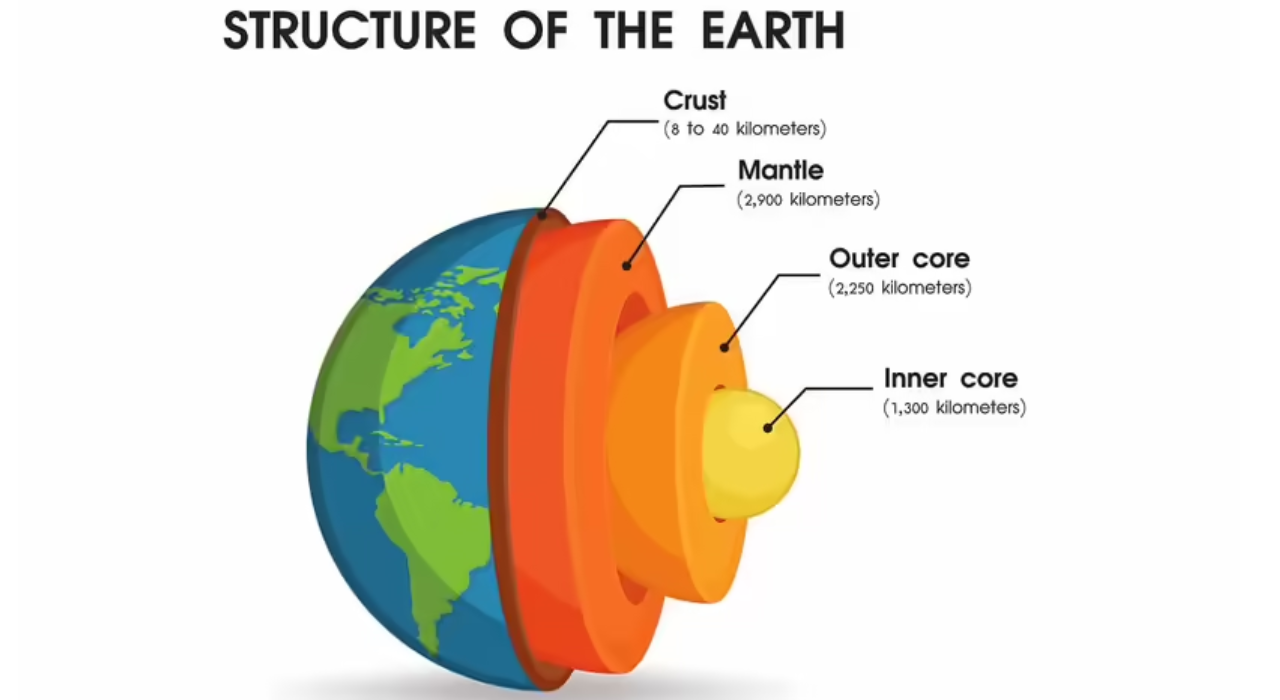
Despite drilling to a depth of more than 40,000 feet (12,192 meters), researchers barely scratched the surface of Earth’s crust.CRStocker/Shutterstock
Drilling started on 24 May 1970. By 1979, the Soviets had already broken the world depth record at around 9.5 kilometres. In 1989, they hit their maximum: 12,262 metres. They never got any deeper.
Why drill that deep at all?
Most very deep holes exist for money: copper, diamonds, oil, gas. The Bingham Canyon Mine in Utah is a three-quarters-of-a-mile-deep copper pit; the Kimberley “Big Hole” in South Africa is one of the largest hand-dug diamond excavations on Earth. Kola, by contrast, was pure science. Projects like this help researchers:
- Study geohazards such as earthquakes and volcanic eruptions by getting instruments as close as possible to active fault zones.
- Understand geo-resources like geothermal heat and deep fluids.
- Reconstruct Earth’s history, including environmental changes and how life evolved.
As Harms puts it, having a borehole into active or formerly active zones lets scientists monitor “the initiation and propagation of even the tiniest earthquake in response to stress and strain” in real rock, at real depth, something that lab experiments and computer models can only approximate. The Kola cores also offered a one-of-a-kind archive: continuous rock samples from progressively deeper layers of the crust, each carrying clues about pressure, temperature, fluids and past conditions.
Why the Soviets had to stop
If we can fling spacecraft billions of miles into interstellar space, Voyager 1 has travelled more than 14 billion miles since 1977 — why did Kola stall at a mere 7.6 miles? Because digging down turns out to be much harder than flying up. At first, the rock cooperated. The drill chewed through shallow granite relatively easily. But at around 4.3 miles (6.9 kilometres), things changed. The rock became denser, more fractured and mechanically awkward. Drill bits broke. Sections collapsed. Engineers had to restart from higher up and adjust the trajectory several times, producing a branching pattern that geologists later compared to a Christmas tree. The deeper problem, literally, was heat. The temperature increase, the geothermal gradient matched predictions down to about 10,000 feet (3,048 metres). Deeper than that, the numbers climbed much faster than expected. At around 12 kilometres, the temperature wasn’t the forecast 100°C (212°F); it was closer to 180°C (356°F). At the same time, the rock wasn’t behaving as a rigid, dry block. Below about 4,500 metres, the crust proved far more porous and permeable than expected. Under intense heat and pressure, it started to act less like brittle stone and more like a slowly deforming plastic. That’s a nightmare for borehole stability and for any drill string designed for cooler, more cooperative conditions. The equipment simply wasn’t built to cope. The Soviets kept trying until the early 1990s, but the combination of extreme temperatures, unstable rock and the collapse of the USSR itself finally killed the programme. In 1992, drilling stopped for good. In 2005, the site was shut and the hole was sealed under that heavy, bolted steel cap. Other deep scientific holes, in Germany, Austria, Sweden and elsewhere, have since been drilled, some longer because they deviated from vertical, but none deeper.
What did they actually find down there?
Despite never reaching the mantle, Kola rewrote parts of the geology textbook. 1. The missing granite–basalt boundary Seismic studies had suggested a transition inside the crust, called the Conrad discontinuity, where upper granite gives way to denser basalt. Drillers expected to see this in the cores. They didn’t. The rock stayed largely granite-like far deeper than models suggested, forcing geologists to rethink how they interpret seismic reflections and what that boundary really represents.
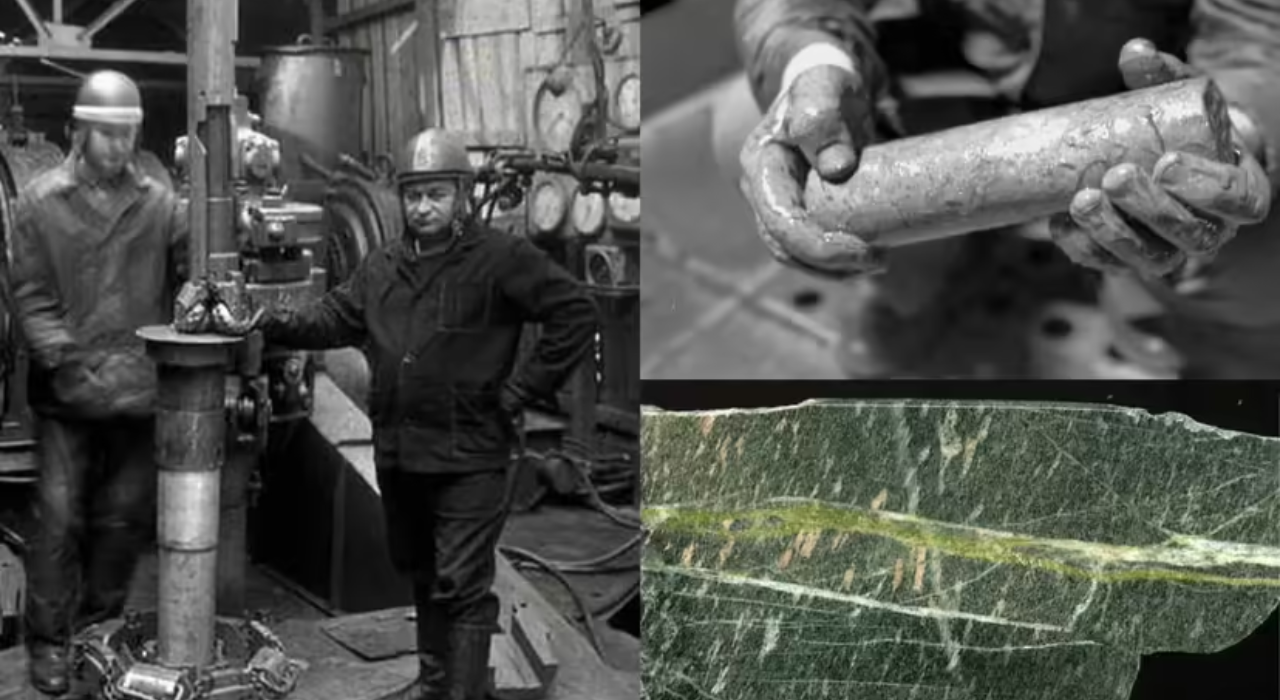
(Clockwise from left) Workers in the drill room; a piece of core extracted from the Kola well; a piece of metabasalt rock from 6,238.25 meters (20,465 feet) deep in Earth’s crust. Pechenga
2. Water where no water “should” be Researchers also found liquid water in salty, fluid-filled cracks miles below the surface, far deeper than conventional wisdom allowed. As Harms notes, the open, saline, water-filled fractures showed that the deep crust isn’t a solid, sealed block, but a network of pathways where fluids can still move. The likely explanation is that water was squeezed out of minerals under immense pressure and trapped in these fractures. 3. Ancient microscopic fossils At around 7 kilometres (4.4 miles) down, scientists found microscopic fossils of single-celled marine organisms encased in organic compounds. They were about 2 billion years old, yet still recognisable despite the crushing pressures and high temperatures. That discovery pushed evidence of biological material deeper into the crust than many had expected and added a striking data point to debates about how and where early life persisted. If Kola never touched the mantle, it still showed that the crust is hotter, more complex, wetter and more biologically storied than early models suggested.
Can we dig deeper, and will anyone try?
In principle, yes. Harms says drilling beyond 12 kilometres depends on two big constraints: temperature, and borehole stability under stress, strain and the chemistry and weight of drilling fluids. Future tools would have to survive temperatures approaching 250°C (500°F) and cope with rock behaving more like slowly flowing plastic than clean, crack-free stone. The true dream target is the mantle itself, starting roughly 25 miles (40 kilometres) down beneath continents and shallower beneath ocean crust. Reaching it would finally give scientists “in situ” samples from the boundary known as the Moho discontinuity, the zone where crust and mantle meet, magmas rise, fluids migrate and key parts of Earth’s long-term evolution are still poorly understood. We’re not there yet, but the story hasn’t stopped. In 2021, Japanese researchers with the International Ocean Discovery Program drilled the deepest ocean hole in the crust to date, reaching about 26,322 feet (8,022 metres) beneath the seabed, still shy of Kola’s record, but part of the same long, slow effort to turn guesses about Earth’s interior into hard data. As for the Kola Superdeep Borehole, it remains sealed under that unremarkable metal lid in the Arctic, a Cold War relic, a scientific milestone, and a reminder that for all our rockets and satellites, the ground beneath our feet is still, in many ways, unexplored. Go to Source