
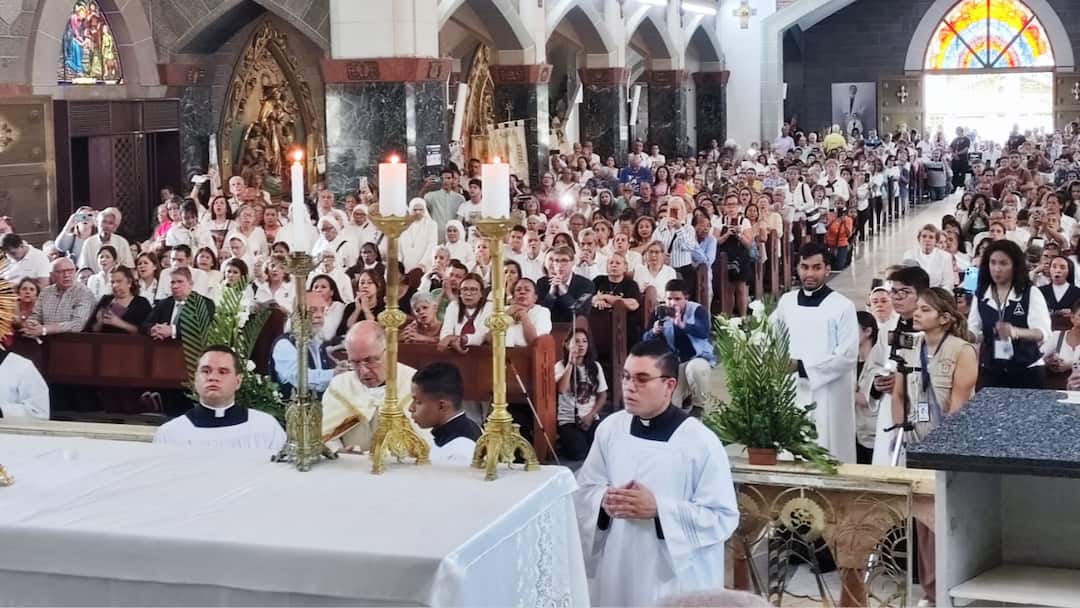

As Venezuela remains at the centre of intense global political attention, public interest is rapidly growing not only in the country’s leadership and power struggle but also in its deeper social fabric. In a nation where religion is closely woven into everyday life, political instability does not stay confined to government corridors. It influences religious institutions, community relationships, and the delicate social balance that binds Venezuelan society together. This has sparked widespread curiosity about Venezuela’s religious composition and the role faith plays during times of national uncertainty.
ALSO READ: Why Venezuela Is Known As The Land Of Beauty Queens: From Miss Universe Triumphs To Global Headlines
Venezuela’s Dominant Religion
Christianity is the most widely followed religion in Venezuela, with Roman Catholicism representing the largest share. An estimated 65 to 70 percent of the population identifies as Catholic. While many citizens may not be actively practising, Catholic traditions continue to hold strong cultural significance across the country.
Venezuelan President Nicolás Maduro comes from a Roman Catholic background. He was born into a Catholic family and publicly identifies as a Christian.
The Historical Role Of The Catholic Church

The roots of Catholicism in Venezuela date back to the Spanish colonial era. For centuries, the Church played a vital role in shaping the country’s education system, healthcare services, and social development. Schools, hospitals, and welfare institutions were long supported by church networks.
However, over the past few decades, political confrontations and shifting social dynamics have reduced the Church’s direct influence compared to its historic reach.
Protestant And Evangelical Growth
Around 10 to 17 percent of Venezuela’s population belongs to Protestant Christian groups, with Evangelical churches experiencing particularly rapid growth. Many families who were once Catholic have gradually transitioned into Protestant congregations.
These communities actively strengthen their presence through social programmes and religious gatherings. Their relationship with the government, however, has often been strained.
Muslim Community In Venezuela
Though small in number, Venezuela’s Muslim population is considered well-organised and socially influential. Approximately 100,000 Muslims, about 0.4 percent of the population, live in the country. Most trace their origins to Lebanon and Syria, whose ancestors migrated during the 20th century in search of trade and employment opportunities.
Where Muslims Live And What They Do

The Muslim community is mainly concentrated in Caracas and Nueva Esparta. These areas host mosques, Islamic centres, and cultural institutions. Muslims in Venezuela are actively engaged in business, education, and community service, generally maintaining a peaceful coexistence while staying largely away from political involvement.
Religion Under Venezuela’s Constitution
Venezuela’s constitution officially declares the country a secular state. Religious freedom is guaranteed, and the state remains separate from religious institutions. No faith holds official status, and government policies are not governed by religious law.
How Religion Is Used In Politics
Although Venezuela is not a religious state, faith has increasingly been used as a political tool. Supportive religious groups have received funding and protection, while critical institutions, particularly some churches, have faced pressure and restrictions. Religion, rather than acting as a centre of power, has often become an instrument of political influence and control.


