Donald Trump is once again rattling the transatlantic alliance, openly floating the idea of pulling the United States out of NATO. The timing is no coincidence. With tensions escalating during the Iran conflict and visible cracks in Western coordination, Trump’s frustration with allies has spilt into public threats. But beneath the rhetoric lies a more complicated question: can he actually do it, and what would it mean for global security if he tried?
What NATO Is And Why It Still Matters
The North Atlantic Treaty Organization was formed in 1949 as a collective defence pact between the United States, Canada, and European nations in the aftermath of World War II. What began as a 12-member bloc has now expanded to 32 countries, with Finland and Sweden the latest additions.
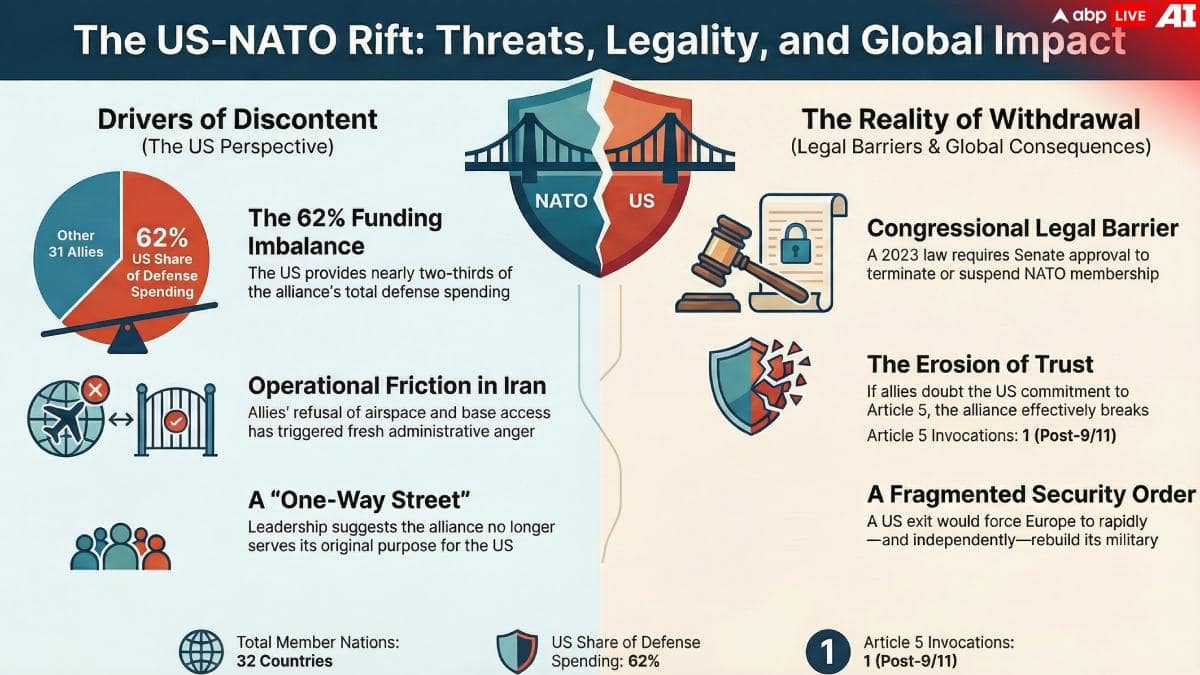
At the heart of NATO lies Article 5, the principle of collective defence. An attack on one member is treated as an attack on all. However, this is not automatic warfare. It requires consensus among members, and historically, Article 5 has been invoked only once, after the 9/11 attacks on the United States.
Despite criticism, NATO remains heavily dependent on Washington. The US accounts for roughly 62 per cent of the alliance’s total defence spending, making it the backbone of both military capability and deterrence.
Why Trump Wants Out Of NATO
Trump’s criticism of NATO is not new. He has long argued that the alliance is unfair to the United States, repeatedly calling it a “one-way street” and even a “paper tiger.” His core grievance remains burden-sharing. He believes European allies are not contributing enough to their own defence.
The Iran conflict has amplified these tensions. Several NATO members have refused US requests for operational support, including denying access to airspace and military bases. This has triggered fresh anger within the administration.
Trump told Britain’s Telegraph that leaving NATO is “beyond reconsideration,” while also saying he is “absolutely” considering an exit. Secretary of State Marco Rubio echoed this sentiment, stating, “unfortunately, we are going to have to reexamine whether or not this alliance, that has served this country well for a while, is still serving that purpose, or is it now become a one-way street.”
Rubio added, “After this conflict is concluded, we are going to have to reexamine that relationship. We’re going to have to reexamine the value of NATO and that alliance for our country. Ultimately, that’s a decision for the president to make, and he’ll have to make it.”
Can Trump Legally Pull The US Out?
Not so easy. NATO’s own rules allow a member to leave after giving one year’s notice. But US domestic law tells a different story.
In 2023, Congress passed legislation preventing any president from unilaterally withdrawing from NATO without Senate approval or an Act of Congress. The law explicitly states that the president “shall not suspend, terminate, denounce, or withdraw the United States from the North Atlantic Treaty… except by and with the advice and consent of the Senate.”
Trump, however, has pushed back on this constraint, saying, “I don’t need Congress for that decision,” and “I can make that decision myself.”
Legal experts suggest any attempt to bypass Congress would trigger a major constitutional battle, likely ending up in the courts.
What Happens If The US Leaves NATO?
Even the threat of an exit is already shaking the alliance. NATO’s strength depends not just on military power, but on trust. If allies begin to doubt whether the US will honour Article 5, the pact weakens from within.
Some analysts argue that the alliance could effectively become irrelevant without Washington’s commitment. Ian Bremmer noted that even without a formal withdrawal, if members “can’t trust” US guarantees, “the alliance is already broken in the way that matters most.”
A US exit would force Europe to rapidly boost its own military capabilities, potentially leading to a fragmented security order. It could also embolden adversaries like Russia, while reshaping alliances across Asia and the Middle East.
At the same time, NATO leaders are expected to intensify diplomatic efforts to keep the US engaged. Secretary General Mark Rutte, often described as a “Trump whisperer,” faces the delicate task of holding together a 77-year-old alliance now confronting pressure not just from external threats, but from within.
The bigger question is no longer whether Trump can legally exit NATO. It is whether his repeated threats alone are enough to fundamentally alter the alliance’s future.