
The Gaza peace plan proposed by US President Donald Trump holds the promise of revitalising the hopes and aspirations of millions across the region by integrating into the ambitious India-Middle East-Europe Economic Corridor (IMEC). If executed faithfully, this initiative could foster a more interconnected economic, social, and political landscape stretching from India to Europe, ultimately benefiting nations from the United States to Europe, the Middle East, and South Asia. Unveiled during the G-20 summit in New Delhi in September 2023, the plan garnered support from influential leaders, including those from the US, Saudi Arabia, and the UAE.
Despite its lack of concrete commitments, the Gaza peace plan has attracted backing from Islamic nations, particularly in the Gulf, as well as from India and various European countries, all of whom see potential in the proposed roadmap for a two-state solution to the enduring conflict.
3 Critical Pillars Of IMEC Corridor
The IMEC corridor is anticipated to attract billions of dollars in new investments, particularly benefiting India’s service sector, and is built upon three critical pillars designed to enhance existing and future infrastructure projects.
The first pillar, transportation, will serve as the backbone of the corridor, integrating rail and maritime networks that will require substantial financial investment.
The second pillar focuses on energy, aiming to create interconnected energy and electricity infrastructures across three continents, thereby facilitating a more efficient energy exchange.
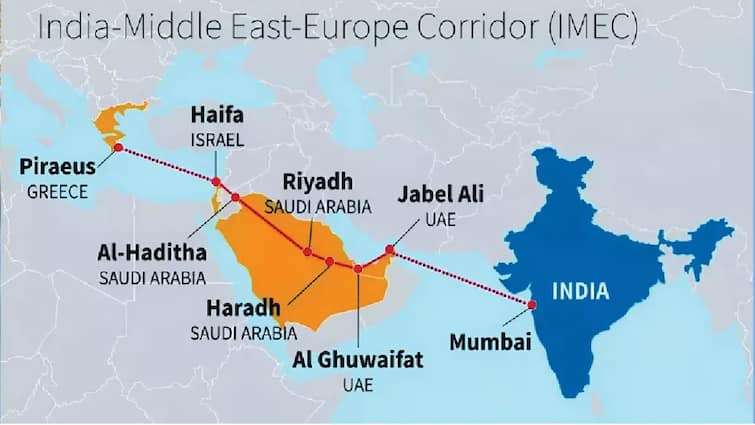
Lastly, the digital pillar will establish new fibre-optic cables and cross-border digital infrastructure, which are essential for modern communication and economic activities. The corridor is planned from Mumbai and Mudra ports by sea route to Jubail Damam port in Saudi Arabia, and from here rail route to Haifa in Israel, taking the maritime route again up to Marseille port in France and Trieste in Italy.
To realise the ambitious goals of the IMEC corridor, a significant workforce will be necessary, comprising specialists, engineers, technicians, and managers.
This demand will not only benefit over nine million Indian expatriates but also skilled professionals and workers from South Asia, particularly India. The initiative promises to create numerous job opportunities, thereby enhancing economic prospects for the region while fostering collaboration among diverse nations.
As the corridor takes shape, it could catalyse broader regional stability and prosperity, ultimately contributing to a more peaceful coexistence among the nations involved.
Nations That Will Play Pivotal Role
Hamas has characterised the Trump peace deal as a form of surrender, expressing reluctance to accept its terms and conditions. In contrast, Islamic and Gulf nations have shown a willingness to support both Israelis and Palestinians in their pursuit of peace, stability, and prosperity throughout the region. These nations will play a pivotal role in facilitating the restoration of tranquillity.
The establishment of three key pillars within the proposed corridor is expected to not only enhance economic integration but also foster political harmony among regional countries, as they will all have vested interests in the success of the India-Middle East-Europe Economic Corridor (IMEC). This initiative has the potential to significantly alter the economic and political dynamics of Eurasia. However, for the IMEC to realise its full potential, the involvement of a powerful entity like the United States is essential to coordinate efforts and ensure seamless interoperability among states and private sectors.
The IMEC presents an opportunity for the United States to solidify its presence in the region by leveraging its leadership to create and manage a coordinating structure that aligns with its long-term strategic interests, while simultaneously diminishing the influence of Chinese infrastructure projects under the Belt and Road Initiative (BRI).
The success of the IMEC would serve as a testament to the effectiveness of US diplomacy in the Middle East, showcasing its ability to convene and maintain a significant role in regional affairs. This initiative could open new markets for American companies and encourage deeper integration between Israeli and Gulf nations, ultimately contributing to a more stable and prosperous regional landscape.
Need For Grid Integration
India has successfully positioned itself within the Gulf region by fostering strong relationships with various Sheikhdoms, a strategy that is further bolstered by the presence of over 9 million skilled Indian diaspora. These professionals are expected to play a crucial role in the development of high-tech infrastructure projects, such as the trans-Arabian gas pipeline that will connect Saudi Arabia to the Eastern Mediterranean, as well as global data transmission initiatives.
Additionally, there is a pressing need for enhanced electricity grid integration along the corridor, which will facilitate the establishment of new subsea and terrestrial fibre-optic cables. These cables are essential for connecting emerging data centres in the Middle East with Europe and India, thereby creating a robust digital infrastructure.
Research from the Atlantic Council indicates that this corridor could serve as a vital platform for refining critical minerals, establishing supply chains, and developing advanced manufacturing zones, including AI data centres and other strategic components.
Rule-Based Connectivity
The corridor is poised to strengthen supply chain security while promoting a Euro-Asian policy framework centred on rule-based connectivity. It presents a promising alternative to existing initiatives, such as the Belt and Road Initiative. A study by Atlantic Council researchers Afaq Husain and Nicholas Shafer highlights that India stands to gain significantly from this corridor, with potential additional exports exceeding US$22 billion. This increase could translate to an enhancement of 5 to 8 per cent in the valuation of Indian exports, underscoring the corridor’s potential to not only bolster India’s economic standing but also to reshape trade dynamics in the region.
The French, Italian, and German members of the G-7 are actively advocating for the inclusion of the IMEC as a key agenda item in the upcoming G-7 summit. They recognise the significant potential of this corridor to bolster American and European technical and economic dominance while simultaneously limiting China’s influence in the rapidly developing economies of the region.
A recent study indicates that the IMEC could reduce transportation times by as much as 40 per cent compared to the current lengthy and indirect routes. This improvement is expected to enhance the export competitiveness of producers in the Asian-European region, yielding savings of over $6 billion based on existing shipping volumes. Furthermore, the interconnected cross-border infrastructure corridors will foster greater interdependence among nations, creating a vested interest in the corridor’s success.
India stands to gain immensely from the successful implementation of the IMEC, as it promises not only enhanced economic opportunities but also a stronger geopolitical presence in the region. This is particularly significant given the recent support from Islamic nations, including the Gulf Kingdoms, for the Gaza peace plan, which India has also endorsed.
The IMEC is poised to transform the strategic landscape encompassing South Asia, the Middle East, Europe, and the United States, with its name reflecting India’s pivotal role in the initiative. It is no surprise that China has voiced opposition to the Gaza deal, recognising that the IMEC could facilitate the resurgence of peace and economic opportunities for its rival nations, thereby undermining China’s influence in the Middle East. The implications of the IMEC extend beyond mere economic benefits; they represent a shift in the balance of power in a region critical to global trade and diplomacy.