
India mounted a sharp and sweeping attack on Pakistan’s internal political developments at the United Nations Security Council on Monday, accusing Islamabad of undermining democracy, empowering its military through constitutional changes and continuing to enable cross-border terrorism. The criticism came during an open debate of the UNSC on the theme “Leadership for Peace,” where New Delhi drew attention to what it described as Pakistan’s deepening democratic and security crisis.
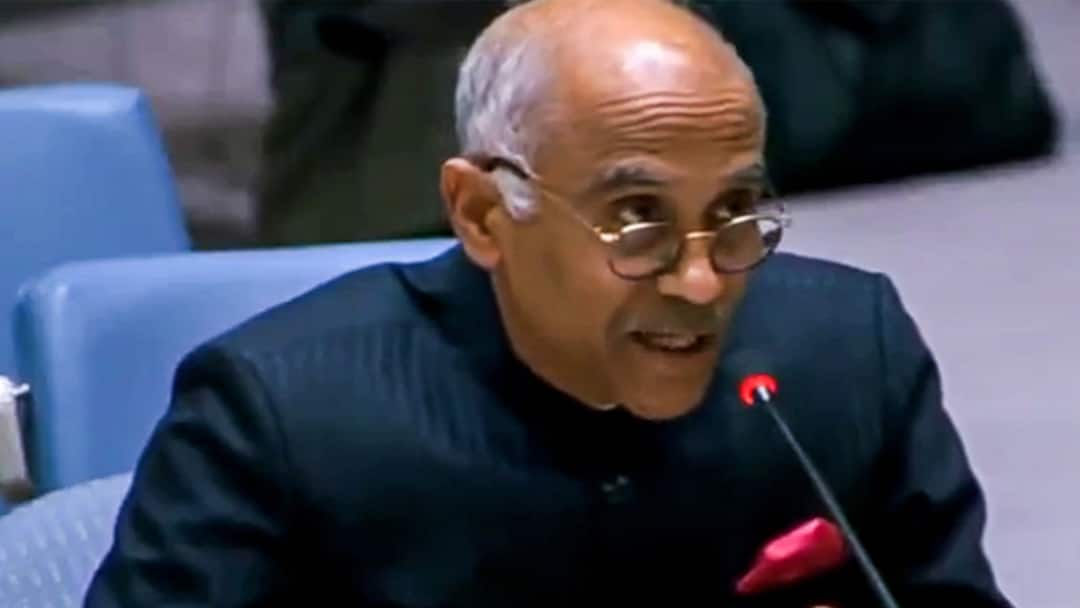
India’s Permanent Representative to the UN, Ambassador Harish Parvathaneni, alleged that Pakistan’s latest constitutional amendment effectively legalises military dominance while silencing popular political voices. Referring to the imprisonment of former Prime Minister Imran Khan and the banning of his party, Parvathaneni remarked that Pakistan has a “unique way of respecting the will of its people” — by jailing an elected leader, outlawing the ruling party, and transferring sweeping authority to the armed forces, as per a report on ANI.
Terrorism, Treaty Suspension
Linking Pakistan’s domestic turmoil with its external conduct, Parvathaneni highlighted India’s long-standing grievances over terrorism emanating from across the border. He said India has lost tens of thousands of lives to “Pakistan-sponsored terror attacks” over the last four decades, underscoring the human cost of sustained violence.
He specifically cited the April 2025 terror attack in Pahalgam, Jammu and Kashmir, which killed 26 civilians, including a foreign national. “In this backdrop, India has announced that the Treaty will be held in abeyance until Pakistan — a global epicentre of terror — credibly and irrevocably ends its support for cross-border and all other forms of terrorism,” he said, reported NDTV.
Democratic Backsliding Under The Spotlight
India also raised alarm over what it called Pakistan’s accelerating democratic erosion. Parvathaneni pointed to Imran Khan’s continued imprisonment, the prohibition of the Pakistan Tehreek-e-Insaf (PTI), and the military’s expanded institutional role following the enactment of the 27th constitutional amendment.
“Let me be clear — India will counter Pakistan-sponsored terrorism in all its forms and manifestations with all its might,” Parvathaneni declared, signalling that New Delhi sees little separation between Pakistan’s internal governance and its external actions.
Khan has been serving a sentence in the €190 million corruption case since August 2023 and faces further proceedings under the Anti-Terrorism Act related to the May 9, 2023 protests. PTI, meanwhile, has cited a report by UN Special Rapporteur on Torture Alice Jill Edwards, which alleges that the former prime minister is being subjected to degrading and inhuman treatment at Adiala Jail.
Sweeping Constitutional Changes Raise Alarm
The Indian envoy also drew attention to Pakistan’s 27th Constitutional Amendment Bill, passed last month, which introduced 59 clauses reshaping both the military and judicial architecture. According to reports cited by Parvathaneni, the amendment grants lifetime immunity to Pakistan’s Chief of Defence Forces, General Asim Munir, and establishes a Federal Constitutional Court that will share jurisdiction with the Supreme Court on constitutional matters.
India warned that these changes further consolidate military influence in Pakistan’s civilian institutions, raising serious concerns about the country’s democratic future and regional stability.