
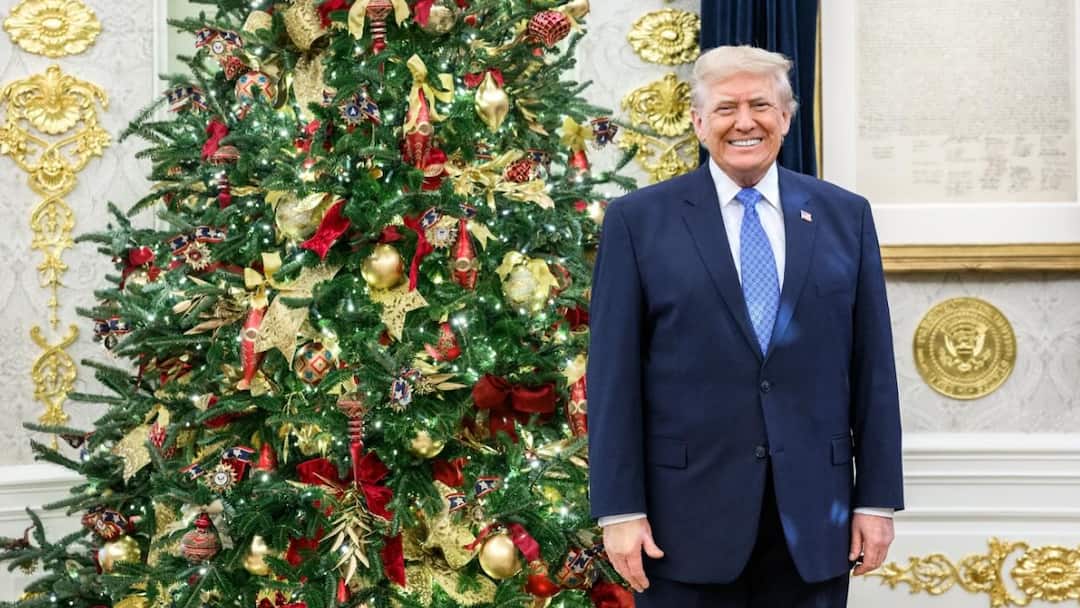


US President Donald Trump on Monday said efforts to bring an end to Russia’s war in Ukraine have reached their most promising stage yet, following intensive discussions with Ukrainian President Volodymyr Zelensky and key European leaders. Speaking from the Oval Office, Trump struck an optimistic tone, suggesting that months of diplomatic maneuvering may finally be yielding results.
“We’re closer now than we’ve ever been,” Trump told reporters, pointing to what he described as “very long and very good talks” with Zelensky, as well as leaders from Britain, France, Germany, and NATO, as per a report on Agence France-Presse. His remarks came as European capitals hosted parallel negotiations aimed at shaping a framework for a possible settlement.
While the latest proposals have sparked cautious optimism across Europe, Moscow has not publicly responded, leaving the outcome uncertain as talks continue.
Security Guarantees Take Center Stage
At the heart of the discussions is the question of how to prevent any future Russian aggression. European leaders issued a coordinated statement backing the creation of a multinational force, supported by the United States, and anchored by what they termed “robust security guarantees.” These guarantees are intended to ensure that any ceasefire or peace agreement is enforceable and durable, rather than a temporary pause in fighting.
Zelensky acknowledged progress on this front, even as he underlined the complexity of the negotiations. He noted that conversations with US representatives had been “not easy,” but said they had resulted in tangible movement on security assurances. At the same time, he drew a firm line on sovereignty and territory.
Washington Envoys Extend Negotiations
Talks continued for a second consecutive day, involving Trump’s envoy Steve Witkoff and his son-in-law Jared Kushner. These discussions are seen as an extension of Trump’s initial peace proposal, with Washington attempting to bridge remaining gaps between Kyiv and its European backers.
Zelensky has welcomed what he described as stronger guarantees emerging from the US side, but has also reiterated concerns that Russia could use negotiations to press for territorial compromises. For Kyiv, the challenge lies in balancing the urgency of ending the war with the long-term need for security and independence.
Europe Sees an Opening For Peace
European leaders have responded positively to the latest developments. German Chancellor Friedrich Merz said the negotiations present “a real chance for peace,” while praising Washington for offering what he called “substantial” guarantees, as reported by Dynamite News. Britain, France and Germany jointly endorsed a plan that would allow Ukraine to maintain a powerful standing military, even in peacetime.
According to the European outline, Ukraine would retain a force of around 800,000 troops, backed by continued international support. In addition, a US-led ceasefire monitoring and verification system would be established to detect violations and provide early warnings of renewed attacks.
US officials, however, have cautioned that Kyiv will ultimately need to accept the deal on the table. They argue that the proposed guarantees reflect the spirit of NATO’s Article Five, which treats an attack on one ally as an attack on all—an assurance they believe could deter future aggression.