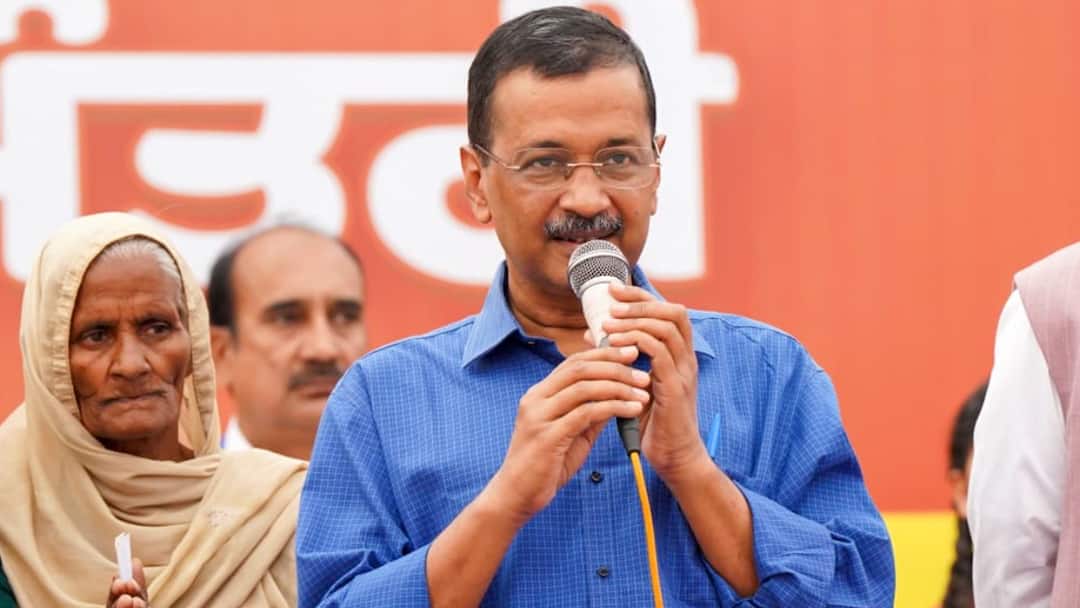

Delhi Chief Minister Rekha Gupta’s remarks on the use of mist sprayers at pollution hotspots have triggered a sharp backlash from her predecessor Arvind Kejriwal, who accused the government of trying to “hide” the real air quality data in the capital.
In a post on social media platform X, Kejriwal said Gupta’s comments showed that the government was working to suppress the truth about pollution levels. Taking a dig at her comparison of the Air Quality Index (AQI) with temperature, he wrote, “When did this new science come about that AQI has now become temperature.”
He further said that the Chief Minister had effectively admitted that water was being sprayed wherever AQI monitors were installed to prevent the actual pollution levels from reaching the public. “In other words, a game is underway to hide the data and show ‘clean air’,” read a rough translation of his vernacular post.
Gupta Defends Spraying At Pollution Hotspots
The controversy arose from an interview in which Rekha Gupta was questioned about opposition allegations that water was being sprayed around air monitoring stations in high-pollution areas to manipulate readings.
Responding to the charge, Gupta said, “Tell me, what is a hotspot? A hotspot is where there’s the most pollution. Right? What’s the solution? You spray there, you water it. You work to improve the soil. So, you’ll spray only on the hotspot.”
She added, “Does using a monitor bring down the AQI? AQI is like a temperature which you can know from any instrument, so watering it is the only solution which we are also doing.”
Her comments came amid a heated public debate over why government AQI figures are not reflecting an apparent deterioration in air quality, even as pollution levels worsen across the city.
AAP Alleges Data Manipulation, BJP Denies Charge
The Aam Aadmi Party (AAP) has repeatedly accused the government of publishing fake data, an allegation the BJP has rejected. Gupta has described Delhi’s winter pollution as a “legacy” problem.
The political row intensified after Gupta earlier this month announced plans to deploy mist spray technology to combat pollution. According to her, the government will install 305 mist sprayers at nine pollution hotspots across the city.
Senior AAP leader Saurabh Bhardwaj alleged that AQI monitoring stations were being shut down when pollution levels spiked, and that spraying was being carried out around monitors to lower recorded readings. “The government’s intention is not to reduce pollution but to reduce its figures,” he said.
AAP spokesperson Priya Kakkar echoed the allegations, accusing the BJP of manipulating data by sprinkling water on AQI monitors. She said the practice undermined the party’s credibility and claimed many BJP leaders were relying on air purifiers at home while people suffered outdoors.
Delhi’s Seasonal Pollution Worsens After Diwali
Delhi is typically blanketed in toxic smog after Diwali every year. This year, the onset was later than usual, but over the past couple of weeks, air quality has fluctuated between “poor” and “very poor” categories.
CPCB AQI Classification
According to the Central Pollution Control Board (CPCB), AQI levels are classified as follows:
- 0–50: Good
- 51–100: Satisfactory
- 101–200: Moderate
- 201–300: Poor
- 301–400: Very Poor
- 401–500: Severe