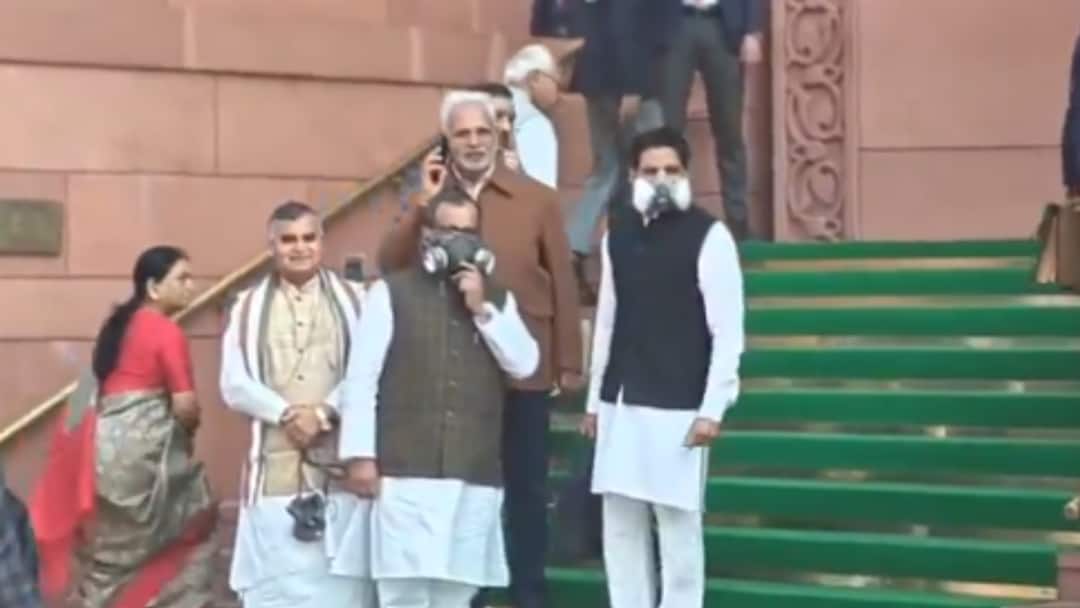

Parliament witnessed an unusual and dramatic moment during the Winter Session when several Opposition MPs walked into the House wearing gas masks, protesting against the alarming rise in Delhi’s toxic air levels. The symbolic demonstration immediately grabbed national attention, reigniting the debate on pollution, public health, and political accountability. The incident comes at a time when Delhi’s Air Quality Index (AQI) has slipped into the “severe” category, raising concerns about long-term health impacts and urgent measures needed to combat the crisis.
ALSO READ: Congress Leader Shares AI-Generated Video Showing PM Modi As ‘Chaiwala’, Sparks Row
MPs Stage Visual Protest Inside Parliament
#WATCH | #ParliamentWinterSession | Opposition MPs enter Parliament House wearing gas masks to protest against air pollution. pic.twitter.com/SkXYqAn9up
— ANI (@ANI) December 3, 2025
In a striking display of dissent, Opposition lawmakers donned gas masks as they entered the Parliament premises. Their aim was to highlight how the national capital’s air has become “unbreathable,” affecting millions of residents, including children and the elderly. The protest video circulated widely online, prompting a surge of public responses and amplifying concerns over air pollution management.
Delhi’s Air Quality Plunges Into ‘Severe’ Zone
The national capital woke up to another alarming spell of pollution as several neighbourhoods recorded AQI levels in the ‘severe’ category. Entire stretches of the city were enveloped in a dense layer of grey smog, drastically reducing visibility and raising fresh concerns over respiratory safety.
#WATCH | Delhi | Visuals from the Akshardham area as a layer of toxic smog blankets the city. AQI (Air Quality Index) around the area is 405, categorised as ‘Severe’, as claimed by CPCB (Central Pollution Control Board). pic.twitter.com/wpJjgofpBH
— ANI (@ANI) December 3, 2025
At Akshardham, a thick haze hovered over roads and residential pockets, with the Central Pollution Control Board reporting an AQI of 405, placing it firmly in the most hazardous bracket. Conditions were no better around AIIMS, where readings spiked to 420, indicating a sharp decline in air quality.
Other major monitoring stations also presented a grim picture:
- Anand Vihar: 405
- Ghazipur: 405
- India Gate: 356
- Dhaula Kuan: 303
With the Winter Session in progress, Congress leader Priyanka Gandhi Vadra voiced serious worry over the worsening air quality, noting that the brunt of the pollution is being borne by young children and senior citizens. She stressed that the growing health threat calls for immediate action from the government to safeguard vulnerable groups.