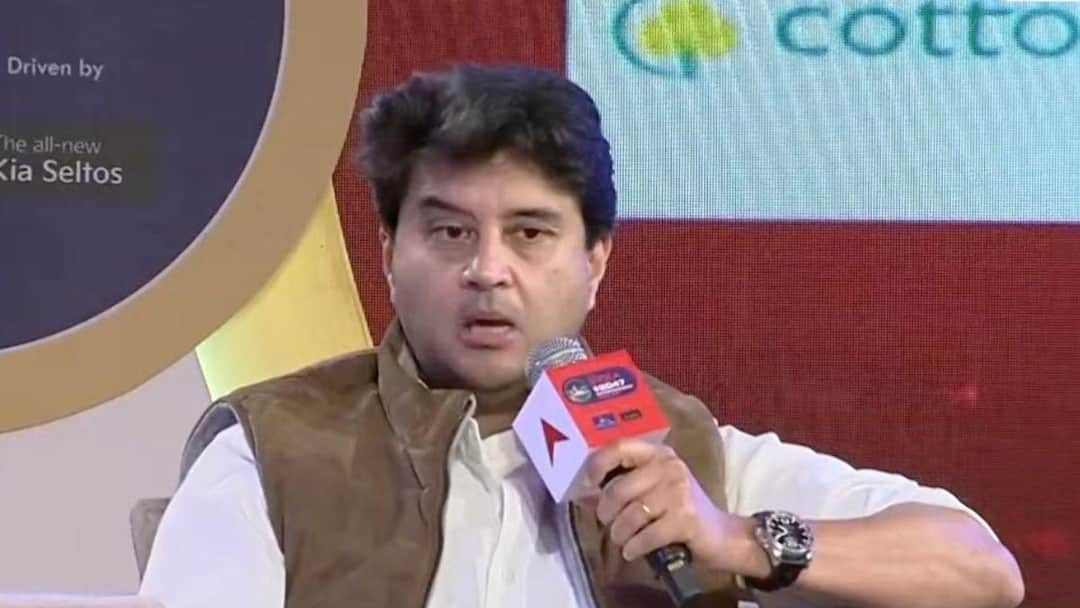

New Delhi: Union Minister Jyotiraditya Scindia on Monday said the government’s Sanchar Saathi mobile security app can be uninstalled like any other application, stressing that its use is entirely optional, even as he revealed that more than 7.5 lakh stolen mobile phones have been traced and returned to their owners in the last one year.
Speaking at the ABP India @2047: Entrepreneurship Conclave, Scindia said the initiative was designed to empower citizens, not monitor them, and that the government remains open to reviewing concerns around its use.
Sanchar Saathi: Optional, Citizen-Centric Tool
Explaining the initiative, Scindia said Sanchar Saathi enables users to check how many connections are active on their Aadhaar, verify IMEI numbers to detect stolen or fraudulent phones, and block devices if a handset is lost.
“Over 7.5 lakh phones have gone back to their owners in the last one year,” he said, adding that the app had been made optional 10 days ago. “You can delete the app just like you delete any other app,” he said, noting that the government would revisit the order if people remained hesitant.
India’s Startup Model Built for Scale
Placing India’s entrepreneurial growth in a global context, Scindia said the country has emerged as the world’s third-largest startup ecosystem, with strengths distinct from developed economies.
“We should not forget that India is the third-largest startup ecosystem in the world today,” he said, drawing on his experience studying and working in the United States. While the US benefits from deep pools of capital, he said India’s advantage lies in its ability to deliver solutions at scale.
“In a state of crisis, you operate in marginal volumes. Only India can deal with high volume,” Scindia said, pointing to India’s market size, skill base, population and demographic dividend.
From Consumer to Architect: India’s 6G Push
On technology, Scindia said India is set to lead the world in 6G, marking a departure from its earlier lag in telecom innovation.
“We were behind the world on 4G, we marched with the world on 5G, but we will lead the world on 6G,” he said.
India currently has around 37 crore 5G users, following what he described as the fastest rollout globally. He added that India has, for the first time, secured representation at global standard-setting bodies such as the ITU and 3GPP through the Bharat 6G Alliance.
“Ten per cent of patent formation for 6G should be India’s contribution,” Scindia said, adding that India is expected to take a leadership role in 6G by 2027.
Digital Infrastructure With Global Reach
Scindia highlighted the global relevance of India’s digital public infrastructure, saying solutions built at home are now usable worldwide.
“You can use UPI even at the Eiffel Tower in Paris,” he said, asserting that India now has the capability to provide solutions not only for domestic needs but also for the rest of the world.
He also referred to the country’s growing semiconductor footprint, noting that India now has several fabrication facilities, each valued at ₹28 crore.
Northeast Emerges as Growth Engine
Calling the Northeast a key growth frontier, Scindia said he had visited the region 10 times in the last month.
He noted that nearly 80 per cent of the population is under 30, with literacy levels ranging between 93 and 94 per cent across states. While India’s decadal GDP growth stands at 6.5 per cent, the Northeast has recorded a 10-year CAGR of 11–13 per cent across all eight states.
Infrastructure expansion in the region includes 17 airports, 20 waterways, and full railway connectivity across all eight states by 2027. He also confirmed that the Tata semiconductor fabrication facility will be set up in Assam.
A Personal Journey Beyond Politics
Reflecting on his own path, Scindia said he consciously sought experiences outside politics. “I am glad to be a member of the Scindia family, but every human being needs to write their life story with their own hands,” he said.
He recalled winning a competition at Stanford University, where he and his peers worked on a startup idea involving a high-tech mirror of a network operating system, including visits to Bengaluru as part of the project.
“I am not in politics; I am here to serve the nation,” Scindia said, adding that he remains grateful to his constituency for the opportunity to do so.