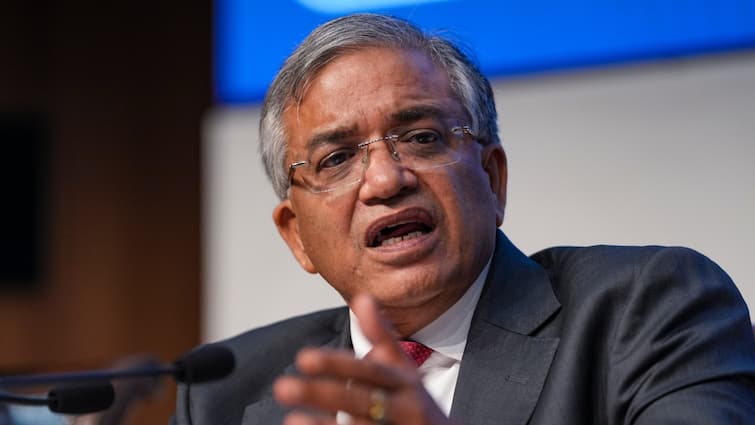

The Election Commission of India (ECI) on Monday announced the second phase of a crucial electoral roll cleanup exercise, known as the Special Intensive Revision (SIR). The SIR aims to overhaul and update voter lists across the country. The new phase will cover 12 states and union territories, Chief Election Commissioner (CEC) Gyanesh Kumar announced.
The 12 states and UTs where the Special Intensive Revision (SIR) will begin are Andaman and Nicobar Islands, Goa, Puducherry, Chhattisgarh, Gujarat, Kerala, Madhya Pradesh, Uttar Pradesh, Rajasthan, West Bengal, Tamil Nadu, and Lakshadweep.
Here is the schedule: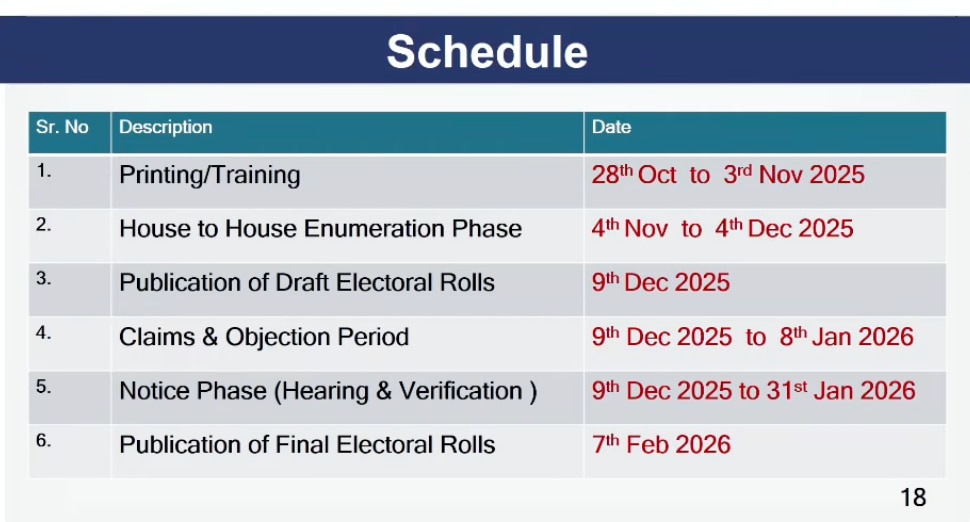
Addressing the media on Monday, CEC Gyanesh Kumar officially announced the next step, saying, “Phase two of the Special Intensive Revision (SIR) will be held in 12 states and Union Territories.”
He extended his greetings to the voters of the state where the exercise has concluded with “zero appeals”. The CEC remarked, “Today we are here regarding the rollout of the second phase of the Special Intensive Revision. I extend my greetings to the voters of Bihar and bow before the 7.5 crore voters who took part in a successful SIR.” The final Bihar list, with nearly 7.42 crore names, was published on September 30.
The CEC noted that the SIR is a critical exercise, the ninth since independence, adding that the “last one happened 21 years ago in 2002-04”. He also acknowledged the persistent concerns from various parties, observing, “Political parties have raised the issue of the quality of electoral rolls on several occasions.” The Commission has already held two conferences with Chief Electoral Officers (CEOs) from all 36 states and union territories to finalise the rollout roadmap.
Electoral Rolls Will Be Frozen Immediately
The primary objective of the SIR is to create clean and accurate electoral rolls by correcting errors that have crept in over the past two decades due to frequent migration, resulting in voters getting registered at more than one place, non-removal of dead voters, and wrongful inclusion of any foreigner.
CEC Gyanesh Kumar confirmed that the electoral rolls will be frozen immediately to begin the process, stating, “…In the states where SIR will be conducted, electoral rolls will be frozen at midnight today. Later, voters will be given unique enumeration forms with all details.”
The Commission’s detailed process focuses on two key mandates: “No eligible citizen is left out, and no ineligible person is included.”
SIR Process and Role of Key Functionaries
The intensive revision requires the coordinated effort of key functionaries. The Electoral Registration Officer (ERO), an officer of the Sub Divisional Magistrate (SDM) level, “prepares the Draft Electoral Rolls, Receives and Decides on Claims and Objections, and Prepares and Publishes the Final Electoral Rolls.”
During the Enumeration Phase, Booth Level Officers (BLOs), one for approximately 1,000 electors, will play a crucial role:
They will print and distribute Unique Enumeration Forms (EFs) to each elector, making “at least 3 visits to the house of each elector”.
BLOs are tasked with “helping the elector in matching/linking with either their name or their relative’s name in the last SIR held in 2002-2004.”
The officer will “identify dead, permanently shifted and voters who are registered at more than one place”.
For the entire process, the last SIR (which took place in most states between 2002 and 2004) will serve as the cut-off date. The District Magistrate will hear the first appeal against an ERO’s decision, with the Chief Electoral Officer of the State/UT hearing the second appeal. The process also includes the involvement of political parties, whose Booth Level Agents (BLAs) are trained to assist electors and submit up to 50 certified EFs per day to the BLO.
Election Commission’s SIR Exercise
The EC has already concluded the revision process in Bihar, where the final list containing “nearly 7.42 crore names” was published on September 30, ahead of the November polling.
The EC has structured the SIR rollout to ensure minimal disruption to other election duties. Officials stated that the electoral roll cleanup will “not hold the electoral roll cleanup exercise in states where local body elections are taking place or are due, as the grassroots poll machinery is busy with it and may not be able to focus on SIR.” The revision in such states, where local poll machinery is otherwise occupied, will be addressed in later phases.
The Commission has held two preparatory conferences with state Chief Electoral Officers (CEOs) to finalise the roadmap for the SIR rollout. For states beginning the revision, the electoral roll from their respective last intensive revision—which for most fell between “2002 and 2004″—will serve as the cut-off date, similar to how the 2003 voter list was used in Bihar. The last SIR in Uttarakhand, for instance, took place in 2006, and in Delhi, the last intensive revision was held in 2008.
The primary objective of the Special Intensive Revision is to thoroughly clean up the lists by focusing on the removal of foreign illegal migrants. This will be achieved by diligently “checking their place of birth.”
The move, officials noted, “assumes significance in the wake of a crackdown in various states on illegal migrants, including from Bangladesh and Myanmar.” Most state and Union Territory CEOs have already progressed in “the mapping of current electors with the voters according to the last SIR held in their respective states or Union territories.” The announcement on Monday is expected to provide definitive timelines and further procedural details for the commencement of this major electoral exercise.