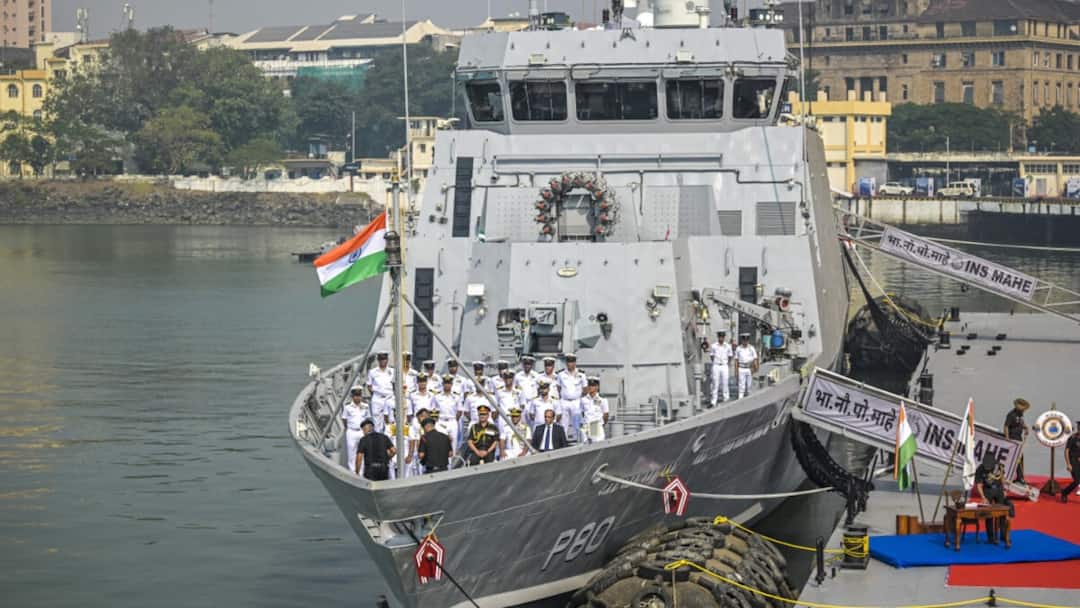

The commissioning of the first of the eight Mahe-class anti-submarine warfare ships marks a significant milestone for the Indian Navy, showcasing the capabilities of indigenous shipbuilding. This vessel is not merely a technological achievement; it plays a crucial role in monitoring and countering the covert operations of adversarial nations that may attempt to deploy submarines within Indian territorial waters. By enhancing the Navy’s ability to detect and neutralize hidden threats, the Mahe-class ship has the potential to transform the landscape of maritime warfare, ensuring that India remains vigilant against underwater incursions.
The strategic importance of this new class of warship evokes memories of the 1971 India-Pakistan war, during which the Indian Navy successfully sank the Pakistani submarine PNS Gazi, while also facing the loss of the Indian frigate Khukhri to the Pakistani submarine PNS Hangor. These historical events underscore the critical nature of subsurface warfare and the vital role that anti-submarine vessels play in national defence. Earlier this year, India also launched the Arnala-class shallow water anti-submarine warfare ship, further demonstrating its commitment to bolstering its underwater capabilities in response to an increasingly complex maritime environment.
The threat landscape is evolving, with not only Chinese and Pakistani submarines posing risks but also the growing capabilities of the Bangladesh Navy, which has acquired two submarines from China and is developing a submarine base at Pekua, designed to accommodate six submarines with Chinese support. This development indicates that the Bangladesh Navy is likely to expand its fleet further, potentially receiving additional submarines from China. Given Bangladesh’s anti-India stance and its aspirations to assert itself as a maritime power, it is imperative for India to remain alert and proactive in strengthening its naval defences to safeguard its interests in the region.
The coastal waters of India are increasingly at risk of being infiltrated by enemy submarines, necessitating a robust response from the Indian Navy to effectively counter the collaborative threat posed by Bangladesh, Pakistan, and China. The Chinese Navy, under the guise of friendly visits to the Bangladesh Navy, is likely to establish a persistent presence in Bangladeshi waters, thereby complicating the operational landscape for the Indian Navy. This situation is further exacerbated by previous instances where Chinese submarines have docked at Colombo ports, provoking significant concern from India. Given the well-documented military ties between Pakistan and China, it is crucial for India to formulate a comprehensive counter-strategy to mitigate these emerging threats.
Currently, China is in the process of supplying eight submarines to the Pakistan Navy, which already operates an additional eight submarines, including three mini submarines. Of the eight Yuan-class Type-39B submarines contracted from China, three have already been delivered, with the remaining units set to be handed over soon. This enhancement of Pakistan’s naval capabilities positions its fleet as a formidable adversary to the Indian Navy, thereby necessitating immediate countermeasures. The potential for the Pakistan and Bangladesh navies to act as proxies for the Chinese Navy creates a multi-dimensional threat to India’s coastal security, particularly at a time when the Indian submarine fleet is in decline and decisions regarding new acquisitions remain pending.
To effectively address the challenges posed by the China-Pakistan-Bangladesh alliance across the vast expanse of the Indian Ocean, from the Bay of Bengal to the Arabian Sea, the Indian Navy is actively deploying anti-submarine warfare assets. The Mahe and Arnala classes of ships are expected to play a pivotal role in this underwater conflict, enhancing India’s operational capabilities in countering submarine threats. By bolstering its naval presence and readiness, the Indian Navy aims to deny free movement to the Chinese, Pakistani, and Bangladeshi navies in and around Indian waters, thereby safeguarding national interests and maintaining maritime security in the region.
The Indian Navy proudly commissioned the first indigenously designed and constructed Mahe class anti-submarine warfare shallow water craft (ASW-AWC) on November 24, 2025. Named INS Mahe, this vessel serves as the lead ship among a total of eight in its class, showcasing the collaborative efforts of prominent Indian defence entities such as Bharat Electronics Limited (BEL), Larsen & Toubro (L&T) Defence, Mahindra Defence Systems, and over 20 micro, small, and medium enterprises (MSMEs). This project not only highlights India’s growing capabilities in naval design and equipment but also reinforces the nation’s commitment to self-reliance, epitomized by the concept of Atmanirbhar Bharat. With more than 80 percent of its components sourced domestically, INS Mahe significantly enhances the Indian Navy’s anti-submarine warfare capabilities, particularly in addressing threats in coastal waters.
INS Mahe is characterized by its compact design and advanced weaponry, making it a formidable asset for the Indian Navy. The vessel is engineered to excel in submarine hunting, conduct coastal patrols, and safeguard India’s crucial maritime routes. Its combination of firepower, stealth, and agility is strategically aimed at providing the Indian Navy with a decisive advantage in countering hostile submarines, thereby playing a vital role in the broader strategy of sea denial. Measuring approximately 78 meters in length and displacing 1,100 tons, INS Mahe is equipped for underwater warfare with an arsenal that includes torpedoes, multifunctional anti-submarine rockets, and cutting-edge radar and sonar systems.
The commissioning of INS Mahe heralds the advent of a new generation of indigenous shallow water combatants that are sleek, swift, and distinctly Indian. These vessels are set to be outfitted with state-of-the-art sensors developed within the country, enabling them to perform a range of operations, including anti-submarine missions, low-intensity maritime operations, and mine-laying activities. As the centrepiece of a new class of littoral combatants, INS Mahe is poised to instill fear in adversary naval forces. In light of the increasing pressure on the Indian Navy’s submarine strength, the introduction of these anti-submarine warfare ships represents a significant strategic advantage, providing much-needed support to naval planners and enhancing the overall operational readiness of the fleet.
The Indian Navy is facing a multifaceted underwater challenge, with threats emerging from three fronts: China, Bangladesh, and Pakistan. These nations are rapidly developing capabilities that pose significant risks to India’s coastal and maritime assets within its territorial waters. In response to this evolving threat landscape, the Indian Navy is significantly enhancing its anti-submarine warfare capabilities. This strategic expansion aims to effectively counter the joint challenges posed by these adversaries, ensuring the protection of India’s maritime interests. By bolstering its operational readiness and technological advancements in anti-submarine warfare, the Indian Navy is positioning itself to neutralize potential threats and maintain security in the region.
(The writer is a senior journalist and strategic affairs analyst)