


- West Asia conflict drives fuel price hikes, increasing inflation.
- This threatens growth, raises food/core costs, impacting consumption.
- Despite FPI outflows, India shows resilience through capex, policy.
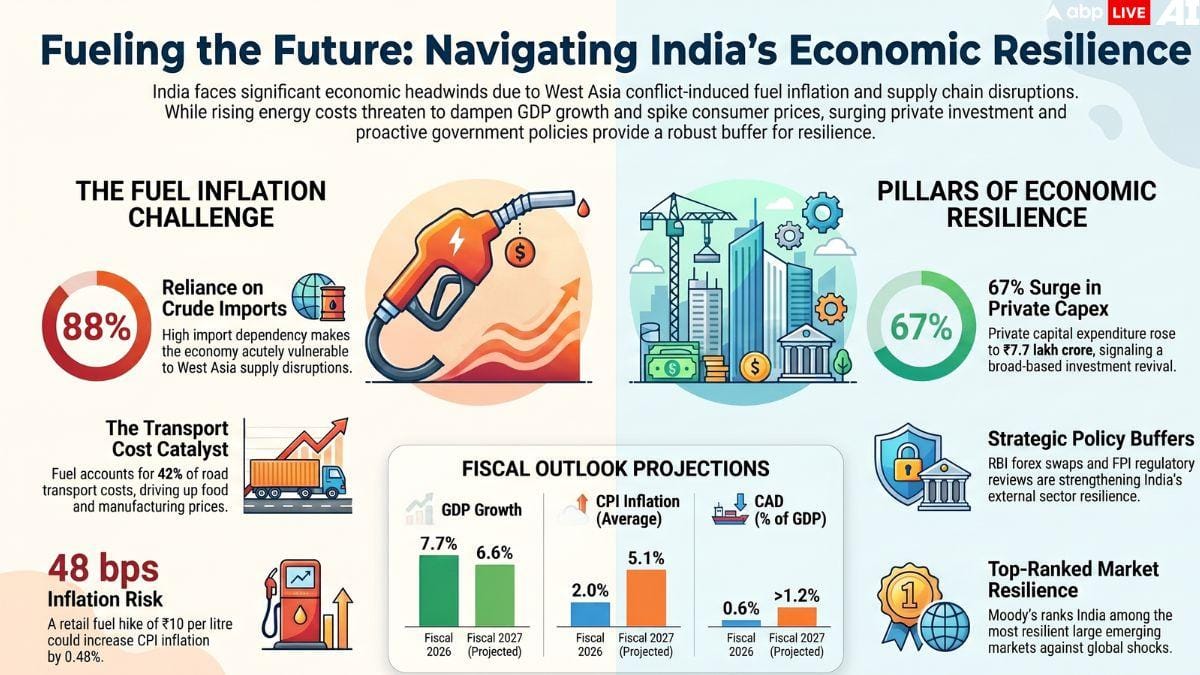
Fuel prices are emerging as one of the key multiple threats to India’s growth prospects as the West Asia conflict-induced crisis continues to cut off supply from the blocked Strait of Hormuz, pushing up the country’s energy costs and forcing the government to hike pump prices, with the inevitable risk of high inflation.
Crude prices have averaged $112 per barrel for the first two months of this fiscal, with CRISIL’s base-case expectation at $95 per barrel for the full fiscal.
The economy has only recently started facing retail fuel price hikes, with some more in the anvil, amplifying both the direct and indirect inflationary risks. Retail petrol and diesel prices have risen Rs 7.5 per litre since May 15, and it takes no rocket science to sense possible further hikes if crude prices remain elevated.
Fuel Woes And Supply Vulnerabilities
According to government data, India imports approximately 88 per cent of its crude oil, 90 per cent of its phosphates, and 25 per cent of its urea.
Given that a critical volume of these maritime crude and LNG flows transits the Strait of Hormuz, geopolitical developments in West Asia have had immediate ramifications. These extend beyond primary energy and fertiliser security and increasingly affect the broader economy through increased living costs and second-round impacts on food prices.
Economists at CRISIL Ratings caution that higher fuel prices can escalate inflation in India and peg the direct upside to inflation linked to the Consumer Price Index (CPI) at 36 basis points (bps) with a hike of Rs 7.5 per litre in petrol and diesel prices. This can rise to 48 bps if retail fuel prices increase by Rs 10.
Rising fuel prices mean increasing transport costs, especially for goods categories that are transport-intensive, as oil marketing companies (OMCs) gradually pare their losses, or under-recoveries.
Inflation projections based on the CPI are in the range of an average 5.1 per cent in fiscal 2027, compared with 2.0 per cent in fiscal 2026, driven by a low-base effect and expectations of broadening price pressures across major segments.
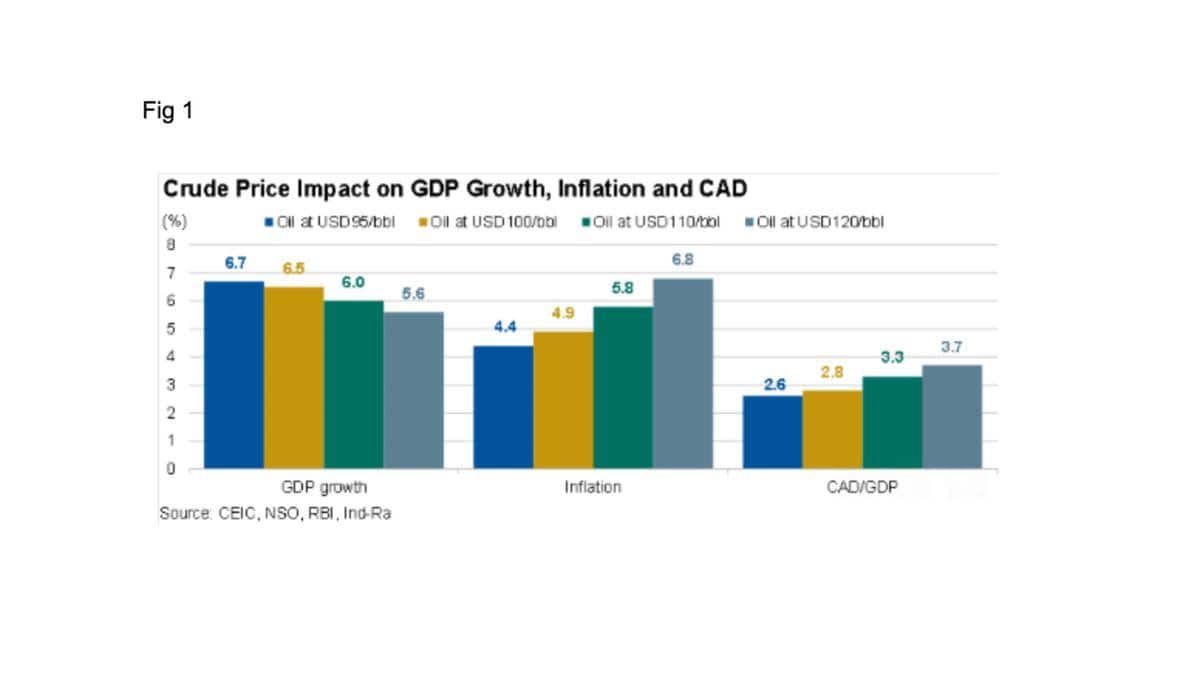
Higher inflation on account of disruptions to agricultural production and higher commodity prices will constrain household budgets and restrain private consumption. (See Fig 1)
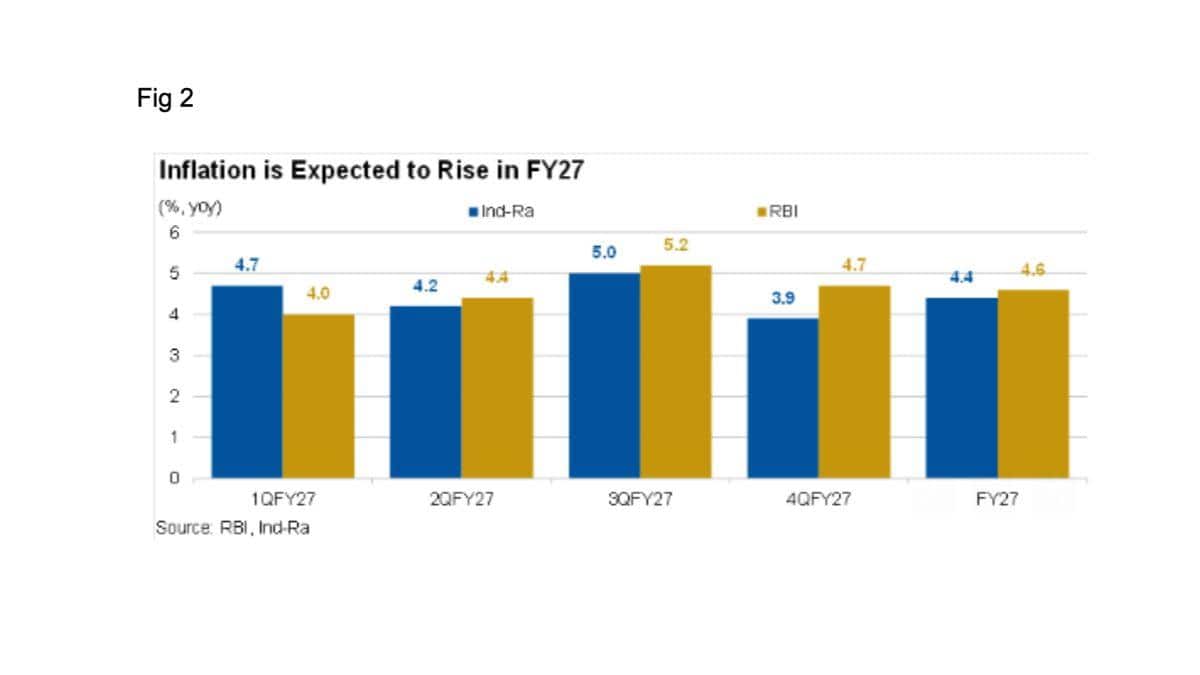
“The economy is facing headwinds of disruption in supply chain, elevated energy prices and deficient rainfall due to El-Nino. The biggest unknown for the economy is the duration of war and time taken in supply normalization. Ind-Ra expects inflation in 1QFY27, 2QFY27, 3QFY27 and 4QFY27 to be at 4.3 per cent, 5.0 per cent, 5.7 per cent and 5.1 per cent respectively,” says Devendra Kumar Pant, Chief Economist, India Ratings & Research.
Pricey Platter: Why Transport Costs Matter
Transport costs matter because they are a major channel through which fuel inflation radiates across the economy.
Fuel is the single largest component of road transport costs at 42 per cent, according to a National Council of Applied Economic Research study.
While freight transport accounts for 54 per cent of India’s logistics cost, road transport represents nearly 71 per cent of total freight movement.
Reports by CRISIL suggest hikes in retail prices could move closer to Rs 10 per litre in the near term, with the broader effect reverberating across the economy through higher transport costs, pushing up both food and core inflation.
The increase in retail fuel prices will directly impact freight cost structures and feed into prices across supply chains in the coming months.
Also Read : 10% Jet Fuel Hike, Rs 10,000 Crore Relief Fund: Inside Govt’s Plan To Shield Airlines
Food Inflation Set To Accelerate
The confluence of a low base and rising transport costs will quicken the pace of food inflation.
Data suggests transport costs contribute more to the prices of dairy products, tea, coffee, fruits, pulses, spices, eggs, meat and fish. These categories are more vulnerable to increases in fuel and transportation costs.
Already, as Pushan Sharma, Director, Crisil Intelligence, points out, the cost of home-cooked vegetarian and non-vegetarian thalis increased 5 per cent and 7 per cent on-year, respectively, in May, driven by higher prices of tomatoes, vegetable oil and liquefied petroleum gas (LPG).
Tomato prices surged 57 per cent to Rs 36 per kg from Rs 23 per kg in May 2025, primarily on account of a 3-4 per cent decline in production. Meanwhile, global supply-side pressures pushed up vegetable oil and LPG prices by 8 per cent and 7 per cent on-year, respectively.
According to Sharma, tomato prices are expected to remain elevated during June-August, with supply likely to tighten because of lower summer sowing amid heat-related concerns in key northern growing states.
Potato prices are also expected to inch up as the rabi harvest season concludes and higher-priced cold-storage stock enters the market. Onions, too, are likely to become costlier in the coming months following an estimated 5 per cent decline in rabi production this year.
Vegetable oil and LPG cylinder prices rose 8 per cent and 7 per cent on-year, respectively, owing to the ongoing global supply disruption.
Core Inflation Pressures Build
It’s not just food.
Producers face a dual cost shock, with higher prices of crude, petroleum products and gas raising manufacturing costs, while a sharp rise in transport costs, coupled with pressure from other commodities, pushes up core inflation.
Clothing, electronic products, wood products and housing-related construction materials, including cement and ceramics, are more transport-intensive than the national average. Rising transport prices will impact the final prices of these products.
Input costs rose sharply due to higher energy prices, particularly for crude petroleum, natural gas and mineral oils, along with higher manufacturing costs for steel, basic chemicals, fertilisers, plastics, synthetic rubber, man-made fibres, plastic products, non-ferrous metals and other non-metallic mineral products.
Given broadly steady demand conditions so far, manufacturers are increasingly likely to pass on higher costs to consumers to protect profit margins.
FPI On Flight Path
A second big worry going ahead is foreign portfolio investment (FPI) outflows, although these have been offset by FDI and other investment inflows.
According to CRISIL data, FPI net outflows doubled to $12.0 billion in the fourth quarter of fiscal 2026 from $5.9 billion in the year-ago period as net inflows into debt plunged to $1.5 billion from $7.5 billion.
However, net outflows from the equity and investment fund segments were broadly stable at $13.6 billion compared with $13.5 billion.
On the other hand, FDI net inflows surged to $4.2 billion from $0.4 billion as inflows rose to $22.5 billion from $18.5 billion, while outflows remained broadly steady at $18.3 billion compared with $18.1 billion.
Net inflow in ‘other investments’ more than doubled to $16.2 billion compared with $7.4 billion. Net outflows from financial derivatives increased to $9.6 billion from $7.5 billion.
Also Read : The Hidden Cost Of The West Asia War: India’s Subsidy Bill Is Soaring
CAD worries
A third formidable challenge is India’s current account deficit (CAD) which widened to 2.3 per cent of GDP from 0.6 per cent as a larger goods trade deficit more than offset an increase in the services trade surplus. Rahul Agrawal, Senior Economist, ICRA notes that India unexpectedly witnessed a current account surplus of $7.1 billion in Q4 FY2026 as against ICRA’s forecast of a small deficit largely driven by a 31 per cent YoY surge in the remittance inflows to a record high of $41.3 billion in the quarter, which also exceeded the Q3 FY2026 levels by a healthy 17.5 per cent.
Owing to the better-than-expected Q4 FY2026 numbers, the CAD was contained at just 0.6 per cent of GDP in FY2026, similar to the level seen in FY2025. “Nevertheless, it was a challenge to finance even such a low level of CAD, amid negligible net capital inflows, leading to a $23.6 billion drawdown in reserve assets during the fiscal,” says Agrawal. (See Fig 2)
The gains may now be reversed with the CAD projected to more-than-double in FY2027 relative to the FY2026 levels, owing to the surge in global energy prices following the West Asia conflict. “While the recent measures to attract capital flows by the GoI and the RBI are expected to provide some respite, these may remain insufficient unless net FDI inflows improve materially from the current levels,” cautions Agrawal.
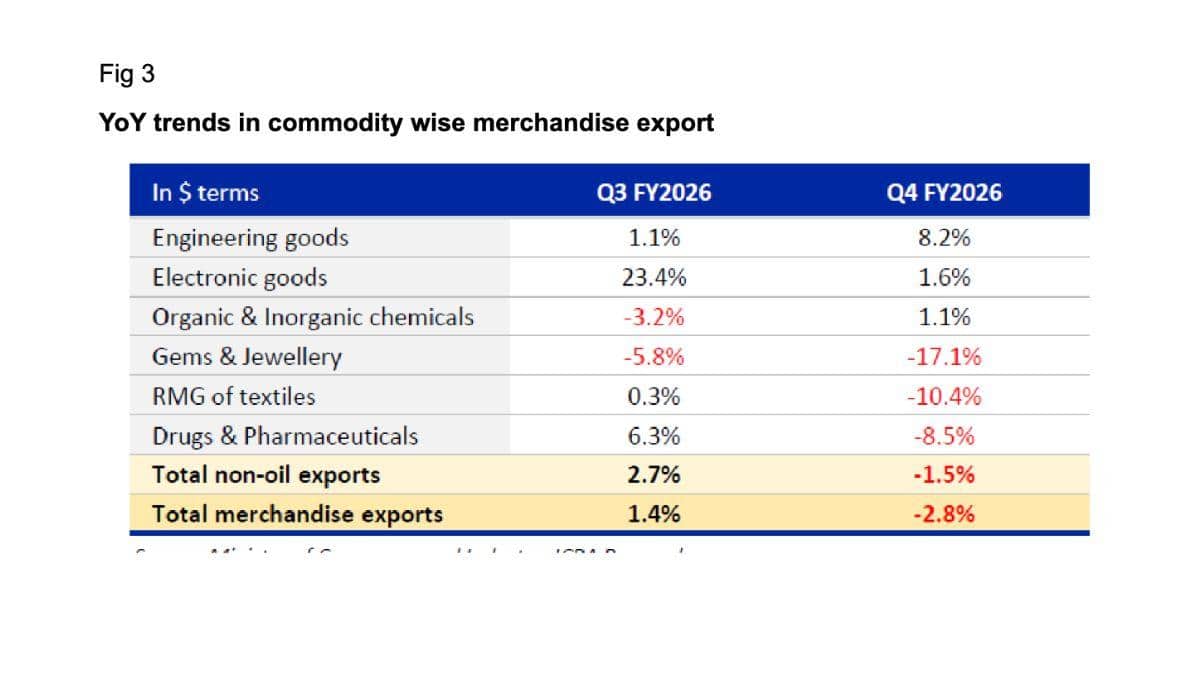
Costlier crude oil, natural gas and fertilisers will crank up India’s import bill significantly this fiscal, while exports are heading for a decline due to global trade disruptions and weakening demand. (See Fig 3)
Exports are expected to be adversely impacted by weaker global demand and trade disruptions with S&P Global revising downward the GDP growth for the US and Eurozone to 1.9 per cent and 0.6 per cent respectively, for calendar year 2026. Eurozone and the US together account for 37 per cent of India’s goods exports. India’s exports to West Asia are already slowing. Remittances from the Gulf (38 per cent of total) are also at risk because of the West Asia conflict.
Growth pangs
The bigger worry is the impact on growth because even though the National Statistical Office (NSO) estimated India’s gross domestic product (GDP) growth for fiscal 2026 at 7.7 per cent, it is only slightly higher than the second advance estimate of 7.6 per cent released in February, says Dharmakirti Joshi, Chief Economist, CRISIL.
The upward revision reflects a higher-than-expected growth in the fourth quarter, which printed at 7.8 per cent down from 8.0 per cent in the third quarter but above the average growth of 7.4 per cent in the previous 10 quarters, driven by healthy private consumption and fixed investments.
“Notably, the growth was despite headwinds from the West Asia conflict that began towards the end of February and intensified in March,” says Joshi,” who forecasts growth to weaken amid multiple headwinds in fiscal 2027, including higher prices of crude and other commodities, softer global growth and forecast of a below-normal monsoon.
“Global supply chain disruptions are already intensifying cost pressures and reduced input availability is expected to add to the pressure. We maintain our GDP growth forecast for fiscal 2027 at 6.6 per cent with risks tilted to the downside. (See Fig 4)
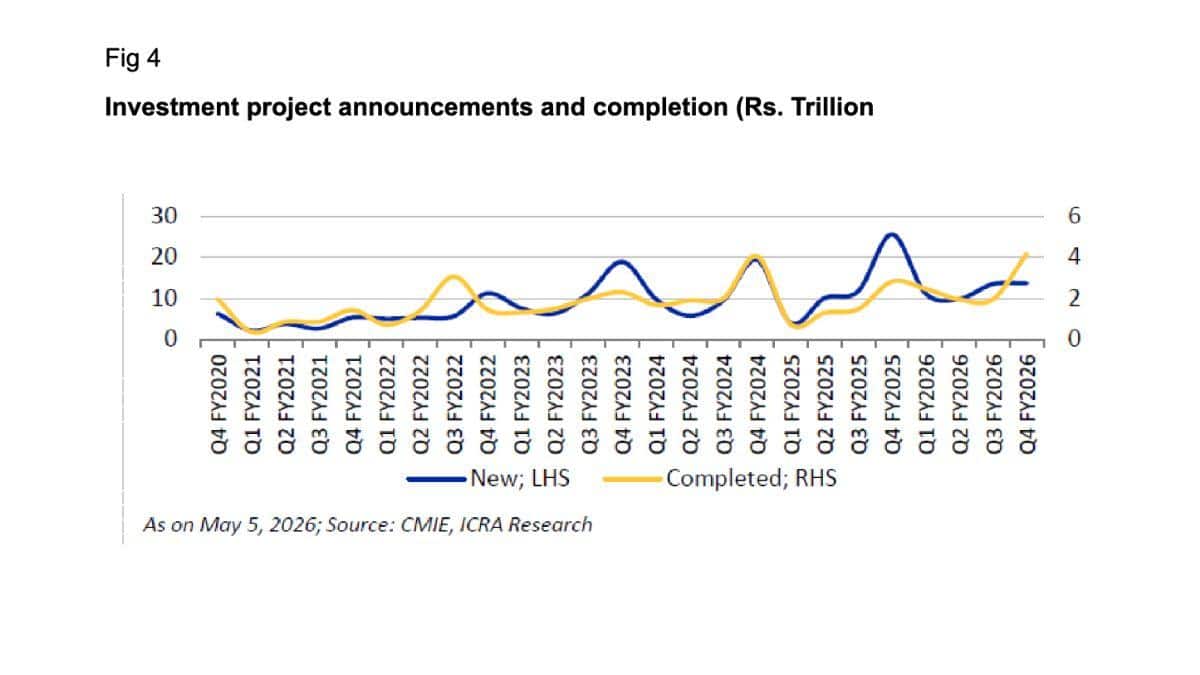
Aditi Nayar, Chief Economist, ICRA Ltd also reflects on the uncertainty around the resolution of the conflict. ”Elevated energy prices for an extended period poses a downside risk to growth in the near term, including muted prospects for investment demand, negative impact on corporate profitability and dampening consumer sentiments,” says Nayar, flagging the potential development of El Nino conditions and weak monsoon forecast for 2026 which have dulled the agricultural outlook and rural demand prospects for H2 FY2027.
“Assuming an average crude oil price of $95/barrel, ICRA pegs the GDP growth to slow down to sub-6.5 per cent in FY2027 from 7.7 per cent in FY2026, with the West Asia crisis expected to transmit to lower growth outcomes, particularly in H1 FY2027. However, nominal GDP expansion is set to improve to above 12 per cent in FY2027 from 8.9 per cent in FY2026, on the back of unpalatably higher inflation,” opines Nayar.
Capex revival
There are however, signs of India’s strong fundamentals which can hold up growth. In an evidence of a broad-based revival in the country’s investment cycle, CII has reported that India’s private capital expenditure surged by a healthy 67 per cent to Rs 7.7 lakh crore in September 2025 from Rs 4.6 lakh crore in September 2024.
An industry analysis of nearly 1,200 companies, drawn from the CMIE Prowess database, shows that private sector investment, measured as the annual change in net fixed assets and capital work in progress, rose to Rs 7.7 lakh crore in September 2025, a 67 per cent jump over Rs 4.6 lakh crore a year earlier, finds CII. “Manufacturing has committed close to Rs 3.8 lakh crore, led by metals, automobiles and chemicals, while services have put in Rs 3.1 lakh crore led by trading, communications and IT/ITeS.
With capacity utilisation hardening to 75.6 per cent, order books expanding at over 10 per cent year-on-year and bank credit growth close to 14 per cent in the second half of FY26, private enterprise is committing capital at scale, and across sectors, in a manner not seen in well over a decade,” says Chandrajit Banerjee, Director General, CII.
The Government is also banking on the proactive regulatory measures announced to strengthen external sector resilience and facilitate capital inflows and has reason to be optimistic that the decision to review the regulatory framework for FPI in Government securities along with rationalisation of taxes on such investments will deepen the G-Sec market and attract greater participation of FPIs in Indian government securities.
“The steps introduced by the RBI like introducing forex swap facilities, facility for bearing full hedging costs to banks for raising foreign currency deposits will incentivise foreign capital inflows and strengthen India’s external sector,” says Anant Goenka, President FICCI. This government is dynamically utilising its policy instruments to safeguard India’s growth trajectory by ensuring appropriate liquidity and introducing measures to support inflow of foreign capital. The Government and the RBI are building a vital buffer against external volatility,” says Goenka.
Also on the brighter side, the Government may find comfort in a Moody’s report which ranks India among the most resilient large EMs since 2020 based on a range of market indicators, including sovereign spreads, local-currency yields and exchange-rate movements. According to Moody’s, India showed some of the strongest market resilience across recent global shocks, with limited and short-lived widening in credit spreads, contained currency depreciation and orderly movements in local bond yields, preserving market access throughout periods of volatility.
Clear and predictable monetary policy frameworks, including inflation targeting adopted well ahead of recent shocks, supported well-anchored inflation expectations and strengthened India’s capacity to absorb external shocks.


