
In the February 9 fact sheet titled “The United States and India Announce Historic Trade Deal”, the White House said the trade agreement would open up India’s market of more than 1.4 billion people to American goods.
The document followed a call between US President Donald Trump and Prime Minister Narendra Modi, during which both leaders agreed to a framework for an Interim Agreement on reciprocal trade while reaffirming their commitment to a broader US–India Bilateral Trade Agreement (BTA).
Under the framework:
- The US will lower its reciprocal tariff on India from 25 per cent to 18 per cent.
- The additional 25 per cent tariff imposed on Indian imports was removed after India committed to stop purchasing oil from the Russian Federation.
- India will eliminate or reduce tariffs on all US industrial goods and a wide range of food and agricultural products.
- India has committed to purchase over $500 billion worth of US energy, information and communication technology, agricultural, coal and other goods.
- India will address non-tariff barriers affecting bilateral trade.
- Both sides will negotiate rules of origin to ensure benefits accrue mainly to the US and India.
- India will remove its digital services taxes and negotiate new digital trade rules.
The White House described the agreement as a step towards “balanced, reciprocal trade” and part of a broader push to confront what President Trump has called unfair global trade practices.
The ‘Certain Pulses’ Addition That Raised Eyebrows
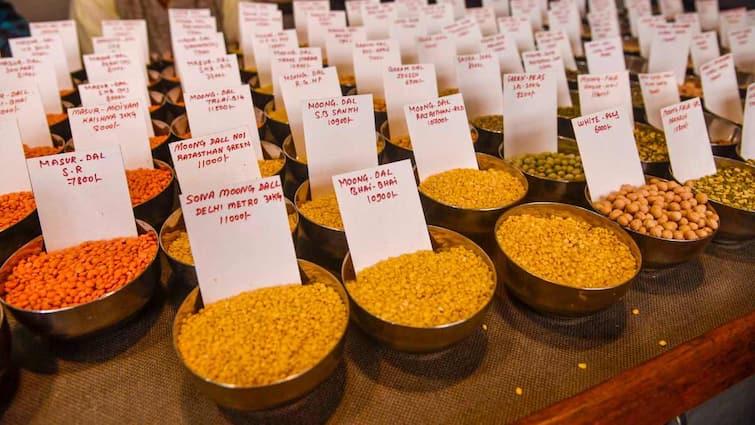
However, the fact sheet also included ‘certain pulses’ among US agricultural products that would see a reduction in tariffs, reported The Financial Express.
This phrase was not present in the earlier February 6 joint statement issued after the Trump-Modi call. That earlier statement listed items such as dried distillers’ grains (DDGs), red sorghum for animal feed, tree nuts, fresh and processed fruits, soybean oil, wine and spirits, but made no reference to pulses.
The inclusion of “certain pulses” signals a potentially significant opening of India’s agricultural market to US exporters. Pulses are politically sensitive in India, given their central role in food security and farmer incomes.
At the same time, India’s Agriculture Minister Shivraj Singh Chouhan sought to clarify the government’s position. Speaking in Bhopal on February 8, he listed categories that would not enter India under the agreement, including hulled grains, flour, wheat, corn, rice, millet, potato, onion, peas, beans, cucumber, mushrooms, pulses, frozen vegetables, oranges, grapes, lemons, strawberries and mixed canned vegetables.
The coexistence of these statements has deepened confusion about which products are actually covered and under what conditions.
Tariff Balance: Equal or Uneven?
India’s interim framework has been framed differently in Washington and New Delhi.
The White House said India has historically maintained some of the highest tariffs among major economies, citing agricultural tariffs averaging 37 per cent and auto tariffs exceeding 100 per cent. The US administration presented the 18 per cent tariff rate as a concession recognising India’s strategic alignment and trade commitments.
However, analysis in Indian policy circles paints a more nuanced picture. According to the Delhi-based Global Trade and Research Initiative (GTRI), the tariff reductions may reflect an uneven exchange, as the US cuts apply to roughly 55 per cent of Indian exports currently facing reciprocal tariffs.
Former Finance Minister P Chidambaram described the framework as “heavily tilted in favour of the US and the asymmetry is obvious”.
Commerce Minister Piyush Goyal has defended the agreement, arguing that the 18 per cent tariff is among the lowest faced by US trading partners and would benefit labour-intensive sectors such as textiles, leather, gems and jewellery.
Farmers’ Fears And Political Fallout
Media reports noted that Indian farm unions and opposition parties are calling for nationwide protests. The Samyukt Kisan Morcha (SKM), which led the 2020–21 farm protests, warned that increased imports of subsidised US agricultural goods could depress domestic prices.
Rakesh Tikait told Reuters that Indian farmers are far more vulnerable than their American counterparts, who operate larger landholdings and receive higher subsidies. SKM national secretary Purushottam Sharma said the organisation would oppose any move to open the Indian farm sector to American companies, particularly pointing to concerns over lower tariffs on crude soyoil, currently taxed at about 16.5 per cent.
The Road Ahead: Celebration Meets Scrutiny
The White House fact sheet outlines an ambitious roadmap covering tariffs, non-tariff barriers, digital trade, technology cooperation, supply chain resilience and investment reviews. It also references ongoing negotiations on intellectual property, labour, environment, services and state-owned enterprises as part of the broader Bilateral Trade Agreement.
Yet in India, the debate is shifting from celebration to scrutiny. While industry associations have largely welcomed the deal, analysts argue that the ultimate impact will depend on the details of tariff schedules and implementation timelines.