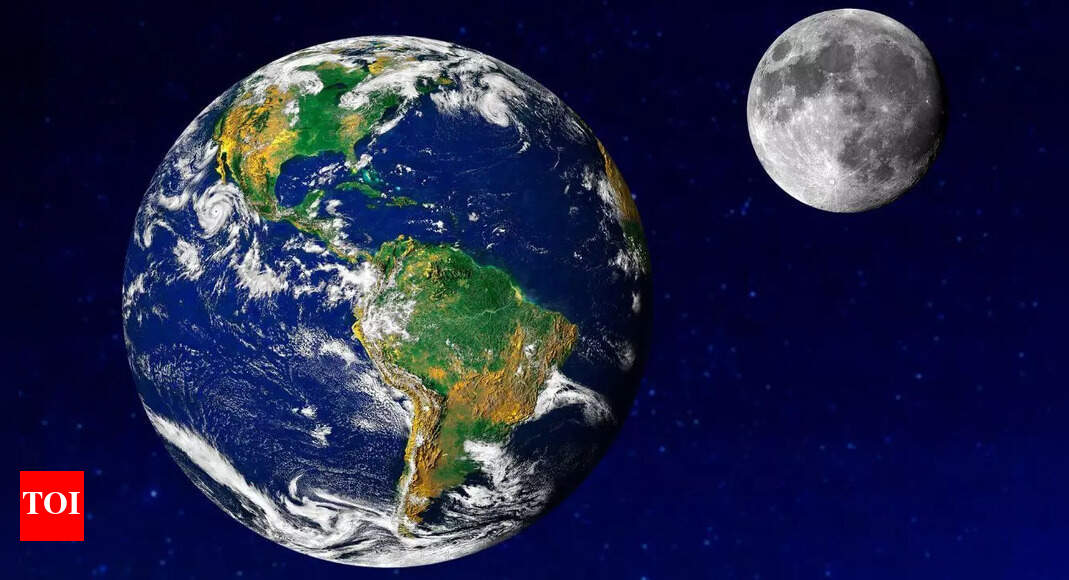

For billions of years, the Moon has been Earth’s steadfast companion, influencing tides, stabilising our planet’s tilt, and shaping the evolution of life. Yet precise laser measurements reveal an astonishing truth: the Moon is drifting away from Earth by about 3.8 centimetres each year. This seemingly minor movement is, in fact, a window into the deep mechanics of planetary motion. Scientists have long attributed this drift to tidal friction, where Earth’s spin transfers energy to the Moon. However, new research suggests there may be more to the story, involving early planetary impacts, internal contraction, and subtle shifts in angular momentum that continue to reshape our cosmic relationship.
How did scientists first notice the Moon’s slow escape from Earth?
The first accurate evidence of the Moon’s gradual retreat came after Apollo 11 astronauts placed a laser retroreflector on its surface in 1969. By bouncing laser beams off this device, scientists discovered that the Moon moves away a few centimetres each year, a finding that revolutionised our understanding of celestial mechanics. Traditionally, this motion was explained by tidal interaction, where Earth’s faster spin creates ocean bulges that exert a forward pull on the Moon, gradually pushing it outward. Yet a study published in the Journal of Physical Science and Application challenges the idea that tides alone can explain this movement. The research introduces additional factors such as collisions with prograde planetesimals and the contraction of Earth’s interior as possible contributors to the Moon’s outward migration. This suggests that the Earth–Moon dynamic may be far more intricate than a simple exchange of tidal forces.
Could ancient planetary collisions be driving the Moon’s outward journey?
Roughly 4.5 billion years ago, when the Solar System was still a chaotic swarm of molten bodies and debris, Earth endured frequent volcanic eruptions and collisions with smaller planetesimals. According to the study, impacts from prograde planetesimals, bodies orbiting in the same direction as Earth’s rotation, may have subtly altered the Moon’s orbital speed. Each impact would have increased its tangential velocity just enough to enhance its centrifugal force, allowing the Moon to drift gradually away from Earth’s gravity.Volcanic eruptions could have also launched debris into orbit around Earth, where fragments eventually merged with the Moon, adding to its mass and energy. This process resembles a slow-motion “snowball effect”, in which accumulating material gently propelled the Moon outward. Such findings echo orbital patterns observed in other planetary systems, where early debris interactions influence the long-term stability and distance of satellites.
How does Earth’s internal contraction affect the Moon’s orbit?
Beyond external impacts, Earth’s inner structure and rotation play a crucial role in the Moon’s migration. As the planet’s molten core cools and solidifies, its volume contracts while conserving angular momentum. This contraction reduces Earth’s rotational inertia, causing its spin rate to accelerate slightly. When the planet spins faster, some of that rotational energy transfers to the Moon’s orbit, increasing its velocity and nudging it outward.Data from the National Institute of Standards and Technology indicate measurable changes in Earth’s rotational speed over time, consistent with this model. Even natural events such as major earthquakes can momentarily shift Earth’s axis and rotation rate. The 2011 Tohoku earthquake in Japan, for instance, altered Earth’s figure axis by about 25 centimetres, subtly increasing its spin. These fluctuations reveal how dynamic our planet truly is, and how even internal processes can ripple outward, influencing celestial motion on a grand scale.
Do Mars and its moons follow a similar cosmic pattern?
If the Moon’s drift results from planetary contraction and rotation, could the same apply to other worlds? Mars provides a compelling comparison. The Red Planet’s two small moons, Phobos and Deimos, also exhibit orbital changes, yet Mars lacks large oceans and significant tidal effects. This suggests that tidal friction alone cannot account for satellite migration.NASA’s observations of Mars’ ice caps and subsurface water deposits reveal another possibility. When molten magma beneath the Martian surface cools upon contact with infiltrating water, it causes the planet’s volume to shrink slightly. This contraction, much like on Earth, speeds up rotation and transfers energy to its moons’ orbits. The study proposes that Mars’ internal cooling process might therefore drive the gradual movement of its moons, mirroring the Earth–Moon dynamic on a smaller scale.
What does the Moon’s drift tell us about Earth’s future and beyond?
The Moon’s retreat is more than a curiosity; it subtly reshapes Earth’s systems over geological time. As it moves away, tidal forces weaken, Earth’s rotation slows, and days become marginally longer. These changes influence ocean tides, atmospheric dynamics, and even biological cycles that evolved under the Moon’s gravitational rhythm.While tidal friction remains a contributing factor, emerging evidence points toward a complex interplay of ancient impacts, internal contraction, and angular momentum transfer as the real drivers of this cosmic drift. This broader understanding helps scientists model not only the Earth–Moon relationship but also the evolution of other planetary systems.Each centimetre of the Moon’s retreat tells a story billions of years in the making, a quiet record of how energy, gravity, and motion continue to sculpt our universe. As technology refines our measurements and models, the Moon’s steady departure reminds us that even the most constant celestial relationships are never truly still.Also Read | Scientists just discovered a new kind of ice ‘XXI’ and it’s nothing like the one in your freezer Go to Source