
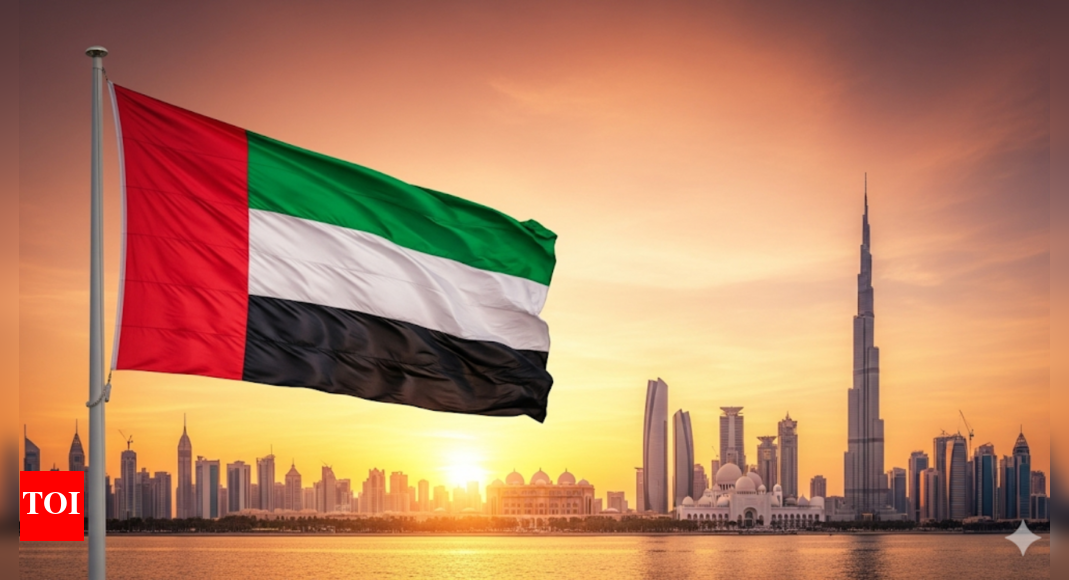

December 2 marks the UAE’s formation, uniting seven emirates into a strong, independent federation/Representative Image
December 2 marks a pivotal moment in the history of the United Arab Emirates — the day it became an independent, sovereign nation in 1971. But the choice of this date was not symbolic alone; it was the culmination of decades of treaties, negotiations, British withdrawal, and a shared vision among the region’s leaders. This is the detailed story of how the UAE came to be, why December 2 became its National Day, and the constitutional foundations that shaped the Federation.
Before the union: The Trucial States and british control
The territory that is now the UAE was historically known as the Trucial States, a group of independent emirates along the southern coast of the Persian Gulf. British involvement in the region began in the early 19th century:
- 1820–1853: A series of treaties were signed between Britain and the ruling sheikhs, starting with the defeat of the Qawasim maritime force. These agreements aimed to curb maritime conflict, prohibit the construction of warships or coastal fortifications, and maintain peace at sea.
- 1853: The Perpetual Maritime Truce formalized an indefinite end to hostilities at sea. Britain limited its role to maritime security without interfering in the internal governance of the emirates.
- 1892: The Exclusive Agreements prohibited the Trucial States from engaging with foreign powers without British approval. In exchange, the UK pledged military protection against external threats.
British control over the region intensified in the mid-20th century, largely driven by oil exploration and geopolitical interests. They controlled oil concession grants and intervened in territorial disputes to secure exploration zones, including helping define inter-emirate boundaries in the 1950s.However, by 1968, economic constraints pushed the UK to announce a full military and political withdrawal from the Gulf by end of 1971. This move set off a chain of political activity among the Trucial States’ rulers to form a new, self-governed entity before the British departure. Also Read: UAE National Day 2025 Public Holidays
The vision for unity: From bilateral accord to a new federation
The initiative to form a unified state began with Sheikh Zayed bin Sultan Al Nahyan, who became Ruler of Abu Dhabi in 1966. Seeing the necessity of regional cooperation, he envisioned a federation that could unify resources and political will.
- February 18, 1968: Sheikh Zayed met with Sheikh Rashid bin Saeed Al Maktoum of Dubai at Al Samha. They agreed to unite their emirates and invite others to join, forming the first step toward regional federation — the Union Accord.
- They agreed to collaborate on foreign affairs, defense, security, social services, and immigration policy.
- Judicial and internal governance would remain under individual emirate control.
- February 25–27, 1968: Rulers from Abu Dhabi, Dubai, Sharjah, Ajman, Umm Al Quwain, Fujairah, Ras Al Khaimah, Bahrain, and Qatar met in Dubai to draft a federal framework.
- The proposed Federation of the Arab Emirates was based on 11 foundational principles including mutual respect for sovereignty, unified foreign policy, and joint developmental goals.
- A Supreme Council was to be established to oversee federal legislation and policy, with decisions requiring unanimous consent.
Despite this progress, Bahrain and Qatar opted for independent statehood in August and September 1971, respectively.
December 2, 1971: The UAE is born
As the British exit approached, six emirates — Abu Dhabi, Dubai, Sharjah, Ajman, Umm Al Quwain, and Fujairah — committed to forming a new union.
- July 18, 1971: The six Rulers formally agreed to establish a federation.
- December 2, 1971: The United Arab Emirates was officially declared an independent, sovereign state.
- A Provisional Constitution was adopted.
- Abu Dhabi was designated as the temporary capital.
- Sheikh Zayed was elected as the first President; Sheikh Rashid became Vice-President, both for a five-year term.
- The Federal National Council (FNC) was established with 34 seats:
- 8 each for Abu Dhabi and Dubai
- 6 for Sharjah
- 4 each for Ajman, Umm Al Quwain, and Fujairah
- Ras Al Khaimah was allocated 6 seats should it choose to join later.
The Supreme Council of Rulers, composed of the Rulers of each emirate, became the highest federal authority. Decisions would require a majority vote — with both Abu Dhabi and Dubai needed to be part of the majority for any decision to pass.
Completion of the union, constitution, and global standing
Ras Al Khaimah joins
- Initially hesitant due to territorial disputes — especially Iran’s seizure of the Greater and Lesser Tunbs islands — Ras Al Khaimah received federal assurances that the UAE would continue to assert its claim over the islands.
- February 10, 1972: Ras Al Khaimah officially joined, completing the seven-emirate federation.
The constitution
- The Provisional Constitution guided federal operations from 1971 until it was made permanent in July 1996.
- It consists of 152 articles, establishing the foundation of:
- Governance
- Distribution of federal and local powers
- Citizens’ rights
- National security, judiciary, and legislative structure
Article 138 specifically enabled the unification of the UAE Armed Forces under federal command, ensuring centralized defense policy and organization.Federal goals outlined in the constitution:
- Preserve the UAE’s independence and sovereignty
- Ensure security and stability
- Defend against any external aggression
- Protect citizens’ rights and freedoms
- Promote economic prosperity, better standards of living, and unified national identity
- Uphold each emirate’s internal autonomy within the constitutional framework
Why the federation workedSeveral shared factors helped facilitate a smooth transition to federation:
- Common language and religion
- Shared customs, traditions, and topography
- Complementary economic resources
- Unified aspirations for development and stability
The UAE on the global stage
Immediately after its formation, the UAE began establishing itself as a credible state in the international community:
- December 2, 1971: Joined the Arab League as its 18th member
- December 9, 1971: Gained admission to the United Nations
- 1972: Became a member of the Organisation of Islamic Cooperation (OIC)
- 1981: Co-founded the Gulf Cooperation Council (GCC) with Saudi Arabia, Kuwait, Qatar, Bahrain, and Oman.

 "Stand up to ‘tyranny’: Hosting Trump, UK King Charles takes aim at Putin")
