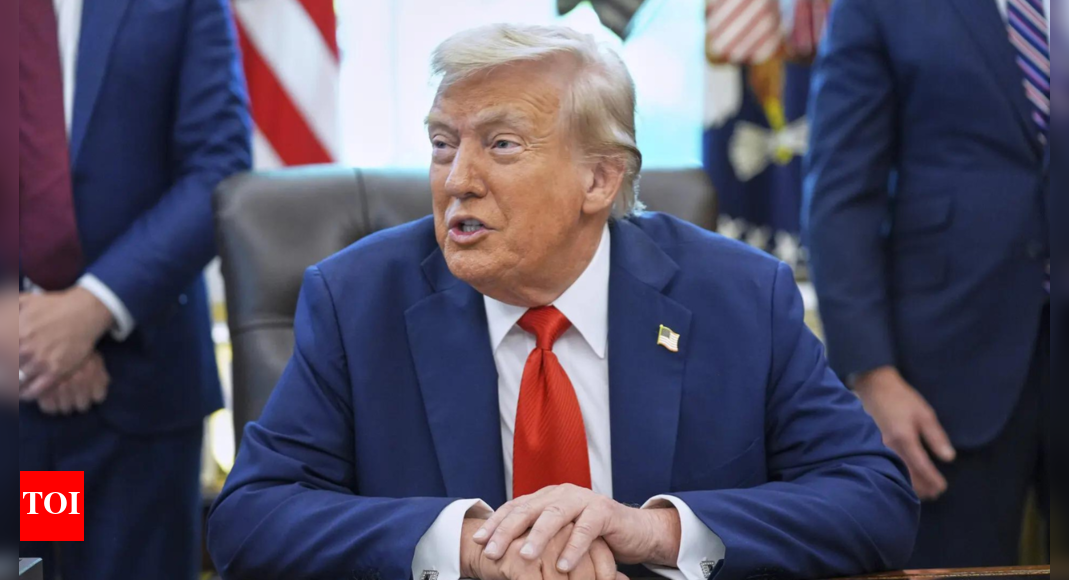

Donald Trump (AP image)
A federal appeals court on Friday ruled that many of President Donald Trump’s global tariffs were unlawful, delivering a significant blow to one of the central pillars of his trade agenda.The US Court of Appeals for the Federal Circuit upheld a lower court’s May ruling that Trump exceeded his authority by using emergency economic powers to levy sweeping duties on imports from dozens of countries. However, the judges allowed the tariffs to remain in place until mid-October, giving the administration time to appeal the case to the Supreme Court, news agency New York Times reported. The ruling casts doubt on Trump’s broader trade strategy, which has relied heavily on a 1977 law known as the International Emergency Economic Powers Act (IEEPA). While presidents have traditionally invoked IEEPA to impose sanctions or block financial transactions during national emergencies, Trump used it in an unprecedented way to justify broad tariffs on imports targeting China, Mexico, Canada, India and other countries.Following the decision, Trump attacked the court on Truth Social platform and indicated he was preparing to appeal to the Supreme Court.”Today a Highly Partisan Appeals Court incorrectly said that our Tariffs should be removed, but they know the United States of America will win in the end,” Trump wrote. “If these Tariffs ever went away, it would be a total disaster for the Country.”What is IEEPA?The International Emergency Economic Powers Act grants the president wide-ranging authority to regulate international financial transactions once a national emergency is declared. Under the law, presidents can take swift economic action to counter “unusual and extraordinary threats” to US national security, foreign policy, or the economy.Historically, presidents have used IEEPA to sanction foreign governments, freeze assets or restrict trade with adversaries. For example, President George W Bush invoked it after the September 11 attacks to cut off terrorist financing, while President Barack Obama used it to target cyber attackers. But no president before Trump had invoked IEEPA to impose tariffs on imports.Trump declared a national emergency over the United States’ trade deficit, arguing that the gap between exports and imports represented an “extraordinary threat” to the US economy. On that basis, he applied new duties on a wide array of goods and warned that removing them could lead to “economic chaos” and even a repeat of the Great Depression.During his first term, Trump threatened to impose tariffs on Mexico under IEEPA, announcing in May 2019 a 5 per cent levy on all imports from Mexico, set to rise to 25 percent unless the country took effective action to curb illegal migration. He later backed down in June 2019 after reaching an agreement with Mexico to address the migrant flow.Beyond tariffs, Trump successfully invoked IEEPA to impose sanctions on Venezuela’s state-owned oil company to target President Nicolás Maduro. He also used it on Iran in response to aggressive acts. In June 2020 he used it on top officials of the International Criminal Court following its investigation into alleged war crimes by American troops in Afghanistan an order later revoked by former President Joe Biden. Court pushback:In a 7-4 ruling, the court noted that while the law gives the President broad powers during a national emergency, it does not explicitly allow imposing tariffs or taxes. The judges concluded that Trump exceeded his authority under the IEEPA.Trump had relied on the IEEPA to justify his tariffs by declaring a national emergency over persistent US trade deficits and cross-border drug flows. The administration argued that the law’s authority to “regulate” imports included the power to impose tariffs.The appeals court rejected that view, saying: “It seems unlikely that Congress intended, in enacting IEEPA, to depart from its past practice and grant the President unlimited authority to impose tariffs. The statute neither mentions tariffs (or any of its synonyms) nor has procedural safeguards that contain clear limits on the President’s power to impose tariffs.”The court has stayed its ruling until October 14, giving the administration time to appeal the case to the Supreme Court. Go to Source