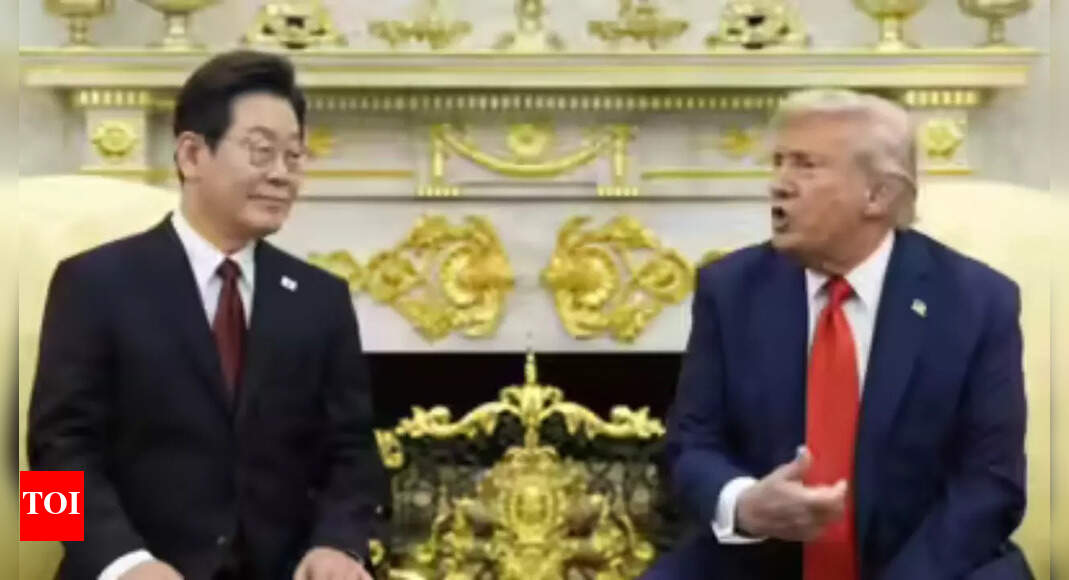

During his White House meeting with South Korean President Lee Jae Myung on August 25, 2025, US President Donald Trump unexpectedly raised the sensitive issue of “comfort women.” The discussion, which otherwise focused on North Korea, security cooperation, and economic ties, touched on one of the most painful chapters in Korean-Japanese relations. Trump’s comments drew renewed attention to the unresolved emotional and historical complexities of the comfort women issue, showing how deeply it still resonates in South Korea despite past attempts at reconciliation with Japan.
What are comfort women?
The term “comfort women” refers to women and girls, primarily from Korea and other occupied territories, who were coerced into sexual slavery by Japan’s military during World War II. Historians estimate that hundreds of thousands of women were victimized, making it one of the largest instances of state-sponsored human trafficking in modern history. Critics argue that the euphemism “comfort women” downplays the severity of the atrocities, leaving many survivors feeling their suffering has been minimized.
Trump’s comments on the issue
During the meeting, Trump said, “The whole issue of the women. Comfort women. Very specifically. We talked and that was a very big problem for Korea, not for Japan. Japan was, wanted to go, they want to get on. But Korea was very stuck on that.” His remarks drew renewed attention to the unresolved emotional and historical tensions surrounding the topic. Trump emphasized the continuing weight this issue holds for South Korea while noting Japan’s desire to move past it.
Why did Trump bring them up?
By raising it, Trump may have been signaling empathy toward South Korean concerns, aiming to build rapport with Lee during sensitive talks on North Korea and trilateral security. Analysts also note that Trump’s blunt style often leads him to bring up controversial topics directly, even if they are diplomatically sensitive. The move could also be seen as a reminder that unresolved historical grievances complicate the US goal of fostering closer cooperation among South Korea, Japan, and itself, particularly as all three face common challenges from North Korea’s weapons programs and China’s regional influence.
Historical and political context
The comfort women issue stems from Japan’s colonial rule over Korea from 1910 to 1945. In 2015, South Korea and Japan reached a controversial agreement in which Japan apologized and contributed about 1 billion Yen ($6.8 million) to a fund for survivors. While intended as a resolution, many South Koreans and survivors view the deal as inadequate, citing the lack of full legal acknowledgment of Japan’s state responsibility.
South Korea’s position on comfort women
President Lee Jae Myung described the comfort women issue as “heartbreaking” and emphasized the need for ongoing dialogue with survivors and Japan. He noted that while the 2015 agreement should not be overturned, it remains difficult for many South Koreans to fully accept. Lee continues to prioritize reconciliation with Japan while respecting the voices of survivors, balancing domestic sentiment with diplomatic pragmatism.
Japan’s position on comfort women
Japan maintains that the 2015 pact has “irreversibly” resolved the matter, contingent on both countries honoring their commitments. This includes refraining from public criticism and removing memorials such as comfort women statues near Japanese embassies. The Japanese government stresses the importance of adhering to the agreement to maintain stable bilateral relations.
Current dynamics and diplomatic implications
The comfort women issue continues to be one of the most politically sensitive topics between Seoul and Tokyo. Survivors and activists demand direct acknowledgment, accountability, and measures to support healing. By bringing up the issue, Trump highlighted both the historical weight of the matter and the ongoing complexities in Korea-Japan-US relations, while also reinforcing the United States’ role as a diplomatic intermediary. Go to Source