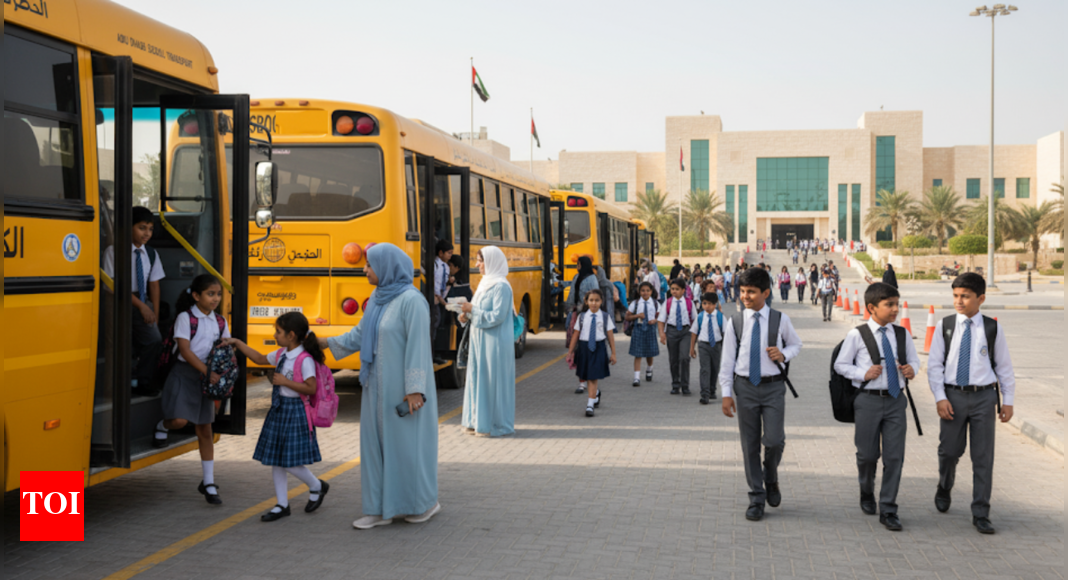

Children under 15 must be accompanied by an adult or authorized person when traveling to and from school, per ADEK/ Representative Image
As schools reopen in Abu Dhabi for the 2025–26 academic year, a major update in student transport policy by the Department of Education and Knowledge (ADEK) is taking effect, and every parent needs to be prepared. From who can pick up your child, to whether they can ride a scooter to school, these new rules are detailed, safety-focused, and carry clear responsibilities for families. Here’s a breakdown of everything you must know as the school run begins.
Independent travel: Who can go solo, and when
One of the most significant updates affects older students. Starting this academic year, students in Cycle 3 (Grades 9–12, ages 14–18) are allowed to commute independently to and from school without using school transport. This includes the use of bicycles, scooters, or other personal transport — as long as certain conditions are met. However, parents must sign a detailed consent form that confirms:
- They understand the distance and route their child will travel.
- They agree to comply with Integrated Transport Centre (ITC) regulations — including permits, approved pathways, and safety requirements.
- They accept that school responsibility begins only once the student is on campus.
If a school does allow the use of personal vehicles like bikes or scooters on its premises, it must provide dedicated infrastructure, including tracks and parking spaces. Schools also retain the right to regulate how and where these are used within the campus. Important: The school is not liable for any incidents that occur while the student is commuting independently — this responsibility falls to the parents.
Supervision, pick-up, and drop-off rules
For students under 15, independent travel is not allowed. These students must be picked up and dropped off by an adult, either a parent or a parent-appointed guardian. If no adult is present at the drop-off point, the child will be taken back to school after all other students are dropped off. However, there’s some flexibility if you have older children:
- Elder siblings aged 15 or above may pick up younger siblings (Grade 1 and above), but only if a signed parental consent form is provided.
- This form must clearly state that:
- The parents believe the elder sibling is mature enough.
- The elder sibling understands the responsibility.
- The school will not be liable for any incidents related to this arrangement.
This system ensures that younger children are never left unsupervised during transit, while giving families a practical option when an adult isn’t available for pick-up.
School bus use – rules, staffing, fees, and timings
School bus use is for students only
School buses are strictly reserved for student transportation. However, for field trips, tourist buses may be used, as long as they meet technical and safety standards like:
- Seat belts for all passengers
- Fire extinguishers
- First aid kits
Journey time limits
The maximum allowable time for a school bus journey is 60 minutes — from the first pick-up point to the last drop-off. Students can only be picked up and dropped off at pre-designated locations. For students under 11, a bus supervisor must ensure that a parent or appointed guardian is present at the drop-off point. If no one is available, the student will be returned to school.
Mandatory bus staff and gender rules
Each bus carrying students under age 11 must have a registered supervisor, in addition to a driver. Both the driver and supervisor must hold ITC permits.
- For mixed-gender or younger student groups, the supervisor must be female.
- Male supervisors may only be assigned to older, all-boys buses.
Fee regulation
Bus transport fees are regulated and must align with the ITC School Bus Fee Framework. Operators propose the fee, which must be approved by ADEK. Any exceptional increases require prior coordination with ITC.
Communication and on-ground safety measures
Salama App and real-time updates
To help parents stay informed and reassured, schools will use Salama — a school transport monitoring application developed by the Integrated Transport Centre (ITC) of Abu Dhabi. This app is designed to enhance school bus safety by offering parents full visibility into their child’s daily commute. Through Salama, parents can:
- Track their child’s school bus in real-time
- Receive live status updates on pick-up and drop-off progress
- View timestamps for when their child boards and disembarks the bus
- Report transport-related issues directly within the app
- Communicate easily with schools and bus operators through built-in messaging features
Bus supervisor’s role
The bus supervisor must maintain regular communication with both parents and the school, and is responsible for:
- Informing parents/guardians of bus delays during pick-up and drop-off.
- Notifying the school if no guardian is present at drop-off.
- Reporting misconduct by students to the School Transport Coordinator.
- Handling any issues that arise during daily journeys.
School transport coordinator
Every school must appoint a School Transport Coordinator, whose contact information must be shared with parents and bus operators. This person is the main contact for any issue that goes beyond the bus supervisor’s duties, including:
- Delays due to fog or road accidents
- Changes to bus schedules
- Other emergency or system-wide issues
On-campus traffic management
Schools are required to implement traffic control plans for safe pick-up and drop-off:
- A trained task force must manage school traffic during peak times.
- Schools must maintain designated parking areas for both school buses and staff vehicles.
- Emergency and communication plans must be regularly updated and shared with parents.
Final notes for parents
The updated school transport policy by ADEK is not just a set of rules, it’s a framework to ensure every child’s journey to and from school is safe, structured, and well-supervised. Whether your child is taking the school bus, riding a scooter, or getting picked up by an older sibling, there are clear expectations and shared responsibilities between schools, parents, and students. To stay compliant, and ensure your child’s safety, make sure to:
- Submit all required consent forms to the school.
- Download and use the Salama app for tracking.
- Follow pick-up/drop-off protocols strictly.
- Stay in contact with your school’s Transport Coordinator for updates.