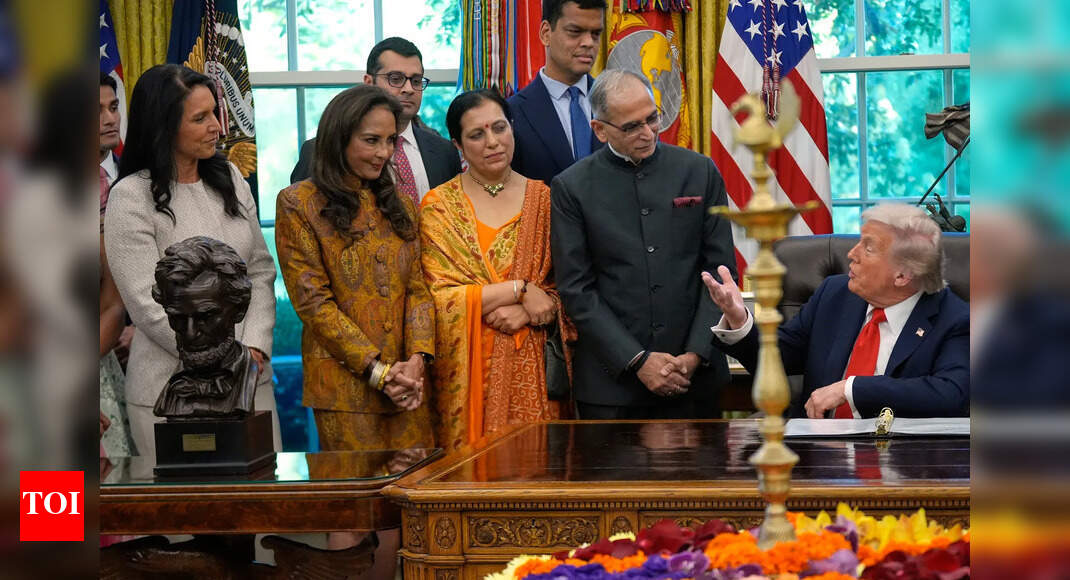

President Donald Trump speaks during a Diwali celebration in the Oval Office at the White House, Tuesday, Oct. 21, 2025, in Washington. At left is Director of National Intelligence Tulsi Gabbard. (AP Photo/Manuel Balce Ceneta)
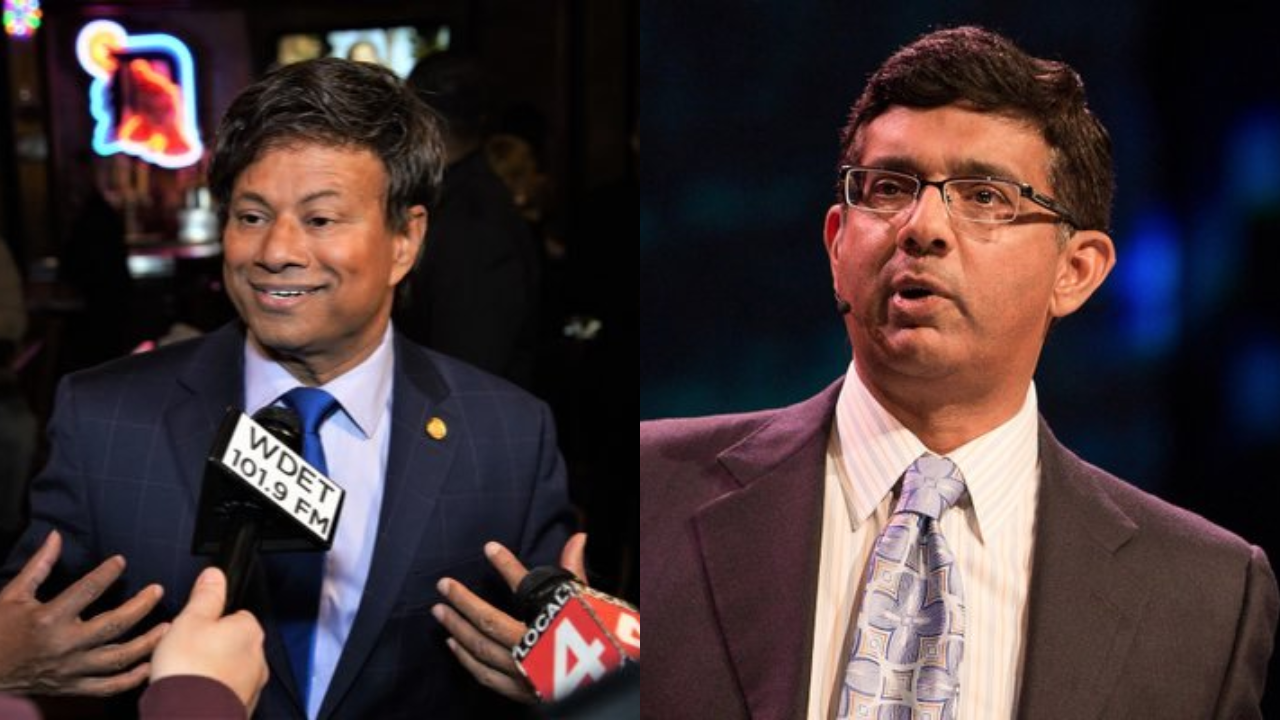
For decades, Dinesh D’Souza was the brown face MAGA could point to when accused of racism. A bestselling author, filmmaker, and one of Donald Trump’s earliest intellectual defenders, he was a symbol of how far the conservative movement had travelled from its white-nationalist caricature.But this week, the man who made a career defending Trump from accusations of bigotry found himself on the receiving end of it.It began, as such things now do, with a post. Responding to a tweet from former Republican congressman Joe Walsh — who criticised Trump for “tearing down the White House like he owns it” — D’Souza replied that “America is also OUR home”, and accused Democrats of “tearing down the walls” and letting “millions of home invaders in.”It was standard D’Souza rhetoric — populist, aggrieved, and full of capital letters. Until a MAGA supporter called Ribbert231167 replied: “You’re Indian, you made nothing, you are nothing… your existence causes me disgust.”For once, D’Souza didn’t hit back. He seemed shaken. “In a career spanning forty years,” he wrote later, “I have never encountered this type of rhetoric. The Right never used to talk like this. So who on our side has legitimised this type of vile degradation?”The answer, as he may be realising, lies closer to home than he’d like.
The loyal propagandist
(Image: X.com)
Born in Mumbai and raised in Pune, D’Souza moved to the US in the 1970s, rose through the conservative establishment in the Reagan era, and became one of its most visible immigrant success stories. His books and films — The Roots of Obama’s Rage, Hillary’s America, 2000 Mules — turned him into the intellectual godfather of modern Republican grievance.When Trump pardoned him in 2018 after a campaign-finance conviction, D’Souza declared it “a full exoneration.” Since then, he’s been an omnipresent voice on right-wing media, using his Indian-American identity as both shield and sword — proof that MAGA couldn’t possibly be racist if it embraced someone like him.Which is what makes this moment so jarring: D’Souza, the movement’s most loyal immigrant, finally realising that the movement doesn’t see him as one of its own.
The new anti-India undercurrent
The insult he faced isn’t isolated. Over the past year, MAGA spaces have become increasingly hostile toward Indian-Americans — a shift from policy resentment to racial contempt.What began as debates over outsourcing and H-1B visas has curdled into something uglier. “Why are we importing Indians to run our country?” is now a recurring refrain on right-wing podcasts and Telegram channels. Indian tech workers are blamed for “stealing jobs,” Indian CEOs are accused of “pushing DEI poison,” and Indian donors are derided as “globalist money.”The tone was set by voices like Paul Ingrassia, a right-wing influencer and self-styled “America First journalist” who has made anti-India agitation his niche. Ingrassia’s posts rail against what he calls the “H-1B invasion” and “Dothead Diversity,” warning that “India is the new China.” He mocks Indian engineers, sneers at Indian CEOs, and claims that Silicon Valley is “run by curry cartels.”Once, such language was confined to anonymous fringe boards. Now, it circulates freely on X and Truth Social, often amplified by verified MAGA influencers with hundreds of thousands of followers. And it’s rarely challenged by the movement’s leaders.
The chat that ripped the mask off
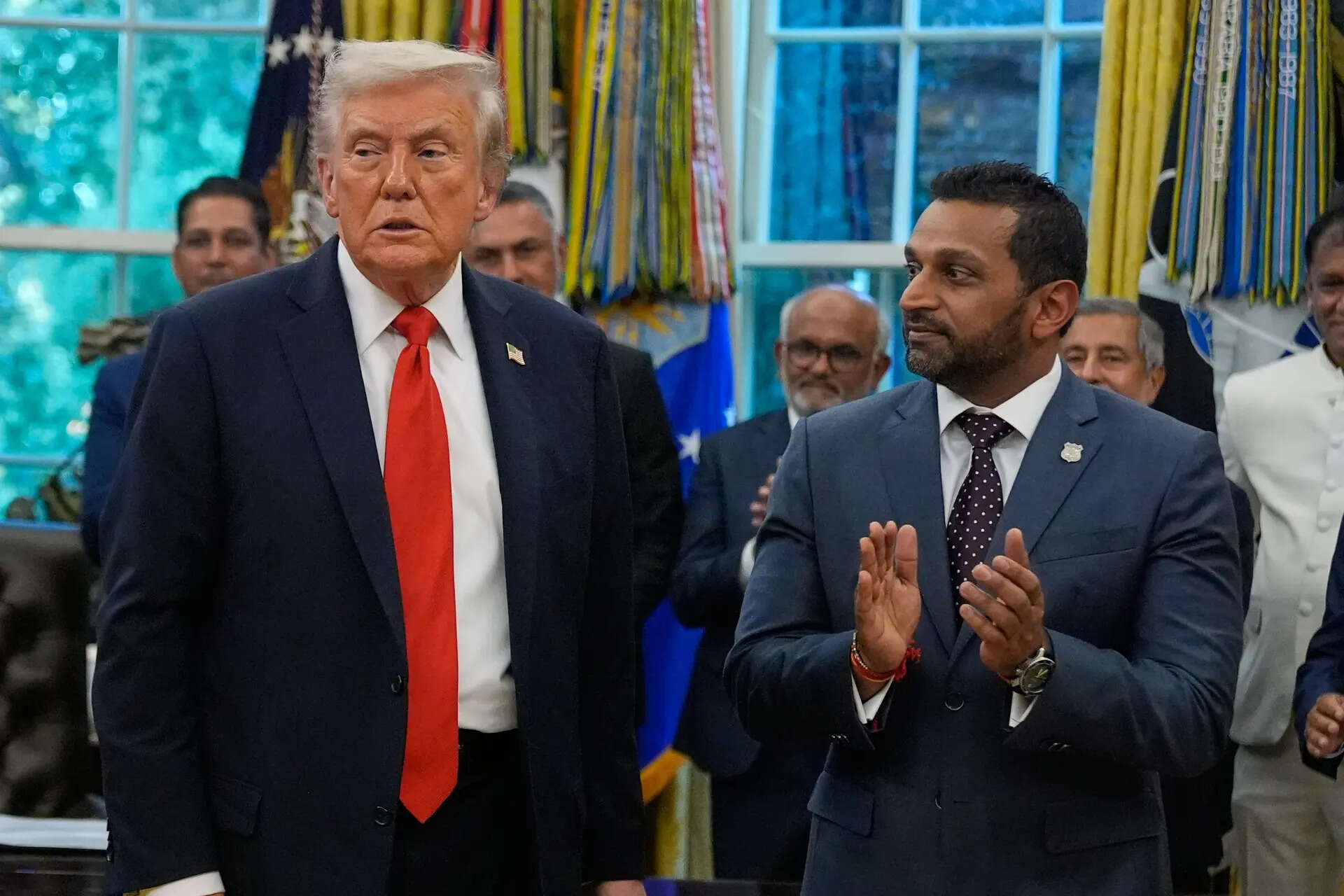
President Donald Trump stands with FBI director Kash Patel as he participates in a Diwali celebration in the Oval Office at the White House, Tuesday, Oct. 21, 2025, in Washington. (AP Photo/Manuel Balce Ceneta)
Then came the smoking gun. In October 2025, Politico published more than 2,900 pages of leaked Telegram logs from the Young Republican National Federation — the GOP’s so-called “farm team.”The messages were a sewer of bigotry. Members joked about Hitler, mocked the Holocaust, and celebrated slavery. Black people were “watermelon people.” Jews were “sneaky.” Asians were “ch–ks.” And Indians? They were “smelly.”One of the most revealing exchanges came when a New York chapter vice-chair mocked a colleague for “dating this obese Indian woman.” A sitting Vermont senator, Samuel Douglass, replied: “She just didn’t bathe often.” No one objected.It wasn’t an anonymous 4chan feed. It was the next generation of Republican staffers and strategists — the people who will run campaigns, write policy, and one day sit in Congress. And for them, Indianness was still a punchline.
Inclusion without acceptance
For years, Indian-Americans were told they were the “model minority,” the ideal conservative immigrant community — hardworking, educated, and family-oriented. Trump courted that demographic with photo-ops, Modi rallies, and high-profile appointments. His second term features Indians in some of the most powerful roles in Washington: Tulsi Gabbard as Director of National Intelligence, Kash Patel as FBI chief, and Sriram Krishnan advising on AI.Yet the underlying contempt never vanished. It just went private — until the leaks dragged it into daylight.In public, the MAGA elite lauds Indian-Americans as proof of meritocracy. In private, they mock their accents, their food, and their smell. It’s not contradiction. It’s hierarchy. Brown faces are tolerated so long as they flatter the narrative. The moment they don’t, they are reduced to caricature.
The deeper resentment
Indian-Americans now occupy the same paradoxical position that Jewish-Americans did a century ago — prosperous, networked, indispensable, and resented for all three.With a median household income nearly twice the national average and dominance across tech, medicine, and finance, Indians are visible in every corridor of power. That visibility breeds anxiety within a movement built on nostalgia for a whiter, simpler America.When factories close, it’s not automation that gets blamed — it’s “the guy from Hyderabad.” When rents rise, it’s not hedge funds — it’s “the IT couple from Bangalore.” In the populist imagination, every Indian success story becomes proof that “real Americans” are being replaced.
D’Souza’s reckoning
That’s why D’Souza’s sudden shock feels so tragic — and so telling. He’s discovering, belatedly, that ideological loyalty cannot buy cultural acceptance. The same ecosystem that made him a millionaire also nurtured the people now calling him a parasite.He asks who legitimised this degradation. The answer, uncomfortably, includes him — and every Indian-American who mistook visibility for belonging.MAGA didn’t just tolerate the Paul Ingrassias of the world; it rewarded them. It turned racism into “anti-globalist authenticity,” made bigotry fashionable again, and sold it as rebellion against “wokeism.” D’Souza, with his decades of intellectual cover, helped build that permission structure.Now he’s standing in its shadow.
The illusion of belonging
The paradox of Indian power in America today is stark: the community is more successful than ever, yet its acceptance remains conditional. The GOP can elevate an Indian to FBI Director and still sneer at an “obese Indian woman” in a private chat. It can praise merit-based immigration while amplifying conspiracy theories about “curry cartels.”For D’Souza, that realisation comes late. But for millions of Indian-Americans watching the MAGA movement drift further into nativism, it is a timely reminder: representation is not the same as respect, and proximity to power is no substitute for belonging. Go to Source