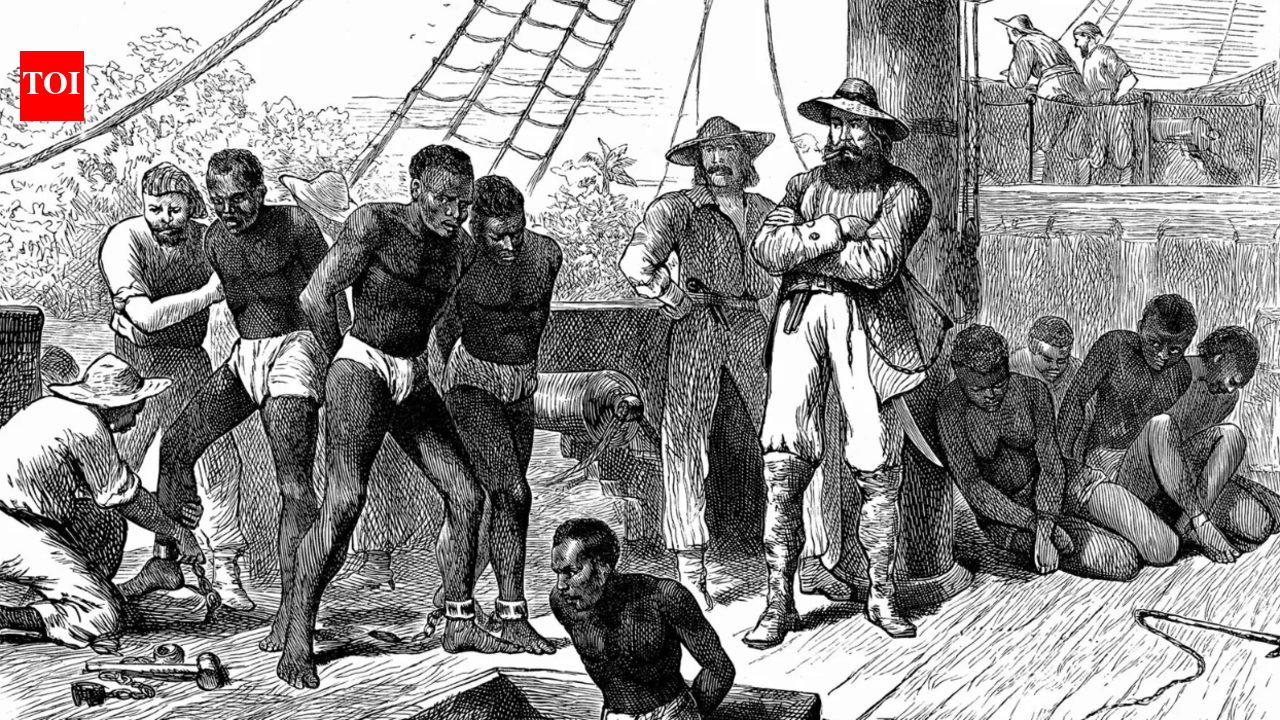

transatlantic slave trade Captive Africans being transferred to ships along the Slave Coast for the transatlantic slave trade, c. 1880. / Image: Brittanica
The United Nations General Assembly has voted to recognise the enslavement of Africans during the transatlantic slave trade as “the gravest crime against humanity”, in a move supporters say is aimed at confronting historical injustice and advancing reparatory justice. But the vote exposed a clear divide. While a large majority backed the resolution, Western powers including the United States, the United Kingdom and European Union member states either rejected it outright or declined to support it, not over the history itself, but over how it should be defined, interpreted and acted upon today.
A resolution framed around history, justice and reparations
The resolution, proposed by Ghana, was adopted by 123 votes in favour, with three against, the United States, Israel and Argentina, and 52 abstentions, including the UK and all EU member states.
Israel Iran War
It declares “the trafficking of enslaved Africans and racialised chattel enslavement of Africans as the gravest crime against humanity,” and links that history to the present through “the persistence of racial discrimination and neo-colonialism”. Beyond recognition, the text calls on member states to engage in discussions on reparatory justice. This includes “a full and formal apology, measures of restitution, compensation, rehabilitation, satisfaction, guarantees of non-repetition and changes to laws, programs and services to address racism and systemic discrimination.” It also urges “the prompt and unhindered restitution” of cultural items, including artworks, monuments and archives, to their countries of origin. Although General Assembly resolutions are not legally binding, they carry significant political weight and are often used to shape global norms and debates.
Why the United States voted against
The United States while acknowledging the horrors of the past, opposed the resolution, arguing that it raised both legal and conceptual problems. Dan Negrea, the deputy US ambassador, said Washington “does not recognize a legal right to reparations for historical wrongs that were not illegal under international law at the time they occurred”. He also objected to the framing of the resolution itself, saying: “The United States also strongly objects to the resolution’s attempt to rank crimes against humanity in any type of hierarchy.” “The assertion that some crimes against humanity are less severe than others objectively diminishes the suffering of countless victims and survivors of other atrocities throughout history,” he added. Negrea further criticised what he described as “the cynical usage of historical wrongs as a leverage point to reallocate modern resources to people and nations who are distantly related to the historical victims”, and questioned the lack of clarity on who would qualify as recipients of reparatory justice.He also argued that the resolution’s historical framing was selective, stating that the time periods referenced were “clearly selected for political reasons rather than historical accuracy, and pointed out that the trafficking of African slaves began well before the 15th century and continued beyond the 19th.
Why the UK and EU abstained
The United Kingdom and European Union member states did not oppose the resolution outright, but declined to support it, citing concerns over legal principles and wording. Speaking on behalf of the UK, James Kariuki, acting ambassador to the UN, said Britain recognised “the abhorrent nature of slavery and the transatlantic slave trade” and acknowledged that its legacy “continues to leave deep scars today”. However, he said the UK “continues to disagree with fundamental propositions of the text”. One key objection was the idea of ranking atrocities. Kariuki argued: “We must not create a hierarchy of historical atrocities… No single set of atrocities should be regarded as more or less significant than another.” He also pointed to core legal principles, saying: “There is equally no duty to provide reparation for historical acts that were not, at the time those acts were committed, violations of international law.” The EU set out similar concerns. Gabriella Michaelidou, speaking on behalf of the bloc, said the use of terms such as “gravest” was “not legally accurate” and risked implying “a hierarchy among atrocity crimes”. She added that the resolution contained “unbalanced interpretation of historical events” and raised concerns about “suggestions of a retroactive application of international rules which was non-existent at the time and claims for reparations”. Both the UK and EU stressed that while they support remembrance and efforts to tackle modern forms of slavery, they could not endorse the resolution in its current form.
Ghana’s case for recognition and reparatory justice
For Ghana and its allies, the resolution is less about legal technicalities and more about historical acknowledgement and long-term consequences. Ghanaian President John Dramani Mahama, who backed the initiative, told the assembly: “Today, we come together in solemn solidarity to affirm truth and pursue a route to healing and reparative justice.” “The adoption of this resolution serves as a safeguard against forgetting,” he said. “Let it be recorded that when history beckoned, we did what was right for the memory of the millions who suffered the indignity of slavery.” Ghana’s foreign minister, Samuel Okudzeto Ablakwa, rejected criticism that the resolution sought to rank suffering. “The perpetrators of the transatlantic slave trade are known, the Europeans, the United States of America. We expect all of them to formally apologize to Africa and to all people of African descent,” he said. He also clarified the intent behind reparations, telling the BBC: “We are demanding compensation, and let us be clear, African leaders are not asking for money for themselves. We want justice for the victims and causes to be supported, educational and endowment funds, skills training funds.” Ablakwa argued that the legacy of slavery remains visible today, adding: “Many generations continue to suffer the exclusion, the racism because of the transatlantic slave trade which has left millions separated from the continent and impoverished.”
A vote that reflects consensus, and division
The resolution was adopted on the International Day of Remembrance of the Victims of Slavery and the Transatlantic Slave Trade, commemorating the estimated 12 to 15 million Africans who were forcibly transported over four centuries, with more than two million believed to have died during the journey. It marks one of the strongest formal recognitions of the transatlantic slave trade within the UN system, linking historical injustice to present-day inequalities and calling for a structured global response. At the same time, the split in the vote underscores an enduring divide. While there is broad agreement on the brutality and historical significance of slavery, there is far less consensus on how that history should be defined in legal terms, and whether it should carry financial and political obligations in the present. Go to Source