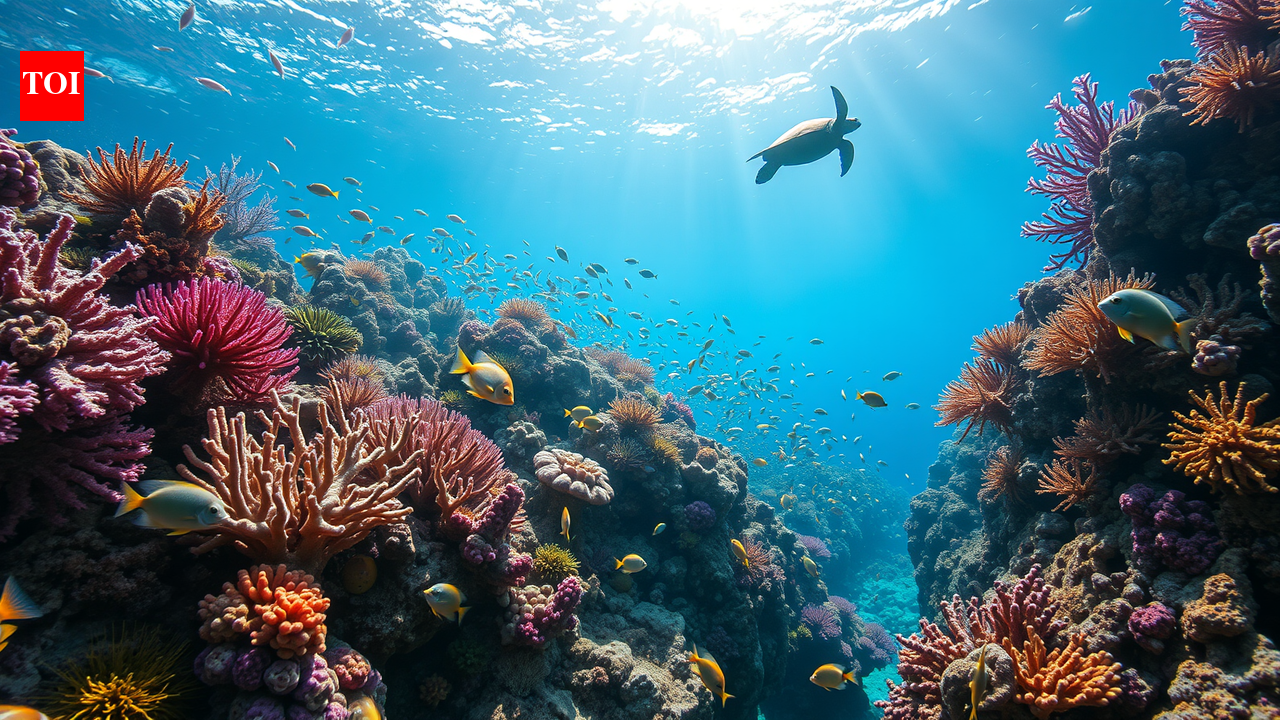

A coral reef off the coast of Benin, long presumed dead, has just been found alive and full of activity, more than sixty years after scientists first wrote it off. Old surveys from the 1960s, carried out mainly to locate good fishing spots, had picked up signs of a possible deep-water reef sitting more than fifty metres below the surface. At the time, researchers assumed there was little chance it had survived. A new expedition using sonar mapping and underwater cameras has now confirmed otherwise, revealing a lively coral system home to multiple fish and coral species that had gone completely undocumented for six decades.
How researchers went looking for a reef presumed dead
The rediscovery is described in a study titled First evidence of live mesophotic coral reefs on the Benin continental shelf, published in Frontiers in Marine Science. Led by Gérard Zinzindohoué of the Institut de Recherches Halieutiques et Océanologiques du Bénin, the team set out to revisit the exact stretch of seafloor flagged in surveys conducted between 1963 and 1964. Since coral reef barriers had been reported in that area but their condition was never confirmed, the researchers suspected the site could actually be what scientists call a mesophotic coral ecosystem, a type of reef that lives in deeper, dimmer waters than the shallow, sunlit reefs most people picture.
Searching seven kilometres of seafloor using sonar
Between April and December 2025, the team surveyed roughly seven kilometres of the Benin continental shelf using side scan sonar, a technique that sends out sound waves to map the shape of the ocean floor in detail. This scanning picked up two separate zones showing unusually strong acoustic reflections, a pattern typically associated with solid, hard-bottomed structures rather than plain sand or mud. These sonar signatures gave the team enough confidence to bring in an underwater drone fitted with the Deep Sea Camera System, supplied by the National Geographic Exploration Technology Lab, to physically inspect the flagged locations.
What the cameras finally revealed underwater
When the footage came back, it showed a coral community thriving at depths of around fifty-four metres on a rocky seafloor, exactly the kind of location the sonar had pointed to. The survey recorded eight distinct coral types along with eight different reef-associated fish species living among them, including golden African snappers, Guinean angelfish and the Monrovia doctorfish. Rather than forming one unbroken wall of coral, the reef appeared as scattered patches occupying suitable rocky ground, a pattern the researchers say is typical of mesophotic ecosystems and explains why earlier surveys may have struggled to properly characterise it.
Why confirming this discovery took so much effort
Zinzindohoué described the fieldwork as a mix of long days at sea, technical setbacks and considerable uncertainty before the team finally spotted reef-like structures on their sonar readings. He recalled the moment the drone footage came through as a mix of excitement and disbelief, since it turned decades of speculation into something concrete on camera for the first time. The researchers have not yet been able to physically sample the coral, meaning exact species identifications still need further confirmation, and it also remains unclear whether the reef genuinely died back in the 1960s and has since recovered, or whether it was simply misjudged by the technology available at the time.
What this discovery could mean for conservation efforts
Beyond the coral itself, researchers involved in the project believe the reef may support a wider range of marine life than currently documented, including several shark and ray species reportedly known to local fishermen in the area. One of the study’s co-authors is now working to have the region formally recognised as an Important Shark and Ray Area through the International Union for Conservation of Nature, a step that could eventually support calls for the site to be protected as a marine protected zone.
A reminder of how little is known about West African waters
Zinzindohoué has been careful to note that this finding should not be treated as proof that similar reefs are common along the coast, since each site still needs direct confirmation through further fieldwork. At the same time, he pointed out that rediscovering a reef presumed lost for sixty years suggests there may be other overlooked ecosystems still sitting undocumented along West Africa’s coastline. The team now plans further surveys to determine how far this coral system extends and whether other historical reef sightings from the region deserve a second, closer look using modern technology. Go to Source