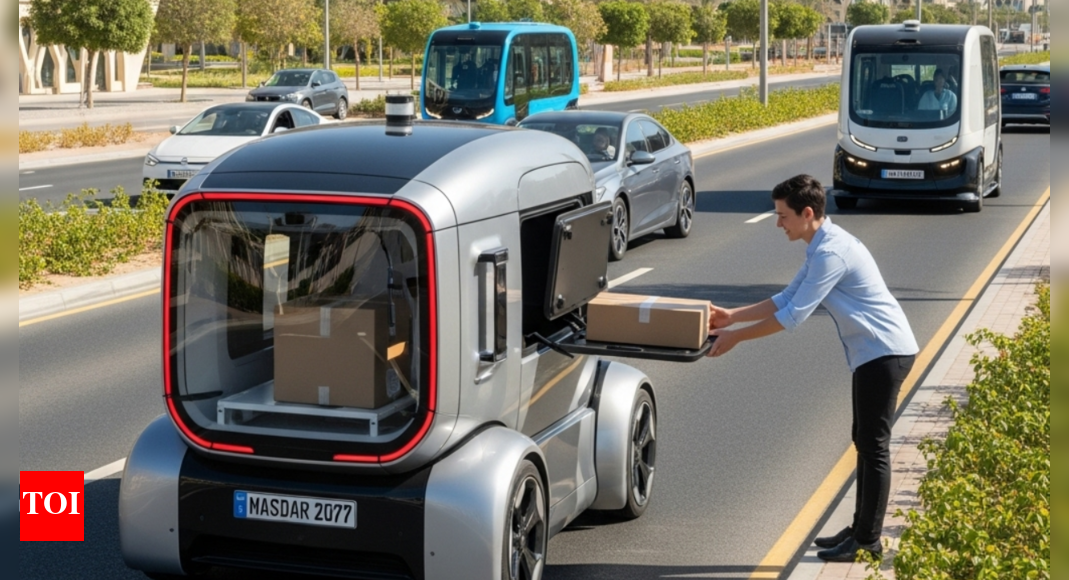

Abu Dhabi’s first driverless delivery vehicle, launched in Masdar City, operates autonomously using advanced AI technology/Representative Image
Abu Dhabi has taken a major leap in its smart mobility ambitions with the launch of its first autonomous delivery vehicle pilot programme in Masdar City. Developed through a public-private collaboration involving local tech and logistics firms, this trial marks the emirate’s initial move toward integrating AI-powered logistics into everyday life—combining sustainability, innovation, and regulatory progress into a single initiative.
Pilot programme launch in Masdar city: AI powered autonomous delivery begins
The Integrated Transport Centre (ITC)—also known as Abu Dhabi Mobility—has officially launched the first pilot programme for autonomous delivery vehicles in Masdar City, a hub for sustainable urban development in the emirate.The vehicles, developed by Autogo, a subsidiary of K2, operate without human drivers and are powered by advanced smart mobility systems and artificial intelligence. The pilot rollout included a significant milestone: issuance of Abu Dhabi’s first official licence plate for a self-driving delivery vehicle.A video from the trial showed the autonomous pod navigating city roads alongside regular traffic. The vehicles are designed to function within urban settings—handling traffic conditions, following traffic laws, and making deliveries autonomously, all without manual operation.Currently limited to Masdar City, the pilot is being closely monitored to assess:
- Integration into existing traffic systems
- Compliance with safety regulations
- Route effectiveness and environmental impact
- Feasibility for large-scale citywide deployment
Key partnerships: Government and private sector driving innovation
The initiative reflects a deep collaboration between public authorities and private sector innovators. The key stakeholders include:
- K2 – Technology developer and parent company of Autogo
- EMX – Logistics arm of 7X, providing support for operational deployment
- Abu Dhabi Investment Office (ADIO) – Strategic partner
- Smart and Autonomous Systems Council (SASC) – Supervisory body
This cross-sector collaboration plays a central role in building a future-ready logistics infrastructure. Officials emphasize the initiative is not just a technical experiment, but a strategic push to localize intelligent system production and position Abu Dhabi as a global leader in autonomous transport.“This project is not just a technical trial but part of a comprehensive strategy to strengthen smart logistics, leverage advanced technologies to reduce emissions and congestion, and improve quality of life in our cities,” said Dr. Abdulla Hamad AlGhfeli, Acting Director-General of the ITC.Tariq Al Wahedi, Group CEO of 7X, added: “We are pleased to play an active role in this transition via an integrated ecosystem that includes last-mile solutions. This is a strategic milestone toward next-generation smart logistics, aligned with the UAE’s digital transformation and green economy goals.”
Sustainability goals: Reducing emissions and traffic through innovation
One of the primary motivations behind the driverless delivery programme is environmental sustainability. The autonomous vehicles are expected to:
- Reduce greenhouse gas emissions
- Lower energy consumption through electric propulsion
- Minimise traffic congestion by replacing traditional delivery vans
- Streamline last-mile logistics to enhance delivery speed and reduce redundancies
These goals are aligned with Abu Dhabi’s long-term transport strategy, which aims for 25% of all city trips to be powered by smart transport solutions by 2040.The programme is also designed to enhance customer experience, offering:
- Timely and contactless delivery
- Increased efficiency across long distances
- Secure and traceable movement of goods
- A reduction in human error and logistical delays
Next steps: Scaling beyond Masdar and full commercial rollout
While the current pilot is limited to Masdar City, plans are underway to expand operations across Abu Dhabi, including:
- Public and private sectors
- Commercial zones
- Residential neighbourhoods
Autogo is preparing to broaden its partnerships and roll out more autonomous delivery vehicles in the coming months, following regulatory approvals and public feedback.The initiative also fits within the broader Smart and Autonomous Vehicle Industries (SAVI) cluster—an ecosystem being developed to support smart infrastructure, localised tech production, and the scaling of autonomous systems throughout the emirate.The move follows earlier steps Abu Dhabi has taken in this space, including:
- The introduction of driverless taxis in key locations
- Launch of autonomous passenger shuttles on a 2.4 km route in Masdar
- Tests of drone parcel deliveries and flying taxis
- The December launch of the Middle East’s first commercial driverless mobility service in partnership with Uber and China’s WeRide.