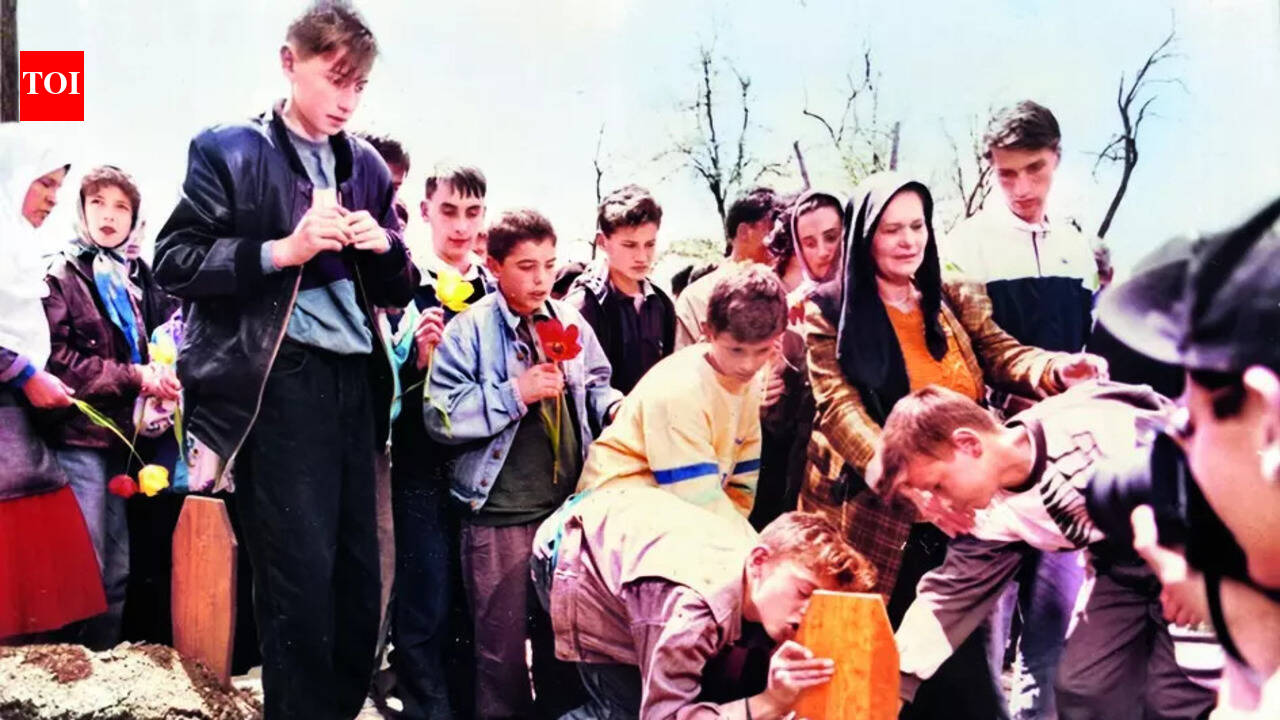

It was a regular afternoon in May 1995 in Sarajevo. Twelve-year-old Djemil Hodzic was out playing with his elder brother, Amel, 16, in their neighbourhood, amid the chatter and laughter of children and parents gathered nearby. Amel was playing tennis while Djemil and his friends were busy with marbles. Suddenly, Amel stiffened, struggling to catch his breath, one hand pressed to his chest. Within seconds, a red blot spread across his white T-shirt. It was a few seconds before the other children realised that Amel had been shot by a sniper positioned in the surrounding hills. “Amel was the tallest among us children – he was an easy target,” recalls Djemil bitterly. Their mother, a nurse who had just returned from a night shift, was cooking lunch for the children. An ambulance was called, but before it arrived, Amel died in her lap. Djemil, who interacted with TOI on email, believes his brother fell victim not just to sniper fire, but possibly to what later came to be described as ‘sniper tourism’ – one of the darkest allegations to emerge from the 1992-1995 Bosnian war in which the army of Republika Srpska, the Bosnian Serb force, clashed with the army of the Republic of Bosnia and Herzegovina after it declared independence from Yugoslavia in March 1992. ‘Sniper tourism’ refers to claims that wealthy foreign nationals paid Bosnian Serb soldiers large sums to shoot at Bosnian civilians from hilltop positions overlooking Sarajevo during the siege. The siege of Sarajevo remains the longest siege of a capital city in modern history. The war began after Bosniaks (Bosnian Muslims) declared independence from Yugoslavia. Bosnian Serb leaders, seeking to create a “Greater Serbia,” opposed the move, triggering a conflict that killed nearly 100,000 people and displaced more than a million. The ghosts of ‘sniper tourism’ resurfaced recently after authorities in Italy opened a probe in Nov 2025 into claims that some of its citizens may have been involved.The probe was triggered by a 17-page complaint filed by Italian journalist and novelist Ezio Gavazzeni, who claims that wealthy foreigners – including Italians – paid between $90,000 and $115,000 – to shoot at civilians, with additional payments made to target kids.Djemil, too, has launched a project titled ‘Sniper Alley’, documenting eyewitness accounts and creating an online archive of photographs taken during the siege. “I found it important to ensure the world does not forget the hell Bosnians went through, while many responsible are still free and unpunished,” he said.Recounting the horrors of the war, a survivor, Elza (who requested to be identified by her first name only), now 50, termed the reports on ‘sniper tourism’ as “despicable and grisly”. “During the war, I was a teen and had a lot of friends. We would meet in underground spaces. Every time I would see my friends, I would try to memorise their faces fearing that it could be our last meeting,” Elza recounted. Harun Mehmedinovic, 42, another survivor, who is now a Bosnian-American filmmaker, said that most people were killed by snipers as they tried to cross the ‘Sniper Alley’ – which refers to the main boulevard in Sarajevo, particularly the streets Ulica Zmaja od Bosne and Mesa Selimovic Boulevard. The two streets formed a key route connecting the city centre to the industrial area and airport. “Anyone who didn’t live in the city centre had to walk 1-2 km through that perilous alley to get potable water. They became easy targets.” Habib AlBadawi, a professor at Lebanese University in Beirut, termed the Italian investigations as a “moral reckoning”. AlBadawi, who has written a research paper titled ‘Hunting Humans- The Paid Killers of Sarajevo and The Milan Investigations’, said, “The siege of Sarajevo remains one of the starkest examples of systematic violence against civilians in modern Europe post World War II. The Milan probe reveals that killing civilians in Sarajevo was, for some, a transactional service,” he said. Incidentally, several buildings in Sarajevo still bear the marks of bullets. As Chan Siu Ki from Hong Kong, a travel vlogger who visited the city in 2018, put it, “The buildings have become ordinary apartments now, with advertisements hung on the rooftop and walls, as if nothing had ever happened.” Go to Source