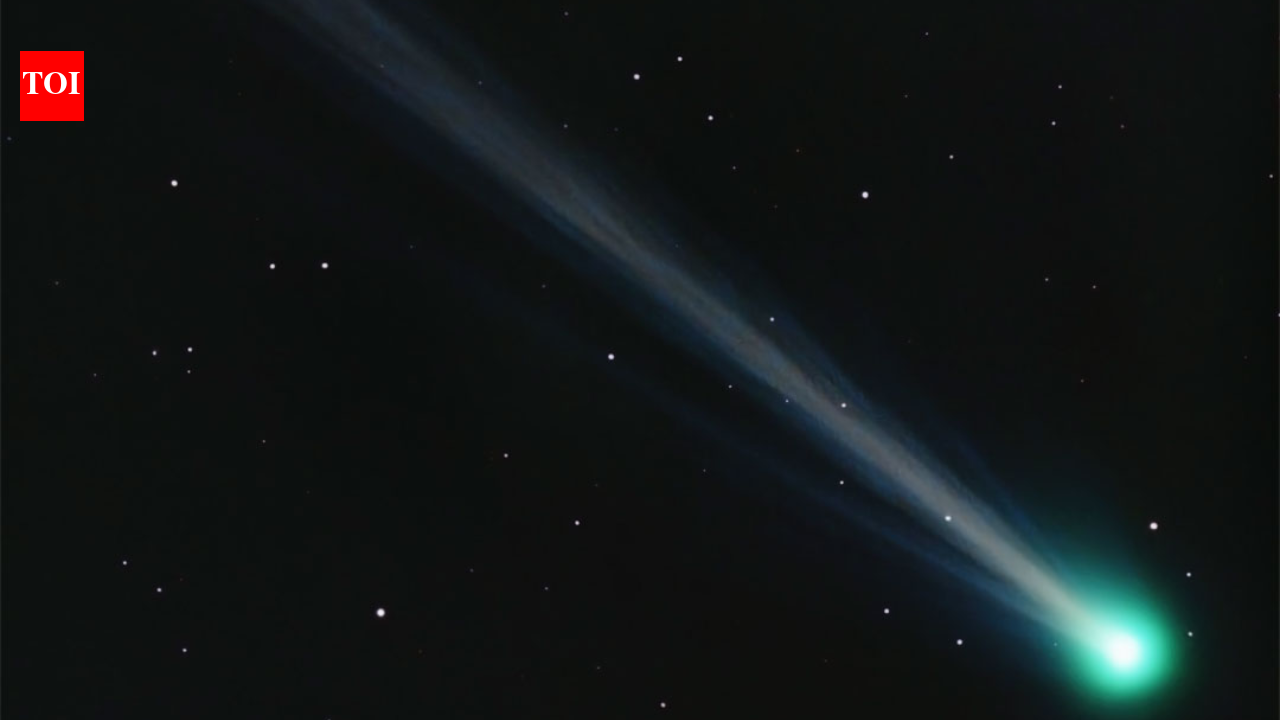

Image: Peter Kennett/NASA
It has long been an exciting area of study for many people to observe comets in the night sky, but according to a recent observation as published in ‘The First Quantitative Study of Cometary Tail Regrowth following a Coronal Mass Ejection-driven Disconnection Event’ of the Comet C/2023 P1, has added a rather unique twist on comets in our universe. It has been observed that the tail of this particular comet seems to “regrow” itself after a portion of it has been knocked out in space, which scientists compared to the ability of lizards to regenerate their own tails. Although it sounds rather far-fetched, it is based on well-established space science.
Comet C/2023 P1 and its tail regrowth phenomenon
It made news when changes were observed within the structure of the comet’s tail. In general, the phenomenon known as the comet’s tail appears as a result of interaction between the gases emitted from the nucleus of the comet and solar rays or solar winds from the Sun.As reported on the NASA:”The tail of any comet will always point straight out from the direction of the Sun because of the solar wind.”Under some circumstances, the solar winds can break up the comet’s tail through processes like coronal mass ejections. After that, there will appear to be a break in the tail; however, with the continuous emission of gases from the nucleus, another tail will grow, creating an illusion of regrowth.
Why scientists compare comets to lizards
The similarity to lizards is due to the biological phenomenon called regeneration. The way some lizards regenerate their tail after it falls off is similar to how comets regenerate their tail.According to the European Space Agency (ESA), “Comets are highly dynamic bodies constantly changing as they move around the Solar System.”It should be noted that, unlike living organisms, comets do not regrow any lost parts because they constantly emit dust and gas, creating a new tail right after the old one is gone.This process emphasises how active comets actually are. They are not just pieces of ice that go around the Sun, but they change dynamically under its influence.
What valuable insights does it bring into space science
Comet C/2023 P1 exhibits behaviour that reveals details about solar winds and cometary structure. For example, tail disconnection is an event which helps researchers study solar winds and their impacts on celestial objects.NASA’s Goddard Space Flight Center provides information explaining this occurrence as follows:“Tail disconnections can be considered a visible tracer of solar wind disturbances.”Understanding more about the effects of solar winds on celestial objects will provide insight into how our star influences objects in the Solar System. This research may also aid future predictions regarding comets’ behaviour.From the point of view of ordinary people, such information increases interest in this phenomenon. The seemingly innocent glow in the sky turns out to be a living object influenced by numerous factors in space. Go to Source