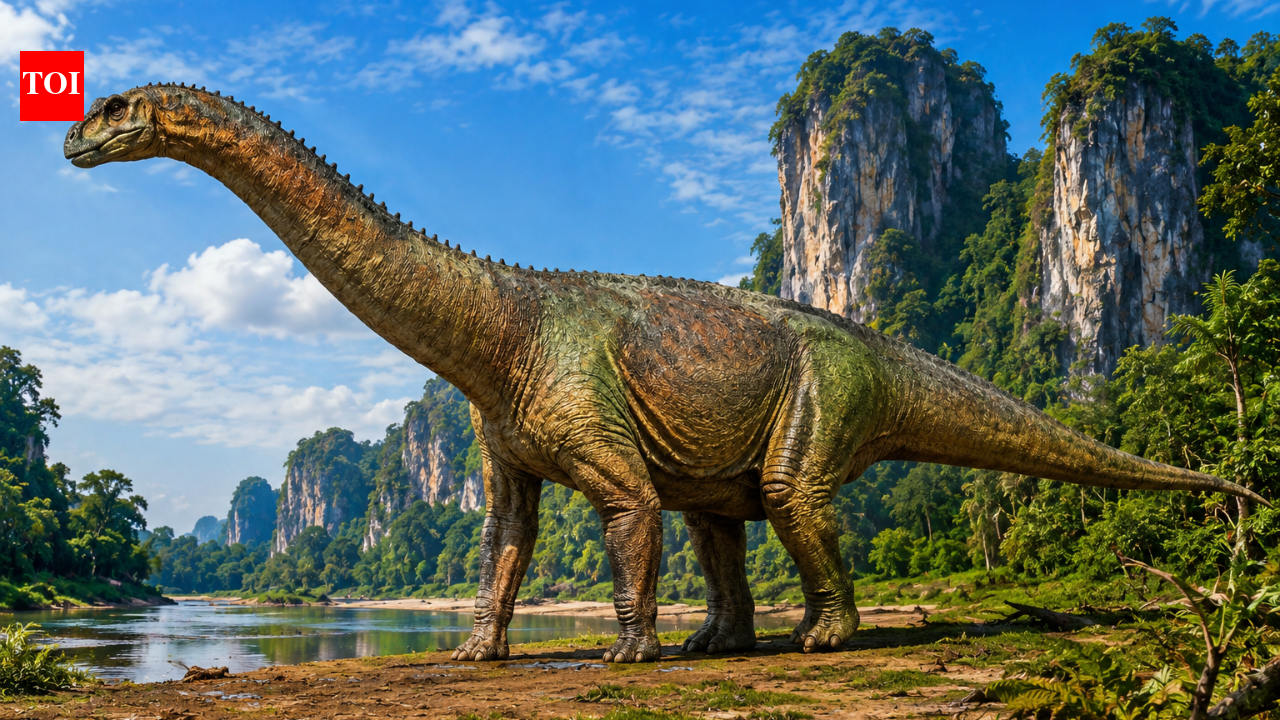

Image: AI Generated
Most new dinosaur species are announced after researchers uncover multiple bones or even an entire skeleton. The discovery of Uragasaurus kalasinensis proves that this is not always necessary. Scientists have identified the giant long-necked dinosaur from a single, exceptionally well-preserved vertebra found in northeastern Thailand. Despite the limited fossil material, the bone preserved a unique combination of anatomical features that had never been documented in any other dinosaur, allowing researchers to recognise it as an entirely new genus and species. Published in Scientific Reports, the discovery makes Uragasaurus the first formally named member of the long-necked dinosaur family Mamenchisauridae from Thailand, while shedding new light on the evolution, distribution and diversity of some of the largest land animals to have ever lived.
How one small bone gave scientists enough evidence to identify Uragasaurus
The fossil that led to the discovery is a dorsal vertebra recovered from Thailand’s Phu Kradung Formation. Although additional bones were found nearby, researchers could not confidently confirm that they belonged to the same individual, so the new species was formally described using only this single vertebra.According to the research titled ‘A new mamenchisaurid sauropod from the Lower Phu Kradung Formation, Upper Jurassic of northeastern Thailand,’ what made the fossil remarkable was not its size but its anatomy. The vertebra displays a distinctive Y-shaped arrangement formed by the intraprezygapophyseal and single intraprezygapophyseal laminae, a feature not previously reported in any known mamenchisaurid. It also possesses elongated teardrop-shaped pneumatic fossae on the transverse processes and a shallow triangular pleurocoel without an internal septum. Together, these characteristics provided sufficient evidence to establish Uragasaurus as a completely new dinosaur.The genus name combines the Sanskrit word uraga, meaning “snake” or “serpent,” a reference to the group’s exceptionally long neck, with the Greek sauros, meaning “lizard”. The species name kalasinensis honours Kalasin Province, where the fossil was discovered.Far from being a limitation, the bone contained a wealth of anatomical information. Dinosaur vertebrae preserve distinctive features such as ridges, joints, air-filled cavities and muscle attachment points that differ between evolutionary groups. By comparing these characteristics with hundreds of known sauropod fossils, researchers determined that the specimen represented a previously unknown genus and species, now named Uragasaurus kalasinensis.The study highlights how modern palaeontology increasingly relies on detailed anatomical analysis rather than simply the number of fossils recovered. A single well-preserved bone can sometimes provide stronger scientific evidence than several poorly preserved skeletons.
Why the discovery is important for understanding the evolution of giant long-necked dinosaurs
The researchers identified Uragasaurus as a member of the mamenchisaurids, an Asian group of enormous plant-eating sauropods renowned for possessing some of the longest necks ever to evolve. Several relatives within this family are estimated to have exceeded 25 metres in length, making them among the largest terrestrial animals in Earth’s history.Although the complete size of Uragasaurus cannot yet be determined because only one diagnostic bone has been recovered, its anatomy clearly places it within this remarkable lineage. The discovery provides fresh evidence that Asia was a major evolutionary centre for these giant dinosaurs during the Late Jurassic, rather than simply a region where they later spread.It also helps scientists refine the evolutionary relationships within the mamenchisaurid family, whose fossil record has remained comparatively incomplete outside China.
Thailand’s ancient landscape continues to reveal hidden chapters of dinosaur history
The fossil was discovered in the Phu Kradung Formation of northeastern Thailand, a geological formation that has become increasingly important for understanding Jurassic ecosystems in Southeast Asia. Around 150 million years ago, this region consisted of river systems, floodplains and lush vegetation that supported enormous herbivorous dinosaurs alongside predators, crocodile relatives, turtles and early mammals.The Phu Noi fossil site has yielded a rich collection of prehistoric animals, including sharks, lungfish, turtles, crocodile relatives and several dinosaur groups, indicating that the region once supported a thriving freshwater ecosystem. Researchers believe Uragasaurus was part of a broader Jurassic fauna that shared close evolutionary links with dinosaur communities in what is now China, highlighting ancient connections across East Asia during the Late Jurassic.While Uragasaurus kalasinensis is currently represented by just one diagnostic bone, the researchers emphasise that it provides an important new piece of the puzzle. It expands the diversity of giant sauropods known from Southeast Asia, offers fresh insights into the early evolution of mamenchisaurids and demonstrates that even a single, well-preserved fossil can transform scientists’ understanding of the prehistoric world.
The discovery shows that even the smallest fossils can transform our understanding of prehistoric life
Many of the world’s dinosaur species have been identified from incomplete remains rather than spectacular skeletons. Advances in imaging technology, anatomical comparisons and evolutionary analysis now allow scientists to extract extraordinary amounts of information from isolated fossils that would once have been considered too fragmentary to study in detail.Uragasaurus is a perfect example of this scientific progress. One carefully preserved vertebra has revealed a completely new giant dinosaur, expanded the known diversity of Jurassic sauropods and strengthened the case for Southeast Asia as an important region in dinosaur evolution.The discovery is also a reminder that countless prehistoric species may still lie hidden beneath the Earth’s surface, waiting to be recognised from even the smallest pieces of evidence. Go to Source