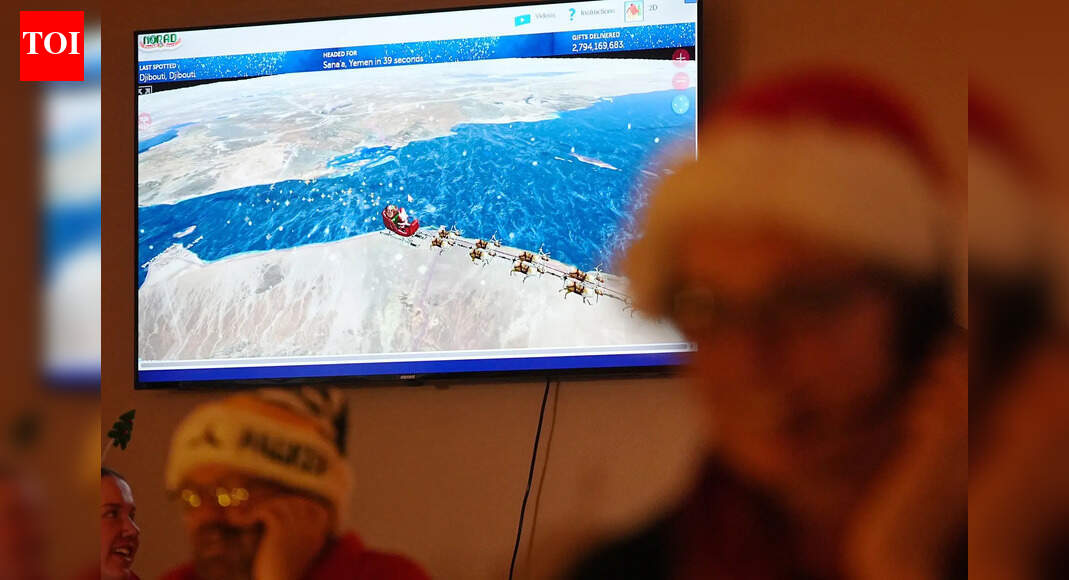

A screen shows the progress of Santa Claus as volunteers answer calls from people wondering where he is on his journey around the globe at a call center Wednesday, Dec. 24, 2025, in NORAD Peterson Space Force Base in Colorado Springs, Colo. (AP Photo/David Zalubowski)
On Christmas Eve, while the world obsesses over last-minute gifts and delayed flights, one of the planet’s most serious military commands performs its most unserious duty. Deep inside command centres built to detect nuclear threats and hostile aircraft, NORAD turns its radars north and begins tracking a sleigh pulled by reindeer. It sounds like a punchline. It is not. For nearly seven decades, the North American Aerospace Defense Command has treated Santa Claus as a seasonal constant, monitored with the same institutional solemnity it reserves for far graver things.There is something quietly comforting about that. In a world saturated with cynicism, this is the rare tradition that does not apologise for believing.
What is NORAD?
NORAD is a joint US–Canada military organisation tasked with defending North American airspace and monitoring maritime approaches. Its job is to provide early warning of aerospace threats, track aircraft and missiles, and coordinate responses if something suspicious enters the skies.It was created during the Cold War, an era when radar blips carried existential weight. Every screen, every alert, every false positive mattered. That legacy remains. NORAD’s systems today include ground-based radars, satellites capable of detecting heat signatures, fighter jets on alert, and command centres that never sleep. Which is precisely why its Christmas Eve ritual works. If an institution this serious can pause to track Santa, the story carries an odd authority. This is not marketing fluff. This is lore backed by radar rooms.
How does NORAD track Santa?
The tradition dates back to 1955, when a department store advertisement mistakenly printed a military hotline as Santa’s phone number. Instead of redirecting callers, the officer who answered played along, telling children that Santa’s sleigh had been detected on radar. The response was so popular that NORAD adopted the idea permanently.Over the years, the explanation has evolved alongside technology. NORAD says its northern warning radars first detect Santa as he lifts off from the North Pole. Once airborne, infrared satellites pick up the heat from Rudolph’s glowing red nose, a neat narrative overlap with systems designed to detect missile launches. As Santa approaches populated areas, NORAD fighter jets from the US and Canada occasionally escort the sleigh, confirming its position and, in official imagery, offering a friendly wave.It is all delivered deadpan. No quotation marks around “tracking.” No excessive irony. The charm lies in the confidence.
How can you follow Santa’s journey?
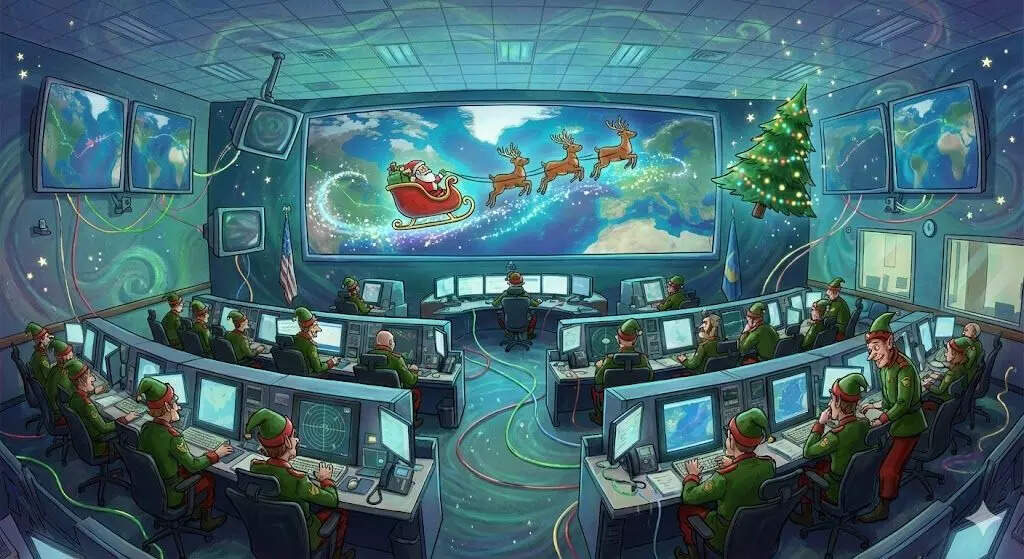
Every December 24, NORAD opens its Santa-tracking operation to the public. The centrepiece is the NORAD Santa Tracker website, which displays a live map of Santa’s route across countries and cities as the night progresses. Each stop comes with trivia, animations, and updates on how many presents have been delivered so far.There is also a mobile app and regular social media updates, but the most old-school element remains the call centre. Thousands of volunteers, many of them military personnel, answer phones from around the world, patiently explaining Santa’s speed, altitude, and snack preferences to eager callers.The point is not realism. It is ritual. NORAD never oversells the tech or breaks the spell. It simply offers a straight-faced narrative and lets the audience decide how much to believe.In an age where surveillance usually signals anxiety and control, NORAD’s Santa tracker flips the script. For one night, radars are not watching for threats but for generosity. Missiles are replaced by milk and cookies. And somewhere between the Arctic and your rooftop, a military command reminds the world that even the most hardened systems can make room for wonder. Go to Source