
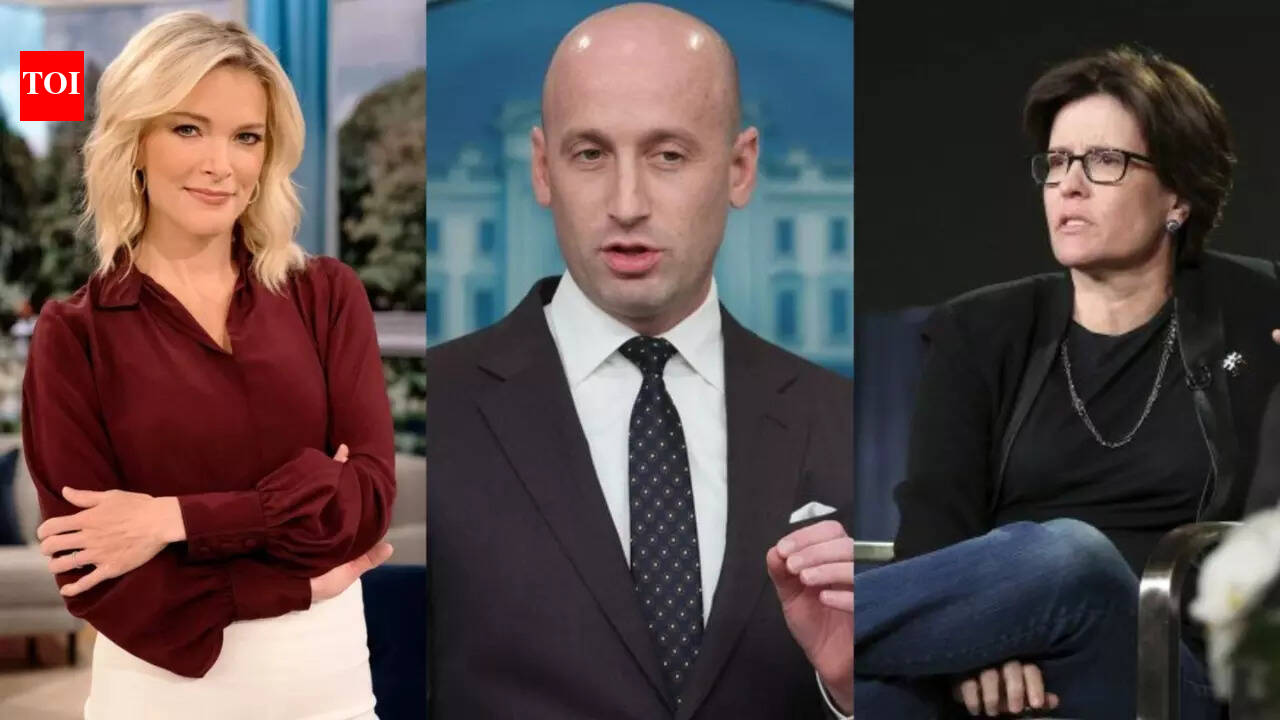


Megyn Kelly Accuses Kara Swisher of “Trying to Get Stephen Miller Killed”
A sharp social media clash erupted this week between prominent American media figures over a controversial comparison made about former Trump adviser Stephen Miller. Megyn Kelly, conservative commentator and host of The Megyn Kelly Show, reacted with outrage to a clip shared by tech journalist Kara Swisher, comparing Miller to historical figures associated with grave abuses of power. Kelly characterised this comment as dangerously extreme and potentially life-threatening.In a tweet on early Wednesday morning, Kelly wrote, “This is SICK. She’s trying to get @StephenM killed. Why else would you say he’s Himmler? Deranged and so far beyond the pale. We can’t become immune to it (sic)” amplifying the controversy and drawing intense reactions across the political spectrum.
What sparked the clash between Megyn Kelly and Kara Swisher
The dispute began with a video clip from the Pivot podcast, hosted by Swisher and Scott Galloway, in which Swisher delivered a blistering critique of Miller’s role in shaping immigration policy, calling him akin to Nazis involved in internment and genocide. In the clip, Swisher said that Miller was similar to figures like Heinrich Himmler and Karl Bendetsen, the latter of whom orchestrated Japanese-American internment camps during World War II. Swisher argued that Miller would “go down in history as evil” and claimed that he had “blood on his hands.” Swisher’s broader point was to highlight what she views as a moral responsibility for decisions in immigration enforcement, especially amid intense scrutiny of federal immigration actions that have drawn national criticism recently. Her comments, however, touched off a backlash from conservative circles.
Social media erupts at Megyn Kelly’s reaction: “Beyond the pale”
Kelly, a long-time political commentator who hosts a nationally syndicated show, seized on the video clip and accused Swisher of a rhetoric which was so incendiary that it could put Miller’s life at risk. In her tweet, she called the comparison to Himmler “sick” and “deranged”, arguing that such language can incite violence against political figures.
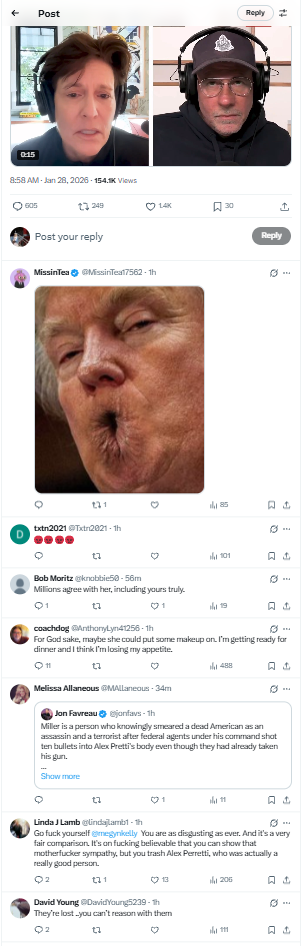
X (formerly Twitter) users react to Megyn Kelly accusing Kara Swisher of Nazi comparison
Her tweet rapidly became a focal point of discussion across social platforms, particularly X (formerly Twitter), with supporters praising her defence of Miller and critics accusing Kelly of overreaction or mischaracterising Swisher’s intent. The debate taps into a larger political battle over public speech boundaries. Conservatives often argue that aggressive criticism from the left dehumanises political opponents, while progressives and critics of Miller’s policies argue that sharp comparisons are a legitimate response to what they see as harmful government conduct.Social media erupted almost instantly as Kelly’s tweet spread. Many conservatives applauded her call-out, sharing the post widely and framing Swisher’s comments as irresponsible or even violent in tone. Others on the political right used the moment to critique what they see as a double standard in how political rhetoric is judged when directed at liberal versus conservative figures online.Meanwhile, some commentators and journalists criticised Kelly’s characterisation, arguing that Swisher’s comments, while hyperbolic, were not literally advocating harm but instead using historical comparisons to underscore perceived moral failures in public policy. The clash highlights the increasingly fraught nature of political commentary in the social media age, where a single tweet can ignite broad national debates about rhetoric, responsibility and political civility.
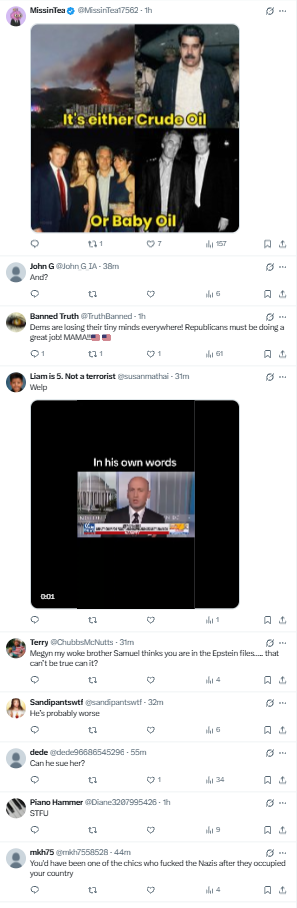
X (formerly Twitter) users react to Megyn Kelly accusing Kara Swisher of Nazi comparison
While one netizen commented, “Millions agree with her, including yours truly (sic)”, another tweeted, “Go f*** yourself @megynkelly You are as disgusting as ever. And it’s a very fair comparison. It’s on fucking believable that you can show that motherf***** sympathy, but you trash Alex Perretti, who was actually a really good person (sic)” and yet another reacted, “Dems are losing their tiny minds everywhere! Republicans must be doing a great job! MAMA!! (sic).”
Who is Stephen Miller? The figure at the center of the storm
Stephen Miller served as a senior policy adviser in the Trump White House and is widely known for shaping hard-line immigration policies. His political views have been described as far-right and heavily focused on restricting immigration; some critics over the years have labelled elements of his advocacy as extremist.Supporters see him as a principled conservative policymaker; critics see his rhetoric and policy impact as dangerously exclusionary. This deep polarisation, particularly over immigration, national identity and federal enforcement, fuels disputes like the recent one between Kelly and Swisher.
What’s next in the fallout between Megyn Kelly and Kara Swisher
The dispute is about more than two media personalities, it reflects how heated public discourse has become in the US and how historical analogies can trigger intense backlash. Critics of Swisher’s comparison argue that using charged historical figures like Heinrich Himmler, associated with atrocities, crosses a line and can make ordinary political disagreements sound like existential moral battles.The incident underlines how rhetoric that blurs sharp critique with symbolic comparison is interpreted differently depending on political alignment, contributing to deepening divisions in national political debate. Swisher’s commentary was rooted in broader criticism of current immigration enforcement tactics, a topic that has triggered mass protests, legal challenges and major political fallout in recent weeks.The clash also exemplifies how media figures like Kelly and Swisher act as influential voices in shaping public opinion and intensifying partisan narratives, often becoming part of the stories they comment on. As reactions continue, observers are likely to watch for further exchanges between media figures on both sides of the political divide, shifts in how commentators frame rhetorical boundaries, especially around controversial policies and figures and potential discussions within media venues about standards for analogies and comparisons, particularly those involving historical atrocities. Go to Source